








Policy_080 ACM-Metropolis Visitor Student Code of Conduct
If you have a disability which makes reading this document or navigating our website difficult and you would like to receive information in an alternative format, please contact: anddegree@acm.ac.uk 


POL-080 ACM-Metropolis Visitor Student Code of Conduct
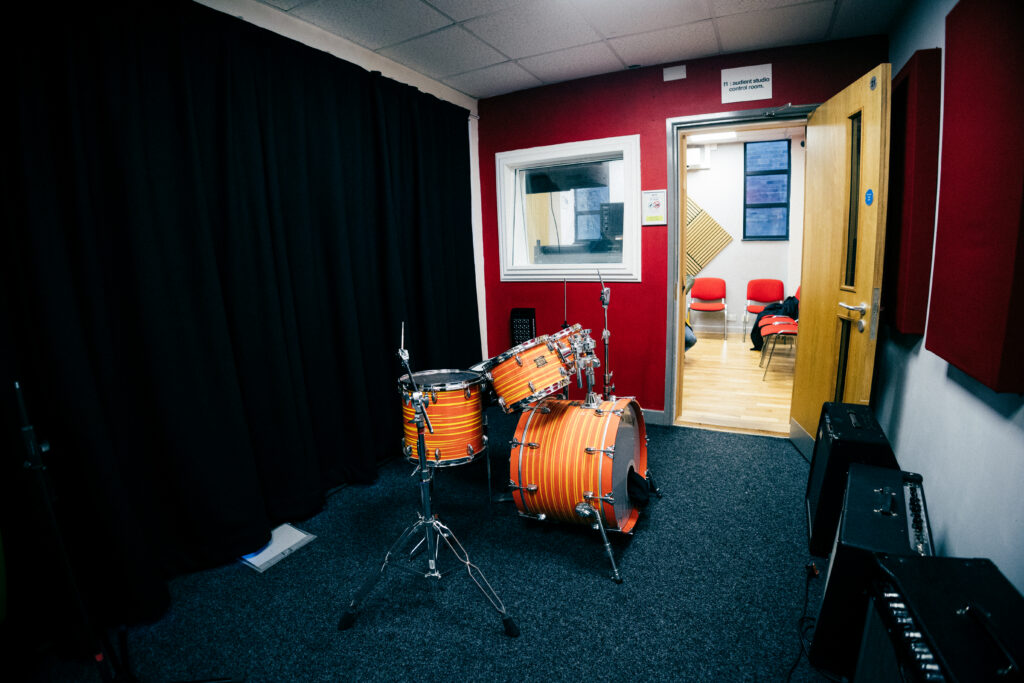
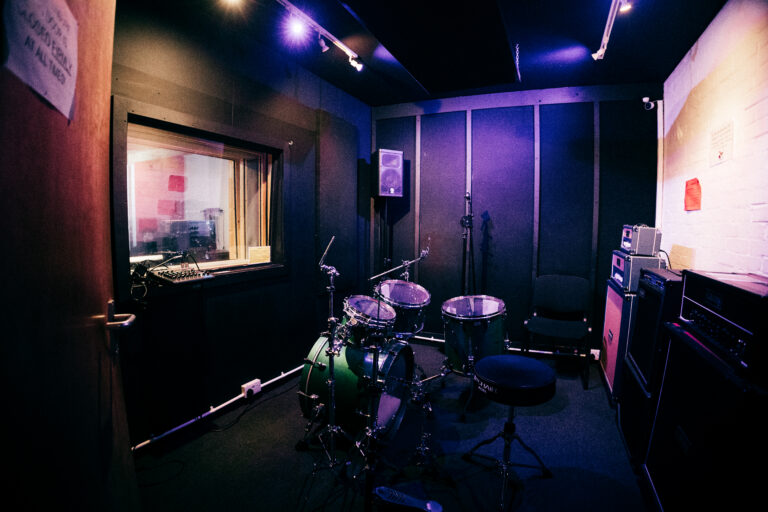
ACM’s long-standing partnership with Metropolis Studios in London gives our students access to one of the most iconic creative spaces in the world. As one of the world’s leading commercial studios, Metropolis boasts a prestigious client list which includes Kendrick Lamar, Clean Bandit, Ed Sheeran, Madonna, Amy Winehouse, Rolling Stones, Adele, Led Zeppelin, Beyonce, The Clash, Rihanna, Queen and Michael Jackson. 

The ACM-Metropolis relationship is built on shared values: artistic excellence, innovation, and a commitment to nurturing the next generation of music professionals. Together, we offer experiences that go far beyond the classroom, connecting education with the heartbeat of the global music industry.

When you step into Metropolis Studios, you step into music history. The energy of that legacy is felt the moment you walk through the door, and we want every ACM student to experience the inspiration that comes from working in a space used by some of the most influential figures in modern music. 

At the same time, Metropolis is a working commercial environment, and students visiting the studios are expected to treat the space – and the people within it – with the professionalism it deserves. These opportunities are not only exciting, they are a chance to practice the behaviours, standards, and etiquette expected in top-tier creative workplaces. By approaching each visit with respect and professionalism, students strengthen both their craft and their future career prospects.

With this in mind, it’s important that all students understand the expectations that accompany access to such a world-class facility. Metropolis Studios welcomes ACM students into its spaces as emerging professionals, and in return, we ask that everyone conducts themselves in a way that reflects positively on both ACM and the studio. 

To ensure that every visit runs smoothly, safely, and professionally, we have outlined the core behaviours and standards required of all students attending courses, sessions, events or recording opportunities at Metropolis. These guidelines are designed to help you make the most of your experience, by respecting the people and projects around you, and by upholding the level of professionalism expected in a high-profile creative workplace. 

The following points set out those expectations and should be followed at all times when representing ACM within Metropolis Studios.

Professional Studio Etiquette & Behaviour

  • Arrive prepared, punctual, and ready to work or observe, and be sure to represent ACM in a professional manner at all times.
  • Respect everyone’s role – engineers, producers, assistants, artists, runners, and other creatives.
  • Do not approach, speak to, or attempt to interact with Metropolis clients unless explicitly invited to do so.
  • Do not post about Metropolis clients on social media, and respect confidentiality regarding any projects, clients, or conversations you encounter. 
  • Do not wander into any studio unless these are booked by ACM or you have been given explicit permission to do so.
  • Seek permission before touching equipment or instruments, and be sure to handle all gear carefully and only as instructed. 
  • Observe without interrupting if you are invited to sit in on a session.
  • Avoid unsolicited feedback or opinions unless you are specifically invited to contribute.
  • Do not record or photograph anyone or anything without explicit permission.
  • Switch mobile devices to silent and limit their use to breaks or permitted areas.
  • Respect the studio schedule – break times, set-ups, and resets often run to tight timelines.
  • Stay aware of your surroundings, especially when people are moving equipment or running cables.
  • Keep food and drink away from consoles, instruments, technical areas and equipment.
  • Treat everyone courteously and professionally.
  • Avoid distracting behaviour, such as side conversations or excessive movement in control rooms.
  • Follow health and safety guidance, including safe lifting and awareness of fire exits, and report any issues or accidents immediately to staff or studio personnel.
  • Be willing to learn – take notes, observe workflows, and ask questions at appropriate times.

Please be aware that ACM’s policies continue to apply during any event, session, or opportunity held at Metropolis Studios. Failure to adhere to this ACM-Metropolis Student Visitor Code of Conduct may result in disciplinary action being taken under ACM’s Student Conduct and Disciplinary Policy, which remains fully in effect at off-campus locations. Any behaviour that breaches ACM standards while at Metropolis will be treated in the same way as if it occurred on campus, ensuring transparency, consistency and accountability across all ACM-related environments. 

Policy Owner

Monitoring of the ACM-Metropolis Student Visitor Code of Conduct will be undertaken by ACM’s Head of Industry Partnerships. 

Decisions and appropriate actions in support of the implementation of the Policy will be authorised by the following designated staff:

  • Metropolis Studios CEO
  • Metropolis Studios General Manager
  • ACM Head of Industry Partnerships
  • ACM Executive Dean of Education
  • ACM Quality Assurance and Enhancement Manager 

Supporting Policies

  • ACM Student Charter (Code of Conduct)
  • ACM Student Conduct and Discipline Policy

Document History and Next Review

Version 1.0
Approved on 25 November 2025
Approved by Academic Board 
Date of next review August 2026 

Download: POL_080 ACM-Metropolis Visitor Student Code of Conduct 
Policy 078: Personal Data Processed by Students

If you have a disability which makes reading this document or navigating our website difficult and you would like to receive information in an alternative format, please contact: anddegree@acm.ac.uk 

POLICY 078: PERSONAL DATA PROCESSED BY STUDENTS

  1. PURPOSE 

1.1 This guidance is intended for students undertaking research or other work involving information about living, identifiable individuals as part of their programme of study at ACM. 

  1. POLICY DETAILS 

2.1 The UK General Data Protection Regulation (UK GDPR) and the Data Protection Act 2018 protect the rights of individuals when you process personal data about them, including obtaining, holding and destroying it.

2.2 The definition of personal data is highly complex. For day-to-day purposes, it is best to assume that all information about a living, identifiable individual is personal data. This includes any expression of opinion by or about the individual.

2.3 Students use personal data for two main reasons:

  1. To maintain a personal life, for example to communicate with family and friends.
  2. To pursue a course of study with the university, for example to research and write an essay, report or thesis.

2.4 Students may use many different methods to process personal data, such as maintaining an email account, a computer database, or using social media accounts.

  1. POLICY SCOPE

3.1 Only in very limited and specific circumstances is ACM responsible for personal data processed by students (see 3.11 to 3.15), and only in these specific circumstances does it become the data controller for that data. A data controller is the person who determines the purposes for which, and the manner in which, any personal data is or is not to be processed. Therefore, ACM is only responsible for the personal data processed by its students when the students process data for the university’s purposes. In all other circumstances students process data for their own purposes and not ACM’s. 

Personal, domestic and household purposes 

3.2 Personal data processed in the course of a purely personal or household activity, with no connection to a professional or commercial activity, falls outside the scope of UK and EU GDPR (Recital 18). This means that where personal data is used for such things as writing to friends and family or taking pictures for your own enjoyment, students are not subject to the GDPR even if they are using ACM email accounts. 

3.3 ACM is not the data controller for personal data processed by students in the course of their personal life, as ACM does not determine the purpose of the processing. The fact that students may choose to use their ACM-provided email account to pursue their personal life does not make ACM responsible for the processing of personal data for that purpose. 

3.4 ACM does not determine the purpose so cannot be the data controller. Students are the data controller and may claim the so-called ‘purely personal or household activity’ exemption. Use of this exemption has the effect that data protection laws do not apply to the processing activity.

Use of personal data in pursuit of a course of study

3.5 Where a student processes personal data in order to pursue a course of study with ACM, ACM is not the data controller for the personal data processed by that student.

3.6 Students undertake a course of study with ACM for their own personal purposes, most obviously to obtain a qualification. Students are not employees or agents of ACM and neither do they act on behalf of ACM. Students decide what work they will do, the way in which they will do it and what they will include in their final submission. They must make these decisions themselves in order to prove that they are capable of Bachelors degree-level or Masters degree-level work. They do this work on behalf of themselves and not ACM. Thus, ACM cannot be the data controller for the personal data processed by students in the course of their studies. 

3.7 However, the student will still be bound by the ACM’s policy and procedures due to their student contract with ACM. This means that when students are processing personal data as part of their work to pursue a course of study, ACM’s Data Access and Protection Policy (and Research Ethics Policy) applies to them, and they will be required to ensure that their work complies with the data protection principles. 

3.8 This contractual duty to comply with the ACM’s Data Protection Policy extends to all work related to the course of study, even if the student contract has expired, such as a promise to inform research participants of results after the dissertation has been submitted and approved.

3.9 If a student subsequently uses the work generated during their course of study as the basis for a post as academic researcher at ACM, then ACM is the data controller for this follow-on work. 

3.10 Students using personal data in their dissertation research must complete the ACM Research Ethics Form and a Participant Consent Form.

Personal data submitted to ACM as part of an assessment

3.11 When a student submits a piece of work containing personal data to ACM for assessment (e.g. a dissertation or thesis), ACM and the student become joint data controllers for the personal data contained within the submitted piece of work from the point at which it is submitted. 

3.12 Once the work has been submitted, ACM is jointly responsible for the personal data within the document. For example, the member of ACM staff who marks the work is processing the personal data contained within it (by reading it) for the purpose of determining what grade ACM should award the student. This is ACM’s purpose. The legal basis for ACM using this data falls under ‘Public Task’ in Article 6 of the UK GDPR. 

3.13 If the work is then transferred to the ACM library to be put on reference (for example if it is a PhD thesis), ACM is responsible for any processing of the personal data associated with the document being placed on reference. This is because providing a reference service is a university purpose. 

University-led postgraduate research groups 

3.14 In cases where a research student processes personal data whilst working on a project led by a university research group, the university is the data controller for personal data processed by the student. This is because the student processes personal data for the purposes laid down by the project, the remit of which has been decided by the university (or the university-employed project leader), not the student. In this scenario, the student is an agent of the university. This is the case whether the student is funded by the research project or whether the student is self-funding. The legal basis for ACM using this data falls under ‘Public Task’ in Article 6 of the UK GDPR. 

University-sponsored studies

3.15 In cases where a university is a sponsor or co-sponsor of a study, and where a research student processes personal data in order to pursue a course of study in connection with that (co-)sponsored study, the university is the data controller. The legal basis for ACM using this data falls under ‘Public Task’ in Article 6 of the UK GDPR. 

  1. GOOD PRACTICE IN USING PERSONAL DATA RESPONSIBLY

4.1 The following steps are examples of good practice in using personal data responsibly: 

  1. Before you start your research, consider carefully what personal data you need to collect for your dissertation or thesis and obtain the consent of your supervisor.
  2. Obtain ethical consent from the data subject. For research this will usually be in writing. Discuss with your supervisor any concerns about obtaining consent before collecting personal data. Be aware that collecting personal data before consent is obtained may be treated as academic misconduct. 
  3. Give a clear explanation of what you are going to do with the data to the people participating in your research.
  4. Do not collect or keep data that is not necessary for your research. Anonymise data where possible by removing names and other identifying information.
  5. Ensure that all personal data, especially opinions, is recorded accurately.
  6. Respect reasonable requests to update or delete data you have collected.
  7. Store personal data securely. Password protection and restricting access to drives is good practice. If you are using information that is already public knowledge such as the names of Grammy award winners, you will not need to take any security measures. However if you are recording less public information, you must ensure that the information is secure.
  8. Do not disclose personal data to anyone except the individual concerned.
  9. Securely destroy personal data when it is no longer necessary for your research. Consult the Assessment Regulations to confirm how long you will need to retain research data for (usually one calendar year). 
  10. Be aware of required safeguards for international transfers of personal data outside of the UK.

    5. RELATED POLICIES 

5.1 Internal 

  • Data Access and Protection Policy
  • Research Ethics Policy

5.2 External

  • Data Protection Act 2018 (DPA 2018
  • UK General Data Protection Regulation (GDPR) 
  1. POLICY OWNER

This Policy is under the responsibility of the Academic Board. The responsible committee will ensure the cyclical review of this Policy is carried out under ACM’s Quality Assurance Framework. 

The Academic Board delegates operational responsibility of this Policy to: 

  • Quality Assurance and Enhancement Manager
  • ACM Research Ethics Chair
  • ACM Research Supervisors
  1. DOCUMENT HISTORY AND NEXT REVIEW
Version 1.0
Approved by Academic Board
Approved on 20 March 2025
Review due August 2026

Download: Policy_078 Personal Data Processed by Students

Procedure 077: Emergency Lockdown

If you have a disability which makes reading this document or navigating our website difficult and you would like to receive information in an alternative format, please contact: anddegree@acm.ac.uk 

Procedure 077: EMERGENCY LOCKDOWN

Purpose:
This emergency lockdown procedure is designed to ensure the safety of students and staff in the event of a major incident outside of ACM buildings. The procedure will be enacted upon notification from the police or relevant authority that an emergency lockdown is necessary. 

Please note: where ACM uses premises operated or managed by a third party, e.g. Brixton House and The Bridge, the lockdown procedures of the building management shall be followed. 

What is lockdown?

Instigating lockdown means locking doors and other physical barriers to restrict entry to and/or exit from a site or one or more zones within a site. It is sometimes referred to as `dynamic lockdown’.

Why instigate lockdown? 

Analysis of historic attacks, including the attack on London Bridge and Borough Market in 2017 and research conducted by the Centre for the Protection of National Infrastructure (CPNI) have shown that instigating lockdown in the event of a marauding terrorist attack (MTA) can be a highly effective way of reducing casualties. 

It is typically most useful when an attack begins outside a site or building, where lockdown can delay attackers from entering an area or deter them altogether. The aims of lockdown are to reduce the immediate threat of harm by: 

  • Delaying attackers’ progress in finding and killing victims;
  • Preventing people inadvertently putting themselves into the path of attackers.

1. Initiating the Lockdown

  • Upon receiving notification from the police or other relevant authority that an emergency lockdown is required, or when we assess the need ourselves, ACM’s security or designated person will immediately inform key stakeholders in each of ACM’s buildings via the walkie-talkie system. 
  • The key stakeholders in each building (e.g. senior staff, designated lockdown coordinators) will communicate the lockdown to all staff and students within their respective buildings.
  • It is recommended that students and staff follow the instructions of the key stakeholders as part of this lockdown procedure. However, Article 5 of the Human Rights Act 1998 protects the right not to be deprived of liberty or freedom unless it is in accordance with the law. It should therefore be understood that all individuals have the right to make their own decisions at any time as to whether they remain on ACM premises under lockdown or not. 

2. Securing the Premises

The designated staff in each building will secure the premises as follows:

  • Buildings with a single entrance/exit: the designated staff member will secure the front door.
  • Buildings with multiple entrances/exits: designated staff will simultaneously secure each entrance and exit.
  • All external doors will be locked where possible to prevent entry.
  • Windows must be closed and locked where possible.
  • Blinds or curtains should be drawn where available.
  • All individuals must move away from windows and doors, remaining out of sight where possible.
  • Internal movement should be minimised; individuals should remain in classrooms, offices, or designated safe areas. 
  • Staff and students should remain calm and quiet to avoid drawing attention. 

3. Communication During Lockdown

  • The lockdown status will be maintained through ongoing communication via the walkie-talkie system.
  • ACM’s security and/or safeguarding team will liaise with the police for updates and guidance.
  • Staff should monitor their emails and other official communication channels for further instructions.
  • Mobile phones should be placed on silent mode to prevent unnecessary noise but kept accessible for emergency use.

4. Registering Students

  • Each classroom/office should take a register of all present individuals and report any absentees to the designated lockdown coordinator via email or internal communication systems.
  • Any discrepancies should be reported to the safeguarding team, who will liaise with the police if necessary. 

5. Students or Staff Outside the Building

  • Whilst every care will be taken to safeguard students, it is important to note that ACM does not act in loco parentis for students. 
  • Any students and staff visible outside at the time of locking down should enter, or will be instructed to enter, the nearest ACM building immediately. 
  • Students or staff who are not in view and are off the premises should follow the ProtectUK guidance:
    • Run: If there is a safe route, escape to a place of safety.
    • Hide: If escape is not possible, hide and stay silent. 
    • Tell: Once safe, inform the police by calling 999.

6. Lifting the Lockdown

  • The lockdown will only be lifted when it is deemed appropriate to do so, such as from direct instruction from the police or relevant authority.
  • ACM security will communicate the all-clear signal via the walkie-talkie system.
  • The designated staff will relay the all-clear message to staff and students in each building.
  • A final headcount will be conducted to account for all students and staff before resuming normal operations.

7. Post-Lockdown Actions

  • A debrief session will be held for staff and key stakeholders to evaluate the lockdown response.
  • Students will be offered appropriate support, including counselling if required.
  • Any necessary amendments to the procedure will be made based on feedback and lessons learned.
  1. Review and Training
  • This procedure will be reviewed annually and updated as required.
  • Regular training will be conducted to ensure preparedness.


  1. Supporting Information for this Procedure

10.1 Internal

  • ACM Run, Hide, Tell Policy
  • ACM Prevent Policy

10.2 External 

  • ProtectUK Advice and Guidance on Emergency Preparedness

https://www.protectuk.police.uk/about-protectuk 


  1. Document History and Next Review
Version 1.0
Approved on 01 September 2025
Approved by Academic Board
Date of next review August 2026

Download: PRO_077 Emergency Lockdown_v1.0

Policy 069: Freedom of Speech

If you have a disability which makes reading this document or navigating our website difficult and you would like to receive information in an alternative format, please contact: anddegree@acm.ac.uk 


Policy 069: FREEDOM OF SPEECH


  1. PURPOSE 

1.1  ACM is committed to fostering an environment that upholds the principles of academic freedom and freedom of speech, as enshrined in the Higher Education (Freedom of Speech) Act 2023. 


1.2  In accordance with the Higher Education (Freedom of Speech) Act 2023, ACM’s objective through this policy is to secure freedom of speech within the law for staff, members and students of ACM, and visiting speakers. 


1.3  ‘Academic freedom’ in relation to academic staff at registered higher education providers refers to their freedom within the law to question and test received wisdom, and to put forward new ideas and controversial or unpopular opinions without placing themselves at risk of being adversely affected by the loss of their jobs or privileges at the provider, and without the likelihood of their securing promotion or different jobs at the provider being reduced.


1.4  This policy acts as a code of practice, fulfilling the requirements of section A2 of the Higher Education (Freedom of Speech) Act 2023. This policy will outline: 


  1. ACM’s values relating to freedom of speech and an explanation of how those values uphold freedom of speech (see 1.5 and 2.1);


  1. the procedures to be followed by staff and students of ACM and any students’ union for students at ACM in connection with the organisation of (i) meetings which are to be held on ACM’s premises and which fall within any class of meeting specified in the code, and (ii) other activities which are to take place on ACM’s premises and which fall within any class of activity so specified (see 2.16 to 2.22). 


        (c) the conduct required of such persons in connection with any such meeting 

             or activity (see 2.2), and 


        (d) the criteria to be used by the provider in making decisions about whether to

             allow the use of premises and on what terms (which must include its criteria       

             for determining whether there are exceptional circumstances for the  

             purposes of section A1(10)) of the Higher Education (Freedom of Speech) 

             Act 2023 (see 2.13 to 2.15). 


1.5  ACM recognises that the free exchange of ideas and diverse perspectives is essential for intellectual growth, critical thinking, and the pursuit of knowledge. This policy outlines ACM’s commitment to protecting and promoting freedom of speech while ensuring that it is exercised responsibly and respectfully within the boundaries of the law and our institutional values.


  1. POLICY DETAILS 


2.1  The guidance outlined in this policy and the obligations to uphold the principles of academic freedom and freedom of speech, as enshrined in the Higher Education (Freedom of Speech) Act 2023, apply to ACM’s students’ union or equivalent as well as to ACM. 


2.2  Guiding Principles:


  • Academic Freedom: ACM is dedicated to maintaining an atmosphere where academic staff and students can engage in open and robust discussions, research, and exploration of diverse viewpoints, theories, and ideas. Academic freedom ensures the pursuit of knowledge is uninhibited by external pressures.


  • Freedom of Speech: ACM respects and safeguards the right to freedom of speech for all members of our community. This includes the right to express opinions, beliefs, and ideas, even those that may be controversial, unpopular, or challenging.


  • Respectful Dialogue: While ACM encourages free expression, it is equally important that all discourse remains respectful and tolerant of differing viewpoints. Communication should be conducted in a manner that upholds the dignity and well-being of all individuals, fostering a constructive and inclusive environment.


  • Lawful Expression: Freedom of speech must be exercised within the boundaries of the law. Speech that incites hatred, discrimination, harassment, violence, or poses a direct threat to the safety and well-being of individuals or the university community will not be tolerated.


Hate speech


2.3  Hate Speech: ACM strictly prohibits the use of hate speech, which includes any form of communication that discriminates, threatens, or incites violence or hostility against individuals or groups based on their race, ethnicity, religion, gender, sexual orientation, disability, or other protected characteristics as defined by the law. 


2.4  Hate Crime: Hate crime is a criminal offence punishable under UK criminal law. The law recognises five types of hate crime on the basis of:


  • Race
  • Religion 
  • Disability
  • Sexual orientation 
  • Transgender identity


Hate crimes can take the form of physical assault, verbal abuse or incitement to hatred and are covered by legislation (Crime and Disorder Act 1998 and section 66 of the Sentencing Act 2020) which allows prosecutors to apply for an uplift in sentence for those convicted of a hate crime. The police and the Crown Prosecution Service (CPS) have agreed the following definition for identifying and flagging hate crimes:


“Any criminal offence which is perceived by the victim or any other person, to be motivated by hostility or prejudice, based on a person’s disability or perceived disability; race or perceived race; or religion or perceived religion; or sexual orientation or perceived sexual orientation or transgender identity or perceived transgender identity.”


2.5  Hate Incident: A hate incident is any incident which the victim, or anyone else, thinks is based on someone’s prejudice towards them because of their race, religion, sexual orientation, disability or because they are transgender. Not all hate incidents will amount to criminal offences, but it is equally important that these are reported and recorded by the police. ACM reserves the right to report such incidents to the police. 


Harassment


2.6  Harassment: Speech that constitutes harassment, whether through verbal, written, or electronic means, is not permitted. Harassment includes unwelcome behaviour that creates a hostile or intimidating environment for others.


Protection from retaliation


2.7  Protection from Retaliation: ACM prohibits retaliation against any member of the community for expressing their opinions in a respectful and lawful manner. This protection extends to academic and employment-related matters.


Application of the Policy


2.8  Classroom and Learning Environments: In academic settings, tutors have the autonomy to teach and discuss topics relevant to their courses. Students are encouraged to engage in thoughtful discussions and express diverse perspectives, promoting a rich learning experience.

2.9  Events and Guest Speakers: ACM values the diversity of ideas and viewpoints that guest speakers bring to our campus. Student groups and organisations have the right to invite speakers of their choice within the confines of the law and ACM’s policies.

2.10  Online and Social Media: The principles of freedom of speech extend to online platforms and social media. Members of the ACM community should be mindful of their online conduct and strive to maintain respectful dialogue. 

2.11  Protests and Demonstrations: Peaceful protests and demonstrations are a valid form of expression. ACM supports these activities as long as they are conducted lawfully and do not disrupt the normal functioning of the institution. 


Events


2.12  Where any person or body subject to the obligations of this Policy wishes to hold any event for the expression of any views or beliefs held or lawfully expressed on premises controlled by ACM or ACM’s student union or equivalent, consent shall not be unreasonably refused. 


2.13  It shall be accepted as reasonable for ACM to refuse consent, or withhold facilities for any event to which this Policy applies, where ACM has reasonable cause to believe, from the nature of the organisation and/or speakers or from similar events in the past (whether previously held at ACM or otherwise), that:


  • the views likely to be expressed by any speaker are contrary to the law;
  • the intention of the speaker(s) is likely to be to incite breaches of the law or to intend breaches of the peace to occur;
  • the views likely to be expressed by any speaker are for the promotion of any illegal organisation or purpose;
  • it is in the interests of public safety, the prevention of disorder or crime, or the protection of those persons lawfully on premises under the control of ACM, that the event does not take place.


For the purposes of this Policy, ‘speaker’ means any organiser or other person invited to address the meeting other than members of any audience at that meeting.


2.14  ACM may impose such conditions and requirements upon the organisers as are reasonably necessary in all the circumstances. These may include, but are not limited to, requirements as to provision of stewards, variation of location and time, ticketing and whether the event shall be open to the public at large. 


2.15  Where ACM concludes that imposing conditions would not be sufficient to prevent serious disorder within premises subject to ACM’s control, it may decline to permit such events to be held.


Booking an external speaker


2.16  Reference to ACM’s External Speaker and Events policy must be made when booking external speakers. In particular, the process in paragraphs 2.17 to 2.22 will apply. 


2.17  The majority of external speaker requests will be straightforward and can be handled entirely at a local (departmental) level. In these cases, following the steps outlined in the “Local assessment of proposed external speaker(s)” below will suffice. However, some requests may be complex and may require referral for further consideration. The “referral process” will only apply in a minority of circumstances – to events or speakers deemed to be higher-risk.

2.18  All requests for an external speaker are to be submitted by the event organiser making the request using the appropriate form to the Industry Link team at least ten working days before the planned event.

2.19  A transcript of the intended talk must be provided, where requested, and a written undertaking to abide by the provisions of this policy and to uphold the ACM policy on Equality and Diversity. Requests that do not comply with this provision will be refused. If the risk is considered medium to high risk a transcript must be attached to the External Speaker Submission Form.

2.20  ACM reserves the right to require references for the proposed speaker and also to refuse permission for the speaker to visit ACM. A refusal is final.

2.21  An appropriate member of staff will be present at all talks to monitor any concerns.

2.22  Speakers must be informed that all such events may be recorded/filmed by ACM. These recordings are for future reference and marketing purposes associated to ACM and to prevent the abuse of trust.


Responsibilities


2.16  It is the duty of all those who are subject to this Policy to assist ACM in upholding the rights of freedom of speech as set out here. Where a breach of this Policy occurs, those to whom this Policy applies should take all reasonable steps to identify the person or persons involved in that breach. Any breach of the provisions of this Policy shall be dealt with under ACM’s disciplinary procedures, where applicable.


2.17  Where breaches of UK criminal law occur, ACM will, where appropriate, assist the Police and the Crown Prosecution Service (CPS). In respect of any criminal charges, ACM will not normally proceed with its own disciplinary proceedings on the same matters until the conclusion of any ongoing criminal proceedings. This does not preclude suspension of a person(s), where deemed appropriate, when actioned in connection with any part of an investigative process. Suspension is not viewed as a punitive measure. 


2.18 This policy will be reviewed periodically to ensure its effectiveness and relevance. Changes or amendments to the policy will be made in accordance with UK law and the best interests of the ACM community.


2.19  By upholding the principles outlined in this policy, ACM aims to create an inclusive, intellectually stimulating, and respectful environment where freedom of speech is celebrated as a cornerstone of our academic and creative community.


  1. RELATED POLICIES AND DOCUMENTS
  • Higher Education (Freedom of Speech) Act 2023
  • European Convention on Human Rights, Articles 10 and 11
  • Public Order Act 1986 
  • Equality Act 2010
  • Office for Students (OfS) Regulatory Framework
  • Middlesex University Code of Practice on Freedom of Speech
  • ACM Student Charter
  • ACM Prevent Duty
  • ACM Equality and Diversity Policy
  • ACM Safeguarding Policy
  • ACM Student Disciplinary Policy


  1. POLICY OWNER

4.1 The policy lead is responsible for the cyclical monitoring and review of the policy in liaison with the Quality Assurance and Enhancement Manager. The Freedom of Speech lead is:

  • Head of Quality and Standards

4.2 Decisions and appropriate actions in support of the implementation of the Policy will be authorised by the following designated staff or their appointed persons:

  • Head of Academic Practice
  • Group Lead on Student Experience
  • Head of Quality and Standards
  • Quality Assurance and Enhancement Manager
  • Designated Safeguarding Lead 


  1. DOCUMENT HISTORY AND NEXT REVIEW

Version:   1.0 

Approved on:   03 September 2024

Approved by:   Academic Board

Date of next review:   August 2025 


Download: POL_069 Freedom of Speech_202309

Policy 064: Sexual Misconduct

If you have a disability which makes reading this document or navigating our website difficult and you would like to receive information in an alternative format, please contact: anddegree@acm.ac.uk


Policy 064: SEXUAL MISCONDUCT

1. PURPOSE

1.1 This Policy outlines ACM’s approach to providing a campus environment in which all members of our community feel safe from sexual misconduct.For the purposes of this policy, this includes sexual harassment, whether explicitly stated or not. 

1.2 This Policy sets out our expectations around the unacceptability of sexual misconduct.

1.3 This Policy makes clear the ways in which ACM supports students who have experienced any form of sexual misconduct.

2. POLICY DETAILS

2.1 The Academy of Contemporary Music (ACM) is committed to safeguarding and promoting the welfare of all students, staff, visitors and guests and acknowledges its particular responsibilities to children, young people and adults at risk.

2.2 All staff within ACM have a responsibility to be involved in contributing to a culture in which safeguarding is embedded, discussed openly and risk proactively reduced. Every member of staff is DBS checked prior to commencing employment, and again every three years, and all staff members must complete training in the following areas:

  • Safeguarding Young People
  • Mental Health Awareness in Children & Young People
  • An introduction to GDPR
  • Health and Safety in Education Awareness
  • The Prevent Duty
  • First Aid Essentials

Members of the ACM safeguarding team also have further awareness and training regarding the following areas:

  • Protecting Children from Child Sexual Exploitation
  • Sexual Violence and Harrasment between Children and Young People
  • Understanding and Working with people affected by Sexual Abuse

2.3 ACM takes a zero tolerance approach to sexual misconduct and sexual harassment, and will support anyone in the ACM community who is subject to any form of sexual misconduct, as per the details in the accompanying Sexual Misconduct Procedure.

2.4 ACM will ensure that reporting parties are responded to in a safe, supportive and trusting environment, as per the details in the accompanying Sexual Misconduct Procedure.

2.5 ACM will educate and support all staff and students to understand:

  • what sexual misconduct is and that it is not tolerated;
  • what consent is; and
  • when consent is, and is not, given.

2.6 ACM will make clear how to disclose sexual misconduct, in person, online and anonymously, what options are available and the support that can be provided, via a clear and robust procedure.

2.7 ACM will ensure that all relevant staff are informed of how to receive and signpost a disclosure of sexual misconduct in a sensitive way. Empower those who disclose an experience to choose which options are best for them and provide access to expert professional support

2.8 ACM will set out all options and processes clearly and transparently. This includes the option to not make a formal complaint.

2.9 ACM will ensure that all relevant staff are provided with training to enable them to support and advise a student who has experienced sexual misconduct.

2.10 ACM will respect the sensitivity of disclosures of sexual misconduct and their consequences, and treat any disclosure confidentially, in line with our Data Protection Policy and the ACM’s duty of care under safeguarding.

2.11 Within Disciplinary Proceedings, ACM will ensure fairness to both Reporting and Responding parties.

2.12 ACM will ensure that all communications are sufficiently clear and detailed, and accurately reflect any decisions made.

2.13 ACM will learn from our experiences and regularly review this policy informed by data trends and with input from independent external experts to ensure it remains relevant.

3. POLICY SCOPE

3.1 The policy applies to all members of the ACM community, including students at all levels and campuses, staff, applicants, associate members, visitors, contractors and volunteers.

3.2 This Policy applies to sexual misconduct which:

  • occurs on ACM’s property and/or land;
  • occurs whilst a student is engaged in any ACM related activity (including placements and trips);
  • occurs via electronic means including, but not limited to: internet, email, social media sites, chat rooms, text messages and instant messaging;
  • results in a legal or police investigation, charge or conviction of an offence;
  • in the view of ACM poses a serious risk or disruption to the institution or members of its community.

3.1 ACM recognises that sexual misconduct can be experienced by any individual, regardless of sex, gender, sexual orientation, relationship status, age, disability, faith, race, ethnicity, nationality or economic status.

3.2 Experiences of sexual misconduct may intersect with other forms of discrimination and harassment, for example in relation to sex, gender, sexual orientation, relationship status, age, disability, faith, ethnicity, nationality or economic status.

3.3 ACM has policies on Equality, Discrimination and Inclusion and does not tolerate any forms of bullying or harassment. ACM does not tolerate behaviour or attitudes supportive of sexual misconduct.

Freedom of Speech 

3.4 ACM has a statutory duty to protect the lawful speech of all staff, students and visiting speakers, which includes protecting the right to express views that are controversial or unpopular. However, vigorous debate does not mean students should be expected to tolerate harassment. Speech or other expression that amounts to harassment is not protected. ACM promotes a culture that is open and tolerant of differences, and students can expect to be able to take part in all aspects of university life without being harassed. 

4. RELATED POLICIES

  • Safeguarding Policies
  • Safeguarding Procedures
  • Staff Code of Conduct
  • Staff-Student Relationship Policy
  • Student Charter
  • Data Protection Policy
  • Prevent Policy
  • External Speaker and Events Policy
  • Acceptable Use of IT and E-Safety Policy
  • Social Media Policy
  • Student Disciplinary Policies
  • Student Complaints and Grievances Policy
  • Equality & Diversity Policy
  • Staff Recruitment Policy
  • Health & Safety Policy
  • Whistleblowing Policy
  • Criminal Convictions Policy

5. POLICY OWNER

5.1 The responsibility for this Policy falls under the remit of the Designated Safeguarding Lead, overseen by the  Student Experience and Opportunity Board. 

5.2 The responsible committee will ensure the cyclical review of this Policy is carried out under ACM’s Quality Assurance Framework.

6. DEFINITIONS

Sexual Misconduct: Sexual Misconduct covers a broad range of inappropriate and unwanted behaviours of a sexual nature. It covers all forms of sexual violence, including sex without consent, sexual abuse (including online and image-based abuse), non-consensual sexual touching, sexual harassment (unwanted behaviour of a sexual nature which violates your dignity; makes you feel intimidated, degraded or humiliated or creates a hostile or offensive environment), stalking, abusive or degrading remarks of a sexual nature, and a vast range of other behaviours.

Consent: Consent is the agreement to participate in a sexual act where the individual has both the freedom and capacity to make that decision. Consent cannot be assumed on the basis of a previous sexual experience or previously given consent, and consent may be withdrawn at any time.

Freedom to consent: For consent to be present, the individual has to freely engage in a sexual act. Consent is not present when submission by an unwilling participant results from the exploitation of power, or coercion or force, regardless of whether there is verbal or physical resistance.

  • Coercion or Force includes any physical or emotional harm or threat of physical or emotional harm which would reasonably place an individual in fear of immediate or future harm, with the result that the individual feels compelled to engage in a sexual act.

Capacity to consent: Free consent cannot be given if the individual does not have the capacity to give consent. Incapacitation may occur when an individual is asleep, unconscious, semi-conscious, or in a state of intermittent consciousness, or any other state of unawareness that a sexual act may be occurring. Incapacitation may also occur on account of a mental or developmental disability, or as the result of alcohol or drug use.

  • Alcohol and/or Drug Use: Incapacitation arising from alcohol or drug consumption should be evaluated on the basis of how the alcohol/drugs have affected the individual; signs of incapacitation may include, but are not limited to, one or more of the following: slurred speech, unsteady gait, bloodshot eyes, dilated pupils, unusual behaviour, blacking out, a lack of full control over physical movements, a lack of awareness of circumstances or surroundings, and/or an inability to communicate effectively. Intoxication is never a defence for committing an act of Sexual Violence and Misconduct, or for failing to obtain consent. If there is any doubt as to the level or extent of one’s own or the other individual’s incapacitation, the safest approach is to not engage in a sexual act.

Disclosure: Disclosure means that an individual tells a member of the ACM community that they have experienced Sexual Misconduct (this is different from a formal Complaint).

Formal Complaint: Submitting a formal Complaint to ACM regarding an individual’s experience of Sexual Misconduct is an instruction for ACM to take appropriate action. The Complaint will allow ACM to investigate the misconduct as set out in this Policy and the accompanying processes.

Reporting Party: The Reporting Party is the person(s) who has made a formal Complaint regarding an experience of sexual misconduct.

Responding Party: The Responding Party is the person(s) named in a formal Complaint who is alleged to have committed an act of sexual misconduct.

Safeguarding: Safeguarding is the action that is taken to promote the welfare of all people and protect them from harm.

Sexual Harassment: Under the Equality Act 2010, sexual harassment is unwanted conduct of a sexual nature. It has the purpose or effect of violating the dignity of a worker, or creating an intimidating, hostile, degrading, humiliating or offensive environment for them. Something can still be considered sexual harassment even if the alleged harasser didn’t mean for it to be. It also doesn’t have to be intentionally directed at a specific person.

Abuse:  any action that intentionally harms or injures another person

DSL: Designated Safeguarding Lead is the member of staff that coordinates all safeguarding concerns and oversees all referrals.

DDSL: Deputy Designated Safeguarding Lead is the member of staff who supports the DSL in maintaining the function of safeguarding throughout all campuses.

LADO: Local Authority Designated Officer


7. PROCEDURES

7.1 The details of the procedures relating to this Policy can be found in the accompanying procedure document.

8. EXHIBITS/APPENDICES/FORMS

8.1 This Policy has been written with reference to the following statutory guidance and legislation. For the avoidance of doubt, it should be noted that UK law carries ultimate authority:

  • Keeping Children Safe in Education (DfE, 2021)
  • Working Together to Safeguard Children (HM Government, 2018)
  • What to do if you’re worried a child is being abused (DfE, 2015)
  • Child sexual exploitation; definition and guide for practitioners (DfE, 2017)
  • Sexual violence and harassment between children in schools and colleges (DfE, 2018)
  • The Children Act 2004 (with later amendments),
  • Safeguarding Vulnerable Groups Act 2006
  • The Sexual Offences Act 2003
  • Guidance for English Higher Education Institutions (HEIs) (DIUS, 2007)
  • Protection of Freedoms Act 2012
  • Children and Families Act 2014
  • Care Act 2014
  • Equality Act 2010
  • Protection from Harassment Act 1997
  • Office for Students (OfS) condition E6 Harassment and Sexual Misconduct;
  • Information sharing: advice for practitioners providing safeguarding services to children, young people, parents and carers (HM Government, July 2018) 

9. SUPPORTING INFORMATION

9.1 There are no further supporting documents to this Policy.

10. DOCUMENT HISTORY AND NEXT REVIEW

Version:                          1.2

Approved on:                01 Sep 2025

Approved by:                Academic Board

Date of next review:     August 2026 

Download: POL064_Sexual Misconduct Policy


Policy 066: FE Student Attendance Policy

1. PURPOSE AND SCOPE

1.1 The purpose of this Policy is to ensure the effective implementation of the ACM Teaching Learning and Assessment Policy. The Attendance and Punctuality Procedure is designed to create a strong attendance culture that supports safeguarding, high retention, achievement and progression.

2. POLICY DETAILS 

2.1 The Academy of Contemporary Music is committed to safeguarding and promoting the welfare of all students, staff, visitors and guests and acknowledges its particular responsibilities to all students in FE provision.

2.2 All FE tutors within ACM have a responsibility to check attendance for all students in every lesson.

2.3 Every member of staff must complete training in the following areas:
 

  • Safeguarding Young People
  • An introduction to GDPR
  • Health and Safety in Education Awareness
  • The Prevent Duty


2.4 ACM will ensure there are established governance structures in place to ensure that all aspects relating to attendance are regularly audited, reviewed and monitored.

2.5 ACM expects all students to participate fully in the life of the institution and attend not only in timetabled lectures but also to book tutorials and participate in workshops and masterclasses, all of which are offered to enhance your programme. Lectures, tutorials, workshops and masterclasses can be expected to take place between the hours of 09.00 and 18.00 (Monday to Friday) and students are expected to make themselves available at these times.

2.6 At ACM FE, we strongly encourage students to pursue industry-related experiences to support and enhance their studies. Absence requests for this nature must be carefully administered so that a student’s attendance, learning, and deadlines are not negatively impacted. Students making such requests must submit an Absence Request Form to Diploma Leadership at least one week in advance for the request to be considered. The full scope of this policy should be reviewed on the FE Course Hub.

2.7 ACM normally expects students to attend 100% with a minimum of 90%. Attendance and full participation is important to gain the most from the programme and prepare students for assessments and develop the skills you will need. Workshops, guest lectures, tutorials and other activities also provide additional support and insight.

2.8 Although 90% attendance is normally required, ACM recognises and is empathetic towards the individual needs of students with disabilities and chronic illnesses. As such, alternative and fluctuating minimum attendance requirements may be agreed with a student on the basis of Reasonable Adjustments. Any adjustments made to attendance requirements must be requested, assessed and approved by the Principal of FE, relevant Level Leader and Lead Tutor, and SENCo.

2.9 In the event that a student’s overall attendance falls below the minimum 90% threshold, without good reason, the Principal of FE, relevant Level Leader, and the student’s Lead Tutor will set up interventions by way of an Individual Learner Agreement.

2.10 Failure to improve overall attendance following intervention via an Individual Learner Agreement may result in removal from the programme.

2.11 ACM acknowledges that mental health is an important factor in its Further Education courses. ACM recognises the World Health Organization 2001 definition of good mental health, where it is defined as “a state of wellbeing in which the individual realises his or her abilities, can cope with the normal stresses of life, work productively and fruitfully, and is able to make a contribution to their community.”

2.12 If a student’s state of mental health is negatively impacting their attendance and academic attainment, reasonable adjustments may be made to support the student and minimise disruptions to their studies, conditional on acceptable written verification being submitted, by the way of the following:

  • authorising absences;
  • authorising late arrivals to and early exits from campus;
  • in some cases, extensions for assignments;

2.13 One of the following forms of written verification submitted to FE Leadership will be deemed acceptable:

  • an email from the student’s parent, carer or legal guardian;
  • a certification from a GP, counsellor, psychiatrist, CAMHS or similar professional

2.14 In some instances, the FE Leadership may require both parental/carer/legal guardian verification and professional certification.

2.15 Upon receipt of acceptable verification the following actions will then be taken:

  • The Wellbeing Team will be notified immediately
  • A check-in phone call will be made to the student to ascertain if any support is required

2.16 Non-attendance for four consecutive weeks could result in withdrawal from the course if sanctioned by the FE Leadership Team, Designated Safeguarding Lead and Principal.

2.17 In cases of a student being absent for more than 5 consecutive days, a meeting will be arranged between the student, parent/carer/legal guardian, Level Lead and The Principal to discuss the student’s Fitness To Study. 

2.18 Students must attend the classes they are registered on (i.e classes as they appear on their timetable), and are not permitted to attend alternative classes at alternative times without prior approval from the Principal of FE.

2.19 Students attempting to attend classes on which they are not registered (i.e classes that are not on their timetable), will be asked by the tutor to leave and attend the correct class and will not be marked as present.

2.20 Students attending the incorrect classes will not be marked as present, and this will affect their overall attendance percentage.

2.21 All ACM students and staff are required to wear ID cards and lanyards and keep them visible at all times whilst on ACM premises. Class registers are able to be taken using the contactless functions within the ID Cards and related systems. Any student found to be abusing this system (e.g. by granting access to another person by using their ID card, obtaining a positive attendance mark using someone else’s ID card), may be subject to the student disciplinary procedures.

2.22 ACM’s FE attendance policy is supported by the Further Education Leadership Team & the ACM Safeguarding Team. Both teams must remain aware of all concerns relating to attendance.

2.23 By promoting good attendance and punctuality we aim to:
 

  • Make good attendance and punctuality a priority for all those involved in the ACM FE community;
  • Raise our students’ awareness of the importance of good attendance and punctuality and its connection to successful study and progression;
  • Provide support, advice and guidelines to parents, guardians or carers, students and staff;
  • Work in partnership with parents/guardians/carers.


3. POLICY SCOPE

3.1 This Policy applies to students on Level 2, and Level 3 FE provision at ACM Guildford and ACM Birmingham. This Policy does not apply to Foundation Year Higher Education students at all ACM campuses.

3.2 The related Procedures to this Policy apply to all students and to all aspects of learning programmes including classroom-based and online sessions, tutorials, workshops, GCSE/Functional Skills, support sessions, work placements/experience and enrichment activities.


4. RELATED POLICIES

  • Safeguarding Procedures
  • Student Charter
  • Data Protection Policy
  • Prevent Policy
  • External Speaker and Events Policy
  • FE Student Disciplinary Policy
  • Health & Safety Policy


5. POLICY OWNER

 
5.1 The responsibility for this Policy falls under the remit of the Safeguarding & Pastoral Services Manager & Principal of FE, overseen by the Student Experience and Quality Committee. This role is supported under the Further Education Leadership Team. 

5.2 The responsible committee will ensure the cyclical review of this Policy is carried out under ACM’s Quality Assurance Framework.
 

6. DEFINITIONS

  • ACM – Academy of Contemporary Music
  • FE – Further Education
  • DSL – Designated Safeguarding Lead
  • FELT – Further Education Leadership Team
  • LSA – Learning Support Assistant
  • SENCo – Special Educational Needs Co-ordinator
  • DfE – Department for Education


7. PROCEDURES

7.1 Class registers are normally electronically marked at the beginning of the lesson, and submitted before the end of each session, or, in exceptional circumstances, by the end of the day. Class registers record attendance, absence, lateness, and early exits, and should be signed or initialled by the tutor.

7.2 In the event that the electronic register system is not working, a paper register must be taken and handed in to a Registry Administrator at the earliest opportunity, and before the end of the day.

7.3 Lateness is defined as arriving any time after the start time of the lesson. All students arriving late must be acknowledged and challenged appropriately. Students should be asked to provide reasons. LSAs should be directed to assist in managing this process. Lateness to the first lesson of the day may sometimes be related to transport or domestic problems and can be a support issue. However, lateness to other sessions in the day may be classified as a disciplinary issue. Students should not be turned away from a class on the grounds of lateness. Lateness should be recorded numerically, reflecting the number of minutes the student is late.


8. STUDENT RESPONSIBILITIES

8.1 Through the ACM Student Charter, students make a commitment to actively engage in their studies. Students are expected to attend all timetabled sessions and attend meetings with their tutors and academic supervisors. Attendance is monitored and records are kept relating to the level of attendance a student has.

8.2 Students are required to contact the Student Hub on the day of any absence by telephone, email or notification on MyACM. Any absence reported must have reasons put on Insight by Administrators and Tutors. Students should be informed of the notification procedure during induction and reminded by their Tutors regularly in tutorials.
 

9. STAFF RESPONSIBILITIES

9.1 All teaching staff should normally email any absent students directly following the lecture.

9.2 All teaching staff should know the name of the Lead Tutor for each student in their class. This can be found in the ‘Year Instance Information’ tab on the students’ records. The Lead Tutor is responsible for monitoring attendance of their group at all classes and implementing interventions to improve attendance with individual students who are below the 90% ACM target. There should be no unexplained absences by 16-18-year-old students. If this occurs then the tutor should contact the Safeguarding team immediately.

9.3 Persistent student absence or consistently poor punctuality must be addressed by Level Leaders in accordance with this Policy.

9.4 At each weekly group tutorial, the Lead Tutor should address the previous week’s absence(s)/punctuality directly with the student concerned and note the reasons for absence on Insight if not already given. If the student is absent, they and their parent/carer should be contacted via an email that seeks a response. If this method gains no response, then standard letters should be sent via a Programme Administrator. Absence with no contact is a safeguarding issue and local authorities or the Police may have to be informed. The Safeguarding Team must be informed in these circumstances immediately.

9.5 In the case of persistent absence (normally after three missed sessions) without valid reasons or evidence, a one to one tutorial should be held to discover the reasons for absence and any underlying problems. The discussion with the student should lead to recorded target setting. This will specify an agreed course of action to be undertaken by the student. Any agreed course of action may include support for the student from the SafeguardingTeam. Non-attendance at the tutorial increases the risk of interruption or withdrawal from the course of study.

9.6 Invitation to and outcomes of attendance meetings and official warning letters should be copied to the parent/carer/employer unless specific evidence or information from the student indicates this may harm them in some way. In this case, the Designated Safeguarding Officer should be involved. Curriculum Administrators are responsible for the administration of letters. Notes of letters sent must be made on Insight.

9.7 If the student continues to miss classes and has not improved attendance over a two week period to meet the agreed improvement target, a Level 1 disciplinary hearing should be held with the FE Leadership Team. The parent/guardian/carer should be invited to the meeting arranged with the student as appropriate. This may also apply in the case of vulnerable adults.

9.8 At the meeting, current data on attendance should be produced and any reasons previously given considered. Validity of reasons should be checked and the impact on achievement and progression opportunities should be highlighted. Teaching /work missed and assignments not completed should also be confirmed in writing. A solution to reverse the poor attendance should be agreed. Finance, ALS and study support needs should be checked. Other external forms of support should be sign posted if appropriate.

9.9 An ILA should be drawn up that is reviewed by the Level Leader fortnightly. Poor attendance will not normally be a reason for exclusion.

9.10 Any agreed plan of action should include support for the student; attendance contract and catch up on learning action plan. This should be added to Insight. Details of the agreed course of action will be communicated to the parent/guardian/carer.

9.11 Insight issues weekly attendance and punctuality reports at College, Department and Course level, including exception reports where the attendance level is below 90%.

9.12 Where this is the case, the FE Leadership Team will monitor that an investigation and appropriate action is being taken.

9.13 Summary reports of attendance and punctuality levels are produced by Curriculum Administrators and reported to the Directorate and the Quality and Standards Committee by the Principal. The Principal also reports to the Executive, and East Surrey College on these matters.

9.14 Levels of attendance and punctuality are a key data set for Course Review, Self-assessment and Quality Improvement planning and it is essential they are reviewed as part of these processes.

9.15 The academy overall target for 2022/23 is 90% with no unexplained absences.

9.16 Attendance will also be monitored in-year through the Further Education & Integrated Services Team.
 

10. HOLIDAY PROCEDURES

10.1 Students are advised that holidays should not be taken in term time as it is likely to impact on guided learner hours and achievement and progression prospects.
 

11. EXHIBITS/APPENDICES/FORMS

 11.1 This Policy has been written in accordance with, and with reference to, the following statutory guidance and legislation:

  • Keeping Children Safe in Education (DfE, 2021)
  • Working Together to Safeguard Children (HM Government, 2018)
  • The Prevent Duty (DfE, 2015, updated 2019)
  • The Children Act 2004 (with later amendments),
  • Safeguarding Vulnerable Groups Act 2006,
  • Protection of Freedoms Act 2012;
  • Information sharing: advice for practitioners providing safeguarding services to children, young people, parents and carers (HM Government, July 2018)


12. SUPPORTING INFORMATION

12.1 There are no further supporting documents to this Policy.
 

13. DOCUMENT HISTORY AND NEXT REVIEW

Version:                      1.3
Approved on:             01 Sep 2025
Approved by:             Academic Board
Date of next review:  August 2026

Download: POL_066_FE Student Attendance Policy


Procedure 064: Sexual Misconduct

If you have a disability which makes reading this document or navigating our website difficult and you would like to receive information in an alternative format, please contact: anddegree@acm.ac.u

1. PURPOSE

1.1 This procedure outlines ACM’s approach to providing a campus environment in which all members of our community feel safe from sexual misconduct. For the purposes of this procedure, this includes sexual harassment, whether explicitly stated or not. 

1.2 This procedure sets out our expectations around the unacceptability of sexual misconduct and sexual harassment.

1.3 This procedure makes clear the ways in which ACM supports students who have experienced any form of sexual misconduct or sexual harassment.

2. PROCEDURE DETAIL

This document outlines our specific Process for handling allegations of sexual misconduct and sexual harassment.

Making a Disclosure
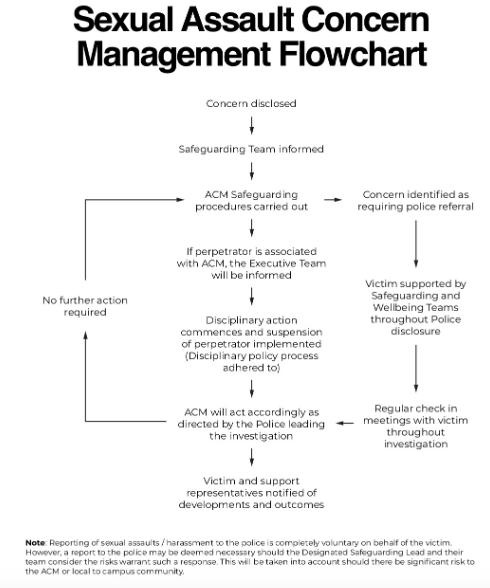
2.1 A disclosure is made when someone tells a member of ACM Safeguarding Team that they have experienced sexual misconduct or sexual harassment. A disclosure can be made in person, online or via other means such as phone or email.

2.2 Students can make disclosures of sexual misconduct or sexual harassment via ACM’s online reporting disclosure link. Where a member of staff has received a disclosure in person or via other means, they may submit a disclosure on behalf of the person who has disclosed via ACM’s online reporting disclosure link. 

2.3 The person who has chosen to disclose does not need to provide the full details of their experience if they do not wish to. They will not be pressured to make a formal complaint.

2.4 If the incident is historical, the person who has experienced it can still disclose it to the ACM safeguarding team and receive support. They can access Wellbeing Support Services, which will be offered.

2.5 Disclosure does not create a formal complaint and is not an instruction for ACM to take action. The person who has disclosed will have the opportunity to be heard and to consider their options before proceeding with any further steps. No action will be taken immediately by ACM unless there is a concern about immediate safety or if ACM has a duty under safeguarding.

2.6 Where a person chooses to disclose anonymously via ACM’s online reporting tool, no action will usually be taken on the basis of their disclosure. Anonymised data will help ACM to understand patterns in behaviour and inform future policy.

2.7 Where a person chooses to disclose, with contact details, via ACM’s online reporting tool, their disclosure will be received by the ACM safeguarding team. The person who has made the disclosure will be contacted by a member of the safeguarding team as soon as is practical to do so.

2.8 Where a disclosure is made but is not submitted via ACM’s online reporting tool, the person who has disclosed can still access support via Wellbeing Support Services.

2.9 The Academy of Contemporary Music recognises the importance of privacy for disclosures and formal complaints of cases of sexual misconduct and will only share information on a confidential, need-to-know basis. All personal data is recorded and held in accordance with the Data Protection Act 2018. ACM will retain anonymised data to understand patterns of behaviour and to inform future policy.

2.10   Confidentiality is not absolute secrecy. There may be circumstances where it is necessary or appropriate to share information either within ACM or with external organisations/bodies, for example to:

  • Allow a case to be appropriately considered and investigated;
  • Ensure those who disclose an experience or are alleged to have committed misconduct receive appropriate academic and pastoral support;
  • Safeguard members of the ACM community and fulfil ACM’s duty of care;
  • Discharge ACM’s duties or as required by law.

3. IMMEDIATE THREATS TO SAFETY

3.1 If after reviewing a disclosure submitted via the ACM’s online reporting tool, the ACM safeguarding team believes that there is a danger to the person who has disclosed or to anyone else, they will refer the disclosure to the ACM executive team along with a risk assessment.

3.2 If the ACM executive team decides via a risk assessment that it is necessary to take precautionary action, it will make a recommendation to the Registrar who will enact these measures. Such measures may include issuing a suspension of rights to restrict the person alleged to have committed the misconduct contact with the person who has disclosed, including restriction of access to campus facilities, and making a recommendation to the ACM safeguarding team regarding appropriate action.

3.3 If a suspension of rights is issued, the person alleged to have committed the misconduct will be informed in writing and, wherever possible, in person. They will be told what they need to do in order to comply with the suspension of rights. They will be assigned a member of the student services team, who will be their main point of contact.

3.4 If no suspension of rights is required, the person alleged to have committed the misconduct will not be informed of the disclosure or assigned a member of the student services team unless the person who has disclosed chooses to either pursue an informal resolution or submit a formal complaint to ACM.

4. STUDENT SUPPORT

4.1 ACM will assign a member of the student support team to the person who has made the disclosure. The member of the student support team will be the main point of contact throughout any subsequent steps, and will be able to help the person who has disclosed to make informed decisions about what happens next.

4.2 The member of the student support team does not represent the person they are assigned to within any subsequent Discipline Committee hearings. They are available to listen, to provide information and to facilitate practical support.

4.3 The member of the student support team will take into account the communications preferences of the person they are assigned to, and wherever possible will communicate key information in person, unless the person they are assigned to wishes otherwise.

4.4 The member of the student support team will contact the person who has made the disclosure as soon as is practical to do so to arrange a First Discussion Meeting between them and the member of the student support team. This will enable the person who has disclosed to talk about what they would like to happen. The member of the student support team will help them to consider the options and support available, to understand the role of the student support team, and to explore possible outcomes.

4.5 The outcome of an investigation, Discipline Committee hearing or Appeal will be shared with both parties and this will include setting out the rationale for the decision.

5. MALICIOUS REPORTS

5.1 Whilst extremely rare, the possibility of malicious reporting is recognised. ACM takes every disclosure seriously but reserves the right to cease consideration of a disclosure if it considers it to be malicious, vexatious or frivolous. In such cases, a member of the Safeguarding Team or its nominee will write to the reporting party explaining why consideration of the disclosure is being halted. This decision will be final.

6. CONDUCT

6.1 ACM recognises the possibility of retaliation against any individuals associated with a disclosure or formal complaint of sexual misconduct, including the Reporting Party, witnesses, the Responding Party, and staff.

6.2 Any retaliation will be dealt with under ACM disciplinary procedure as per policy.

6.3 If there is a further incident of sexual misconduct, anti-social behaviour or any other behaviour which breaches ACM’s regulations that occurs whilst an investigation is being conducted under the Sexual Misconduct Policy, this may be considered as an aggravating factor and taken into account during decision-making.

7. OPTIONS FOLLOWING DISCLOSURE

7.1 After disclosure there are several options available to the person who has disclosed their experience. They can choose the level and types of support that are right for them.

7.2 After discussion with their member of student support the person who has disclosed may choose to:

7.2.1 Take no further action at this time: In this case advice will be provided regarding the preservation of evidence which may be needed if they subsequently decide to make a report to the Police or to submit a formal complaint to ACM. They will also be informed of the ongoing support available to them via the student support team, Wellbeing Support Services and the safeguarding team.

7.2.2 Undertake an informal resolution: This option is dependent on the person alleged to have committed the misconduct being willing to participate. The member of student support assigned to the person who has disclosed will facilitate an informal resolution in collaboration with services such as Wellbeing Support Services and the safeguarding Team.

7.2.3 Make a report to the Police: In this case no disciplinary action will normally be taken by ACM whilst a Police investigation and legal proceedings are taking place, although ACM reserves the right to investigate and take action if it deems it necessary. Support will however still be available from the Wellbeing Support Services and the Safeguarding team.

7.2.4 Make a formal complaint to ACM: If the person who has disclosed chooses this option they will be asked to confirm that they wish ACM to proceed with a formal investigation. Support will be available from the Wellbeing Support Services and the Safeguarding team.

8. INFORMAL RESOLUTION

8.1 The person who has disclosed can always choose to make a formal complaint even if they have chosen informal resolution, and vice versa.

8.2 Where an informal resolution is appropriate, a member of student support will be assigned to the person alleged to have committed the misconduct. This will be a different member of student support to that assigned to the person who has made the disclosure.

8.3 The member of student support will arrange for the informal resolution to take place, in collaboration with services such as Wellbeing Support Services and the safeguarding team.

8.4 Informal resolution can only go ahead on the mutual agreement of both parties. The member of student support will follow up to check that the informal resolution has taken place, however as the allegation has not been proven they cannot enforce compliance.

8.5 Informal resolution may include, but is not restricted to, the following outcomes:

8.5.1 Written apologies

8.5.2 Attendance at awareness sessions

8.5.3 Participation in behavioural change programmes

8.5.4 No contact agreements

8.5.5 Any other penalties which are not punitive in nature

9. POLICE INVESTIGATION AND LEGAL PROCEEDINGS

9.1 If the person who has disclosed has made an independent report to the police they may still make a formal complaint to ACM.

9.2 ACM does not have the legal investigatory powers of the Police, and is not able to make a determination of criminal guilt.

9.3 Any disciplinary action is undertaken as a breach of ACM’s Sexual Misconduct Policy and is not a substitute for a Police investigation or a criminal prosecution.

9.4 The fact that criminal proceedings have been instituted or have concluded does not preclude ACM from taking its own disciplinary action, if it is thought fitting or necessary to do so.

9.5 The fact that the Police are unable or unwilling to proceed does not preclude ACM from taking its own disciplinary action.

9.6 A case which does not progress through legal channels, where a decision to take no further action has been made, and/or a ‘not guilty’ verdict has been returned, does not mean that the person has made a malicious or vexatious report.

9.7 The fact that criminal proceedings have returned a ‘not guilty’ verdict does not preclude ACM from taking its own disciplinary action.

9.8 If a student has been convicted of a criminal offence or accepts a Police caution in relation to behaviour that falls within the scope of ACM’s Sexual Misconduct Policy, then ACM will accept this as conclusive evidence that the behaviour took place. It may not be necessary for a further full investigation to take place and the complaint will be deemed proven and proceed directly to mitigation.

10. MAKING A FORMAL COMPLAINT TO ACM

10.1 The person who has experienced sexual misconduct may choose to make a formal complaint to ACM under the Sexual Misconduct Policy, and thereby seek a resolution via the ACM Disciplinary Procedure. A formal complaint is different to disclosure; it is a document informing ACM that something has happened and that the person who has made the complaint wishes ACM to take action. From this stage onwards, the person who has submitted the complaint is referred to as the Reporting Party, and the person who is alleged to have committed the misconduct is referred to as the Responding Party.

10.2 The complaint must be submitted via the online disclosure link. The complaints form may be completed by the Reporting Party, or if they prefer, someone can complete it on their behalf. The safeguarding team and Wellbeing Support Services can all provide help in completing the form.

10.3 The complaints form does not need to include in-depth detail about the experience. There does however need to be enough information so that ACM can take the complaint forward and understand what has happened.

10.4 The complaints form will be referred to the Student Discipline team. ACM will not take any action without the involvement of the Reporting Party unless there is an immediate threat to safety.

10.5 The Reporting Party has the right to withdraw their complaint and to stop the formal Sexual Misconduct Disciplinary Process at any time.

Freedom of Speech 

10.6 ACM has a statutory duty to protect the lawful speech of all staff, students and visiting speakers, which includes protecting the right to express views that are controversial or unpopular. However, vigorous debate does not mean students should be expected to tolerate harassment. Speech or other expression that amounts to harassment is not protected. ACM promotes a culture that is open and tolerant of differences, and students can expect to be able to take part in all aspects of university life without being harassed. 

11. PROCEDURE SCOPE

11.1 The procedure applies to all members of the ACM community, including students at all levels and campuses, staff, applicants, associate members, visitors, contractors and volunteers.

11.2 This procedure applies to sexual misconduct which:

  • occurs on ACM’s property and/or land;
  • occurs whilst a student is engaged in any ACM related activity (including placements and trips);
  • occurs via electronic means including, but not limited to: internet, email, social media sites, chat rooms, text messages and instant messaging;
  • results in a legal or police investigation, charge or conviction of an offence;
  • raises questions about the fitness of the student on a fitness to practice programme; or
  • in the view of ACM poses a serious risk or disruption to the institution or members of its community.

11.1 ACM recognises that sexual misconduct can be experienced by any individual, regardless of sex, gender, sexual orientation, relationship status, age, disability, faith, race, ethnicity, nationality or economic status.

11.2 Experiences of sexual misconduct may intersect with other forms of discrimination and harassment, for example in relation to sex, gender, sexual orientation, relationship status, age, disability, faith, ethnicity, nationality or economic status.

11.3 ACM has policies on Equality, Discrimination and Inclusion and does not tolerate any forms of bullying or harassment. ACM does not tolerate behaviour or attitudes supportive of sexual misconduct. 

12. RELATED POLICIES

  • Safeguarding Policies
  • Safeguarding Procedures
  • Staff Code of Conduct
  • Student Charter
  • Data Protection Policy
  • Prevent Policy
  • External Speaker and Events Policy
  • Acceptable Use of IT and E-Safety Policy
  • Social Media Policy
  • Student Disciplinary Policy
  • Student Complaints and Grievances Policy
  • Equality & Diversity Policy
  • Staff Recruitment Policy
  • Health & Safety Policy
  • Whistleblowing Policy
  • Criminal Convictions Policy

13. PROCEDURE OWNER

13.1 The responsibility for this Policy falls under the remit of the Designated Safeguarding Lead, overseen by the  Student Experience and Opportunity Board. 

13.2 The responsible committee will ensure the cyclical review of this Policy is carried out under ACM’s Quality Assurance Framework.

14. DEFINITIONS

 Sexual Misconduct: Sexual Misconduct covers a broad range of inappropriate and unwanted behaviours of a sexual nature. It covers all forms of sexual violence, including sex without consent, sexual abuse (including online and image-based abuse), non-consensual sexual touching, sexual harassment (unwanted behaviour of a sexual nature which violates your dignity; makes you feel intimidated, degraded or humiliated or creates a hostile or offensive environment), stalking, abusive or degrading remarks of a sexual nature, and a vast range of other behaviours.

Consent: Consent is the agreement to participate in a sexual act where the individual has both the freedom and capacity to make that decision. Consent cannot be assumed on the basis of a previous sexual experience or previously given consent, and consent may be withdrawn at any time.

Freedom to consent: For consent to be present, the individual has to freely engage in a sexual act. Consent is not present when submission by an unwilling participant results from the exploitation of power, or coercion or force, regardless of whether there is verbal or physical resistance.

  • Coercion or Force includes any physical or emotional harm or threat of physical or emotional harm which would reasonably place an individual in fear of immediate or future harm, with the result that the individual feels compelled to engage in a sexual act.

Capacity to consent: Free consent cannot be given if the individual does not have the capacity to give consent. Incapacitation may occur when an individual is asleep, unconscious, semi-conscious, or in a state of intermittent consciousness, or any other state of unawareness that a sexual act may be occurring. Incapacitation may also occur on account of a mental or developmental disability, or as the result of alcohol or drug use.

  • Alcohol and/or Drug Use: Incapacitation arising from alcohol or drug consumption should be evaluated on the basis of how the alcohol/drugs have affected the individual; signs of incapacitation may include, but are not limited to, one or more of the following: slurred speech, unsteady gait, bloodshot eyes, dilated pupils, unusual behaviour, blacking out, a lack of full control over physical movements, a lack of awareness of circumstances or surroundings, and/or an inability to communicate effectively. Intoxication is never a defence for committing an act of Sexual Violence and Misconduct, or for failing to obtain consent. If there is any doubt as to the level or extent of one’s own or the other individual’s incapacitation, the safest approach is to not engage in a sexual act.

Disclosure: Disclosure means that an individual tells a member of the ACM community that they have experienced Sexual Misconduct (this is different from a formal Complaint).

Formal Complaint: Submitting a formal Complaint to ACM regarding an individual’s experience of Sexual Misconduct is an instruction for ACM to take appropriate action. The Complaint will allow ACM to investigate the misconduct as set out in this Policy and the accompanying processes.

Reporting Party: The Reporting Party is the person(s) who has made a formal Complaint regarding an experience of sexual misconduct.

Responding Party: The Responding Party is the person(s) named in a formal Complaint who is alleged to have committed an act of sexual misconduct.

Safeguarding: Safeguarding is the action that is taken to promote the welfare of all people and protect them from harm.

Abuse:  any action that intentionally harms or injures another person

DSL: Designated Safeguarding Lead is the member of staff that coordinates all safeguarding concerns and oversees all referrals.

DDSL: Deputy Designated Safeguarding Lead is the member of staff who supports the DSL in maintaining the function of safeguarding throughout all campuses.

LADO: Local Authority Designated Officer

15. EXHIBITS/APPENDICES/FORMS

15.1 This procedure has been written in accordance with, and with reference to, the following statutory guidance and legislation:

  • Keeping Children Safe in Education (DfE, 2021)
  • Working Together to Safeguard Children (HM Government, 2018)
  • What to do if you’re worried a child is being abused (DfE, 2015)
  • The Prevent Duty (DfE, 2015, updated 2019)
  • Child sexual exploitation; definition and guide for practitioners (DfE, 2017)
  • Sexual violence and harassment between children in schools and colleges (DfE, 2018)
  • The Children Act 2004 (with later amendments)
  • Safeguarding Vulnerable Groups Act 2006
  • The Sexual Offences Act 2003
  • Office for Students (OfS) Condition E6 Harassment and Sexual Misconduct
  • Guidance for English Higher Education Institutions (HEIs) (DIUS, 2007)
  • Protection of Freedoms Act 2012
  • Children and Families Act 2014
  • Care Act 2014
  • Information sharing: advice for practitioners providing safeguarding services to children, young people, parents and carers (HM Government, July 2018)

16. SUPPORTING INFORMATION

There are no further supporting documents to this procedure.

17. DOCUMENT HISTORY AND NEXT REVIEW

Version:                           1.2

Approved on:                 01 September 2025

Approved by:                 Academic Board

Date of next review:      August 2026

Download: PRO_064_Sexual Misconduct Procedure


Procedure 011: Fitness to Study

If you have a disability which makes reading this document or navigating our website difficult and you would like to receive information in an alternative format, please contact: and@acm.ac.uk 

Procedure 011: FITNESS TO STUDY


  1. Purpose and Scope 

1.1 This procedure describes how the Academy of Contemporary Music (ACM) ensures that there is a consistent and supportive approach when assessing an individual’s capacity to satisfactorily participate and fully engage as an ACM student. 

1.2 This procedure may apply to all current and prospective students including students that have interrupted and/or deferred their studies (herein referred to as ‘the student’) and refers to their time as an ACM student. 

1.3 Fitness to study will be assessed in a timely manner ensuring that students are treated in a fair and equitable manner, with discretion and consideration of individual needs. 

  1. Procedure 

2.1 ACM and its wider staff are committed to supporting student wellbeing and achievement amongst all students. Intervention should only take place where there is a level of need, and should take place discreetly and at the earliest opportunity. ACM recognises that a positive approach to the management of student needs is crucial to student learning and academic achievement. 

2.2 A unified and non-judgmental approach to physical and mental health, and any arrangements that may affect a student or prospective student’s ability to exercise suitable fitness to study should be exercised and demonstrated at all stages of consideration of a student’s fitness to study. 

Informal Stage (Standard Interventions) 

Stakeholders: Programme Admins, Registry Manager, Student Services, Tutors, Pathway Leads and Personal Tutors. 

2.3 It is recognised that studying at Higher Education level comes with a series of natural stresses such as working to meet multiple deadlines, potentially experiencing financial stresses, as well as dealing with difficult personal circumstances. As such, a student receiving support with their studies would not necessarily be put through the FTS process as a first step. 

2.4 Students who come to the attention of ACM where a need for support is identified, whether that be through referrals made by staff or the student themselves, will be referred to the appropriate team to receive support relevant to the difficulties they are facing. The support implemented can include, but is not limited to: 

– Wellbeing support; 

– Tutorials with a tutor/Pathway Lead; 

– Advice to apply for EC’s; 

– Advice and support with applying for DSA (where relevant); 

– Hardship loans (pending approval); 

– Consultation with Registry and/or Programme Administrator on their academic standing and support in constructing a plan of action. 


2.5 The interventions administered at this stage would not be logged as part of a formal FTS process, but would be logged to show the attempts made by ACM to support the student at that time. 

2.6 If concerns persist over the student’s engagement or wellbeing, the decision would be made to refer the student to a Stage 1 Fitness to Study. 

Stage 1 Fitness to Study 

Stakeholders: Designated Programme Administrators and DSL relevant to student’s campus. 

2.7 When referred to a Stage 1 FTS, the student will be sent a letter at least 7 working days before the proposed date to notify and invite them to the panel. If the student is unable to attend the proposed date then it is expected of them to inform the FTS panel in the first instance in order for a new date to be arranged. 

2.8 The purpose of a Stage 1 FTS panel will be to discuss with the student the support that has already been implemented, what reasons there may be for this support not being effective, and the concerns that ACM now has regarding the continuation of their studies. Following this discussion, the panel and the student will explore what the most appropriate next steps will be to ensure the student’s wellbeing is treated as the priority. The two possible outcomes at this stage will be a choice of the following: 

– Continuation of study with the implementation of further support and an Individual Learner Arrangement; 

– A request made by the student for a change of circumstance, i.e., an interruption or withdrawal. 

2.9 Should the student wish to continue with their studies, it will be permitted based on the student being administered an Individual Learner Arrangement (ILA). Under this arrangement the student will receive further interventions of support from ACM, which can include but will not be limited to: 

– Continued wellbeing sessions; 

– Referrals for a series of set counselling sessions; 

Bespoke tutorials with tutor/pathway lead; 

– The application of EC’s for upcoming assessments where appropriate based on the provision of necessary supporting documentation. 

2.10 The conditions set for the ILA will be that the student must engage with their upcoming assessments following the Stage 1 FTS panel in order to show that they have engaged with the support set and that it has been effective in helping them re-engage with their studies. 

2.11 As part of the ILA, the student will undergo a period of monitoring by their personal tutor and the Programme Administrator Team as outlined in the Individual Learner Arrangement Policy. The student will continue to be expected to inform their personal tutor and the relevant support staff of any issues that are continuing to pose prohibitive to the student’s engagement to ensure that support can be adjusted where necessary. 

2.12 If following the given assessment period the conditions of the ILA are met, the student will be signed off as a Fitness to Study and following a short period of academic monitoring, no further action will be taken. 

2.13 In the event that the terms of the ILA are not met, the result will be a progression to a Stage 2 FTS panel and would be notified accordingly. 

2.14 Where a mutually agreed outcome is reached the matter will not be escalated further. All agreed arrangements should be documented and the student may still be subject to a period of academic monitoring at the discretion of the panel. 

Stage 2 

Stakeholders: Registry Manager, Group Lead on Student Experience, and Designated Safeguarding Lead 

2.15 Following the decision to proceed to a Stage 2 FTS, the student will be sent a letter at least 7 working days before the proposed date to notify and invite them to the panel. If the student is unable to attend the proposed date then it is expected of them to inform the FTS panel in the first instance in order for a new date to be arranged. 

2.16 Prior to the panel taking place, a pre-stage 2 consultation will take place between the members of the Stage 1 panel and the Stage 2 panel to discuss the student’s journey throughout this process in order to provide context for the Stage 2 panel to deliberate the most appropriate outcome. The potential outcomes are as follows: 


  1. Interruption – If the continuation of the student’s studies are not feasible at this time, but given a period of respite there could be scope for the student to return, the panel will conclude that the student will be put on an interruption for a maximum period of up to 12 months. The conditions of the student’s return and the most appropriate date of return will also be set and shared with the student. 


  1. De-registration – if the Panel concludes, taking into account the individual circumstances of the case and any supporting medical evidence, that there is no reasonable prospect of the student re-engaging with their programme or that doing so would pose a significant risk or disadvantage to a student’s mental or physical well being, a decision will be made that the student is terminated from their programme of studies. This decision should only be made in the most serious cases, and where all avenues of recourse, support mechanisms or arrangements have been exhausted or are deemed inappropriate. 


  1. Any other action considered to be appropriate and proportionate. 

2.17 The Stage 2 FTS panel will consist of members of staff who have had limited to no involvement in the student’s situation in order to remain impartial in their decision making. 

2.18 The student will normally be required to attend the panel to discuss their case. If the student does attend, they will have the right to bring a friend or student representative to the meeting for support. 

2.19 The student may be permitted to be accompanied by a support worker, for example in cases of visual or hearing impairment, where this is appropriate to their needs. 

2.20 When the panel takes place, the student will take part in the discussion surrounding their circumstances, what may have lead to all previous interventions not being effective and will then be informed of the outcome that has been reached by the panel. 

2.21 In the event that the student in question is under the age of 18, a parent, guardian or nominated adult with responsibility for the student will be required to attend proceedings with the student 

2.22 Any individuals who attend the hearing in support of the student, will not be included to influence or act as an intervention to any decisions or proceedings arising from the hearing. Students are advised that individuals who attend hearings will not be considered representative of the student in a formal or legal capacity. 

2.23 Following the conclusion of the panel, the student will be informed of what the next steps are depending on the outcome reached and any relevant changes of circumstance will be actioned with immediate effect. 


Emergency FTS Panel 

Stakeholders: Registry Manager, Group Lead on Student Experience, and Designated Safeguarding Lead 

2.24 Referrals for an Emergency Fitness to Study can only be made by a Designated Safeguarding Lead. If there are concerns held by a member of staff wherein they feel an Emergency FTS is appropriate, they must disclose these concerns to their campus DSL in the first instance. 

2.25 In the event where a disclosure is made that – in line with the Fitness to Study policy – leads to an Emergency FTS, the panel will sit within 48-working hours of the disclosure being made. 

2.26 The student concerned will be invited to attend the panel and will be notified by letter of the time and date in the first instance. However due to the serious nature of this stage, the panel will sit without the student’s attendance if it comes to it. 

2.27 The Emergency FTS Panel will consist primarily of the Stage 2 panel with potential attendance from additional staff who have provided relevant support to the student. 


2.28 An outcome will be reached based on the circumstances disclosed prior to the panel. Once this outcome has been decided all relevant changes of circumstances, should there be any, will be processed with immediate effect. 

Actioning CoC’s prior to Stage 2 or Emergency FTS 

2.29 Making the decision to interrupt a student on their behalf is usually reserved for Stage 2 and Emergency FTS Panels. However, ACM reserves the right for an interruption to be implemented for a student at Stage 1 if there are immediate and substantial concerns where the student’s wellbeing & safety are clearly seen to be at risk. 

2.30 The decision to action a change of circumstance (CoC) prior to Stage 2 or an Emergency FTS can only be actioned by the Designated Safeguarding Lead, Registry Manager, or Group Lead on Student Experience at their discretion. 

Return to Study 

Stakeholders: Registry Manager, Group Lead on Student Engagement, and Designated Safeguarding Lead 

2.31 Following the end of the student’s interruption, a reintegration meeting will be set prior to the student’s expected date of return to discuss the student’s eligibility to return. An outcome is not reached in this panel but will be concluded once the panel has sat. 

2.32 The student will be welcome to have a friend, parent or guardian, or support worker be in attendance to provide support in a personal capacity. 

2.33 The conditions set prior to the interruption will be reviewed and the student will be expected to provide authoritative documentation that evidences these conditions being met. 

2.34 Following the reintegration meeting, all information shared and supporting documentation provided will be reviewed and considered with a decision being made as to whether or not the student will be permitted to return to study. This outcome will be shared with the student and their re-enrolment will be processed in the first instance. 

2.35 If in the event that the panel concludes the student is not fit to return to study, they will make a decision on an outcome that can include, but will not be limited to: 


  1. A request for further/updated supporting documentation that pertains to evidencing the student’s fitness to return. A follow up reintegration meeting would be arranged to give the student adequate time to source the requested documentation. 


  1. An extension of the student’s interruption might be actioned if the panel concludes that a return to study at the original date set will not be conducive to the student’s wellbeing. 


2.36 The outcome of all FTS panels and reintegration meetings will be communicated to the student within 48-working hours of the panel being held to ensure that they are aware of what the next steps will be. A post-Emergency FTS consultation can also be arranged to discuss the outcome with the student if they couldn’t attend the panel itself. 

2.37 All FTS panels and reintegration meetings will be recorded and minuted in order for an accurate record to be kept. Should the student request a copy of either they will be welcome to do so. Any informal discussions and undertakings made by the staff that are managing this process will be held on file for a period of 6 years. 

Right of Appeal 

2.38 If the student does not agree with the outcome(s) and wishes to contest or appeal any or all of the decisions made in the FTS panel(s) or the Reintegration meeting, they may refer to and utilize the Appeals Policy. 

Applicants who are refused a place at ACM 

2.39 Prospective students and applicants should follow ACM’s Admissions Complaints Policy and Procedure if they wish to make a complaint. 

  1. Responsible Parties 

3.1 The Procedure lead is responsible for the cyclical monitoring and review of the policy and procedure in liaison with the Quality Assurance and Enhancement Manager. The Fitness to Study Procedure lead is: 

  • Registry Manager 

3.2 Decisions and appropriate actions in support of the implementation of the Policy will be authorized by the following designated staff: 

  • Academic Registrar 
  • Group Lead on Student Experience 
  • Designated Safeguarding Lead(s) 
  • Additional Needs & Disabilities Coordinator 
  • Pathway Lead(s) 
  • Head of Education 
  • Programme Administrator(s) 
  • Designated Safeguarding Lead(s) 
  1. Related Documentation 
  • Fitness to Study Policy 
  • Appeals Policy 
  • Student Disciplinary Policy 
  • Risk Assessment Policy 
  • Safeguarding Policy 
  • Finance Policy 
  • Attendance Policy 
  • Extenuating Circumstances Policy 
  • Interruption of Studies Form 


  1. Date of Approval and Next Review 


Version: 1.1 

Approved on: 01 September 2025

Approved by: Academic Board

Next Review: Aug 2026

Download: PRO_011_Fitness to Study

Procedure 010: Safeguarding

If you have a disability which makes reading this document or navigating our website difficult and you would like to receive information in an alternative format, please contact: anddegree@acm.ac.uk 

Procedure 010: SAFEGUARDING


1. PURPOSE 

1.1 ACM recognises its responsibilities for safeguarding students, staff and the wider community in institution-led activities fully, effectively and in accordance with statutory guidance and legislation. 

1.2 Safeguarding and promoting the welfare of children, young people and adults at risk is everyone’s responsibility and everyone has a role to play in child protection and safeguarding. 

1.3 All staff will ensure that their actions are student-centred. Where there is a safeguarding concern, our response will ensure the student’s wishes and feelings are taken into account when determining what action to take and what services to provide. This means that we will consider at all times what is in the best interests of the student.

2. PROCEDURE DETAILS 

2.1 If you become aware of the actual or alleged harm to or abuse of a child or adult at risk or you receive information alleging risk to a child or adult at risk posed by an adult, or by the actions or lack of actions of an organisation providing services or activities for children, you must act without delay. This also includes where you may be concerned about a child or adult at risk’s behaviour, but there is no evidence of or allegation of abuse. 

2.2 Abuse can take different forms and includes physical abuse, sexual abuse, emotional abuse as well as neglect and bullying as set out in section 6. DEFINITIONS of the Safeguarding Policy. 

2.3 The signs of abuse are not always obvious and those experiencing abuse may not feel able to tell anyone what is happening to them. Within a university setting the following may be indicators of a safeguarding issue: 

  • the student is frequently absent from teaching sessions or fails to submit/sit for assessments 
  • the student is very often late for teaching sessions and/or unprepared 
  • the student is studying an online programme and is very reluctant to turn on their camera in teaching sessions or one to one sessions 
  • the student’s academic performance declines over time 
  • the student does too much work or appears overly conscientious – this may be because they are anxious or that study is a distraction from something else in their life that is causing them distress 
  • the student’s behaviour is erratic or disruptive or they are very irritable and easily agitated 
  • the student appears persistently sad, very tense or is very emotional or lacks emotion 
  • the student is withdrawn, does not have friends or appears to have difficulty interacting with classmates 
  • the student expresses feelings of low self esteem 
  • the student avoids eye contact and is hesitant to engage in conversations 
  • the student lacks concentration, is often tired and/or struggles to think logically or make decisions 
  • the student’s appearance or behaviour changes 
  • the student’s appearance is unkempt and/or they have poor personal hygiene 
  • there are visible bruises, cuts, burns 
  • the student uses explicit sexual language out of context 
  • the student’s views have become increasingly extreme regarding another section of society or government policy 
  • the student is observed downloading, viewing or sharing extremist propaganda or sexually explicit content from the web 
  • the student is increasingly intolerant of others’ views and beliefs 
  • the student demonstrates high levels of anxiety, indecision, irritability, hopelessness, despair and distress which cannot be resolved by discussion or explanation 
  • the student is avoiding contact and help from others 
  • the student is exhibiting an overwhelming sense of not being able to cope 
  • the student is preoccupied with odd beliefs and thoughts (be mindful of cultural differences) 
  • the student is misusing drugs and/or alcohol, or taking part in other high risk behaviours 

2.4 All suspicions and allegations of abuse or inappropriate behaviour will be taken seriously by ACM and responded to appropriately. 

Responding to reports of abuse 

2.5 If a child or adult at risk says something or acts in a way that abuse is suspected, the person receiving the information is required to: 

  • React in a calm and considered way but show concern; 
  • Tell them that it is right for them to share this information and that they are not responsible for what has happened; 
  • Take what they have said seriously; 
  • Only ask questions to ascertain whether there is a concern, but not interrogate them. Do not ask leading questions; 
  • Listen to them and don’t interrupt if the child or adult at risk is recounting significant events; 
  • Offer reassurance that the problem can be dealt with; 
  • Do not give assurances of confidentiality but explain that the information will need to be passed on to those that need to know; 
  • If it is an adult at risk, consider their mental capacity to give consent – if it is considered that they have capacity, try to gain their consent for information to be passed on. 
  • Make a comprehensive record of what is said and done immediately and keep all original notes. 

Recording reports of abuse 

2.6 The record should include: 

  • a verbatim record of the child or adult at risk’s account of what occurred in their own words (this could be used in court so needs to be as accurate as possible); 
  • details of the nature of the allegation or concern; 
  • a description of any injury. Please note, you must not remove a child or adult at risk’s clothing to inspect any injuries; 
  • dates, times or places and any other information. 

2.7 The incident should then be reported immediately to your Designated Safeguarding Lead (DSL) or Deputy DSL for action to be taken. 

2.8 Remember – it is not your role to investigate disclosures, allegations or information about harm or abuse of children or adults at risk, or risk to them. This is the role of Social Services (and/or the police). It is your role under these procedures to pass on the information to those who are qualified and authorised to do so. In normal circumstances, this will be via your Designated Safeguarding Lead (DSL) or Deputy DSL If you have any of these concerns you must comply with the following process: 


2.9 Should you wish to contact someone other than staff associated with ACM then you should contact your campus Local Authority Designated Officers (LADO): 

  • ACM Guildford – 0300 470 9100 
  • ACM Clapham – 0121 675 1669 
  • ACM Birmingham – 0208 871 7440 

Whistleblowing 

2.10 Staff are provided a platform to disclose anonymously any low level concerns they may have regarding ACM. 

This could include, but is not limited to: 

  • Concerns regarding staff behaviour 
  • Staff member health or wellbeing concerns 
  • Concerns for ACM organisational risk 
  • Concerns for ACM reputational risk 

2.11 All responses are reviewed by three stakeholders across the organisation and followed up accordingly. 

2.12 The named stakeholders who will review the low level Staff Concerns response are: 

  • Head of Governance and Quality Assurance or nominee
  • Designated Safeguarding Lead 
  • Group Lead on Student Experience 

2.13 Should the concern relate to any of the above stakeholders, concerns can be sent directly to HR by emailing hrrequests@acm.ac.uk 

Safeguarding Information 

2.14 Information relating to Safeguarding can be found at the following locations: 

  • On the ACM website 

○ Including: 

■ Safeguarding team information 

■ Disclosure platform 

  • Campus posters 

○ Health & safety information 

○ Student & visitor disclosure information (Student areas) 

■ QR code link 

○ Staff disclosure information (Staff areas) 

■ QR code link 

○ Do’s & Don’ts of safeguarding (Staff areas) 

  • Ask for Angela poster 

○ Code for immediate support 

Contacting the Safeguarding Team 

2.15 This can be done in a number of ways: 

  • ACM Website 

○ A disclosure link and information pages can be found at the base of each page 

○ Calling 01483 910197 

○ Emailing dsl@acm.ac.uk 

○ or using the QR code link found on the campus and staff area posters 

Staff Awareness of the ACM Safeguarding Culture 

2.16 To fulfil our requirements as an educational establishment as stated in ‘Part 1 of Keeping Children Safe In Education’, all staff have been invited into a shared drive titled ‘ACM Staff Safeguarding Folder’. 

This folder contains the following information: 

  • ACM Safeguarding Policy 
  • Disclosure Procedure 
  • Government Legislation Information 
  • Best Practises 
  • Staff CPD Resources 
  • Useful Links and Information 

2.17 Further information regarding the ACM Safeguarding Policy can be found on the ACM Website, within the Staff Safeguarding Shared Drive or by asking a member of the safeguarding team. 

Safeguarding ACM Staff 

2.18 In order to safeguard both staff and students against potential misunderstandings or miscommunication, all staff must be aware of ACM policies and procedures relating to all aspects of their role and adhere to these at all times. It is staff’s responsibility to ensure that they seek additional support and guidance where necessary to undertake their roles and responsibilities. 

2.19 When working, it is important for staff to be aware of their environment and the space in which they are occupying. It is advisable that staff maintain safer working practises such as the following: 

  • Ensuring that all exits are clear at all times 
  • Ensuring that staff are aware of how and where to access additional staff support 
  • Ensuring that staff undertake dynamic risk assessments and adjust their working as necessary. For example if there is a concern where a student has displayed violent or aggressive behaviour historically, it may be appropriate, that staff do not undertake 1-1 working with the student in isolated areas, without support.
  • It is advised that staff do not engage with physical contact with students (for example, hugging). This is to protect and safeguard staff in establishing and maintaining positive, professional and appropriate relationships with students. Whilst this is advised, it is noted that in some exceptional circumstances, physical contact may meet the needs of the student and may be appropriate at the time (for example, if a student is distressed). The Designated Safeguarding Lead and Safeguarding Team are available for support within this area. 

Student interactions 

2.20 It is recognised that due to the high levels of support that we offer to our students some students might form close relations with certain staff members. It is imperative that staff establish and maintain professional, positive and appropriate relations with students at all times. Where there are concerns that a student has developed an inappropriate relationship with a member of staff (such as an over-reliance, dependency or an over-familiarity) they must ensure that they refer this to the Designated Safeguarding Lead or Safeguarding Team immediately. 

2.21 The Designated Safeguarding Lead or member of the Safeguarding Team will provide advice, support and guidance on how to manage the concern and how to establish professional boundaries whilst continuing to maintain the necessary support for the student. 

2.22 Social / personal contact with students outside of ACM – It is advised that staff never give out personal details or request them, e.g. telephone numbers or email addresses. 

2.23 Do not contact or respond to students via social networks. Report any attempts of contact by students to the Designated Safeguarding Lead immediately.

2.24 Staff should safeguard themselves on social media or networks by assuming that all information they post is public and act accordingly in relation to their job and associated status. 

2.25 As a minimum, in order to protect themselves, staff should ensure that they are in control of who can see their account details and content and that this information is private. 

2.26 Staff should be mindful that if they comment on a friend’s page / post – their profile settings may be different to their own and may make their comment public. 

2.27 Staff should not take photographs (via any method including phone cameras) of students, students’ performances, events or any part of ACM premises on your personal devices. ACM equipment should be used at all times for ACM business. 

2.28 The above should be seen as best practice unless otherwise directed and approved by ACM Executives and the Designated Safeguarding Lead. 

Safeguarding Training 

2.29 ACM staff are required to attend safeguarding training at the start of each term. Content for this training includes safeguarding essentials as well as topic specific information that is current nationally or internally. 

2.30 ACM staff also have topic specific videos produced by the ACM safeguarding team that are required to be played at the start of any training session booked regardless of the main focus. This is to maximise awareness of embedding a culture of safeguarding in everything ACM staff do. 

2.31 The safeguarding team attends weekly CPD sessions where the content is focused on topics featured within the most recent Keeping Children Safe in Education legislation. 

2.32 Students are required to complete the Safeguarding canvas module at the start of the academic year. 

2.33 Students of further education also are required to attend the Pastoral Development Programme lessons that are based weekly within their timetables. Each topic features awareness of safeguarding furthermore building a culture that is based on awareness and understanding of its importance. 

2.34 Students of higher education also have specific topics of this programme embedded within their programmes. 

Safeguarding Data and Reports 

2.35 The Designated Safeguarding Lead produces monthly and annual reports relating to Safeguarding data: 

  • Students at risk 
  • Annual / Monthly Data and actions submitted to the ACM Executive Committee 
  • Partner report (e.g. East Surrey College) 
  • Local authority data and information 
  • PREVENT compliance and accountability 
  • NSPCC data and information 

2.36 The data produced from these reports help to map out necessary staff training requirements, interventions and awareness programmes that can be presented through social media campaigns, staff and student training, pastoral development education programmes or monthly safeguarding blogs. 

2.37 The data also helps to map out a calendar trend that benefits the proactive approach and awareness via calendered interventions. 

Confidentiality 

2.38It is imperative that all information relating to safeguarding and child protection concerns should be treated as confidential and should not be shared with staff outside of the Safeguarding Team. 

2.39 Safeguarding concerns must be managed with the highest levels of professionalism and sensitivity. Therefore where information needs to be shared, it will be done so on a need to know basis, in accordance with relevant guidance and legislation by the Safeguarding Team. 

2.40 If you have any questions regarding Safeguarding at ACM or require any further support or guidance, please do not hesitate to contact a member of the safeguarding team. 

External Services and Local Authority Intervention 

2.41 The safeguarding team are fully qualified and experienced to manage communication with external agencies / services and assist local authorities with their support of vulnerable students. 

2.42 ACM has developed relationships with local authorities, charities and organisations local to each campus to enable further support options to all our students. 

2.43 The procedure applies to all members of the ACM community, including students, staff, applicants, associate members, visitors and contractors. 

ACM Lanyards and Photo Identification 

2.44 When on campus all staff and students are required to wear their ACM lanyards visibly at all times 

2.45This is for safeguarding and security purposes so that everyone who accesses our campuses can be easily identified. 

2.46 If you lose or misplace your lanyard, everyone is required to report this to reception immediately. 

Social Media Communication 

2.47 Staff are advised that they are not to communicate or add students as friends to their personal social media platforms. Where platforms do not require permission for a student to follow a member of staff, it is included in regular communication and training to staff that they are not to communicate with students on any platforms. 

Staff Communication to Students 

2.48 Staff are only to communicate with students via ACM internal platforms, they are not to communicate using their own personal devices or platforms. 

Best Practice for handling a disclosure 

2.49 Educate Yourself 

  • Identify who the Designated Safeguarding Lead is 
  • Understand who the wider safeguarding team is 

2.50 Respond Immediately 

  • Report any issues using the ACM Safeguarding Disclosure Link Report ● Act Immediately by making a Safeguarding Disclosure 
  • You can contact the team by emailing – dsl@acm.ac.uk 

2.51 Be Safe 

  • Keep the students/staff safe at all time, create a safe working culture/environment 
  • Safeguard yourself and others 
  • Implement professional boundaries and following good/positive working practice 
  • Password-protect your laptop / PC / Mac / mobile phone 

2.52 Always Listen 

  • It’s very important you listen carefully to what any individual has to say without interrupting. Listening is key as you can capture important information 

2.53 Be Impartial 

  • Remain calm, approachable and receptive. Take all concerns seriously and follow the appropriate procedure 

2.54 Be Aware 

  • Make yourself aware of the indicators of the following 4 categories of abuse: Physical / Emotional / Sexual / Neglect (see following sections). 
  • Make yourself aware of the indicators of (FGM) Female Genital Mutilation, (CSE) Child Sexual Exploitation, drug abuse and of the PREVENT duty (see following sections) 
  • Understand the ACM Social Networking Policy (including the use of mobile phones) 

2.55 Remember It Could Happen To Anyone 

  • ALL individuals, no matter what background can suffer from any type of abuse and that an abuser is often known to them 

2.66 Do NOT Investigate concerns yourself 

  • Do not try and resolve any safeguarding concern yourself this is the role of the Safeguarding Team 

2.67 Do NOT Ignore or Dismiss Individuals 

  • Always make the time to listen, never tell any individual to come back later if they want to make a disclosure 

2.68 Do NOT Follow Poor Practice 

  • React in a professional way, do not look shocked or in a distasteful manner when an individual discloses information to you 
  • Do not speculate or make negative comments 
  • Keep concerns about others to yourself, only inform the appropriate team (safeguarding team) 
  • Do not delay in reporting the disclosure to the Safeguarding team. ● Do not examine an Individual yourself or take any photographs of injuries that are reported to you 
  • Do not ask leading or probing questions 

2.69 Never Make Promises 

  • You cannot make promises to any individual, the likelihood is that you won’t be able to honour it. 
  • YOU have a duty of care to report any safeguarding concerns to the safeguarding team if anyone is at risk of harm or if you have concerns regarding their welfare. 

2.70 Never Assume 

  • Everyone that works with children, young people or vulnerable 

individuals is safe and will do them no harm. 

  • If you are in any doubt report straight to the DSL or wider safeguarding team 

2.71 Concerns relating to Extremism and Radicalisation 

2.72 Concerns relating to Sexual Assault / Sexual Misconduct

Bullying and Harassment

2.73 ACM is committed to maintaining a working and learning environment free from any form of bullying or harassment. ACM operates a zero-tolerance policy towards bullying, harassment, and threatening or antagonistic behaviour from staff and students. Matters relating to bullying and harassment will be subject to this policy, in order for a resolution and outcome to be reached.

2.74 Bullying is the abuse of power or position to, for example, threaten, abuse, intimidate, insult, ridicule or criticise; to humiliate and undermine a person so that their confidence and self-esteem is destroyed. This can range from violence, shouting and sarcasm to more subtle forms such as setting a person up for failure with impossible workloads and deadlines.

2.75 It may be difficult to identify whether name calling is banter or bullying. A student may feel intimidated or under pressure not to raise a complaint or discuss the incident with a member of staff because others are saying it is just a joke. If it is a one-off incident then it may be that it is banter with no harm intended. 

2.76 Harassment may be intentional bullying which is obvious or violent, but it can also be unintentional or subtle and insidious. Harassment can create a hostile environment and violate a person’s dignity. 

2.77 The terms bullying and harassment are often used interchangeably, and many definitions include bullying as a form of harassment. Harassment may have a strong physical component and may be linked to gender, race, disability or physical violence; bullying tends to be a number of incidents (individually trivial) over a period of time comprising constant unjustified and unsubstantiated criticism. 

2.78 A hate crime is any offence committed against a person or property which is motivated by the offender’s hatred of people because they are seen as being different. People do not have to be a member of a minority community to be a target of hate crime. Any incident where an individual or group of people are targeted because they are believed to be of a different race, religion/belief, sexual orientation, gender identity or have a disability can be reported as a hate crime.

2.79 Bullying and harassment can come in different forms and may not necessarily occur face to face; they may be written communications (such as notes, emails, SMS texts or posts on social networking sites); other visual communications (such as photos, pictures or videos); or verbal communication (including via the telephone).

3. RELATED POLICIES 

  • Safeguarding Policy 
  • Staff Code of Conduct 
  • Student Charter 
  • Data Protection Policy 
  • PREVENT Policy 
  • External Speaker and Events Policy 
  • Acceptable Use of IT and E-Safety Policy 
  • Student Conduct and Discipline Policy 
  • Student Complaints and Grievances Policy 
  • Equality & Diversity Policy 
  • Staff Recruitment Policy 
  • Health & Safety Policy 
  • Whistleblowing Policy 
  • Criminal Convictions Policy

4. PROCEDURE OWNER 

4.1 The responsibility for this Procedure falls under the remit of the Safeguarding and Pastoral Services Manager, overseen by the Student Experience and Quality Committee. This role is supported under the Integrated Services Division. 

4.2 The responsible committee will ensure the cyclical review of this Procedure is carried out under ACM’s Quality Assurance Framework.

5. DEFINITIONS 

Safeguarding: Safeguarding is the action that is taken to promote the welfare of all people and protect them from harm. 

DSL: Designated Safeguarding Lead is the member of staff that coordinates all safeguarding concerns and oversees all referrals. 

DDSL: Deputy Designated Safeguarding Lead is the member of staff who supports the DSL in maintaining the function of safeguarding throughout all campuses. 

LADO: Local Authority Designated Officer 

ABUSE: A form of maltreatment of a person. Somebody may abuse or neglect another person by inflicting harm or by failing to act to prevent harm. Someone may be abused in a family or in an institutional or community setting by those known to them or, more rarely, by others. Abuse can take place wholly online, or technology may be used to facilitate offline abuse. People may be abused by an adult or adults or by young people. 

PHYSICAL ABUSE: A form of abuse which may involve hitting, shaking, throwing, poisoning, burning or scalding, drowning, suffocating or otherwise causing physical harm to anyone. Physical harm may also be caused when a responsible adult fabricates the symptoms of, or deliberately induces, illness in someone. 

EMOTIONAL ABUSE: The persistent emotional maltreatment of a person such as to cause severe and adverse effects on that person’s emotional development. It may involve conveying to a person that they are worthless or unloved, inadequate, or valued only insofar as they meet the needs of another person. It may include not giving the person opportunities to express their views, deliberately silencing them or ‘making fun’ of what they say or how they communicate. It may feature age or developmentally inappropriate expectations being imposed on people. These may include interactions that are beyond a person’s developmental capability as well as overprotection and limitation of exploration and learning or preventing the person from participating in normal social interaction. It may involve seeing or hearing the ill-treatment of another. It may involve serious bullying (including cyberbullying), causing people frequently to feel frightened or in danger, or the exploitation or corruption of people. Some level of emotional abuse is involved in all types of maltreatment of a child, although it may occur alone. 

SEXUAL ABUSE: Involves forcing or enticing someone to take part in sexual activities, not necessarily involving violence, whether or not the person is aware of what is happening. The activities may involve physical contact, including assault by penetration (for example rape or oral sex) or non-penetrative acts such as masturbation, kissing, rubbing, and touching outside of clothing. They may also include non-contact activities, such as involving someone in looking at, or in the production of, sexual images, watching sexual activities, encouraging people to behave in sexually inappropriate ways, or grooming someone in preparation for abuse. Sexual abuse can take place online, and technology can be used to facilitate offline abuse. Sexual abuse is not solely perpetrated by adult males. Women can also commit acts of sexual abuse, as can people under the age of 18. The sexual abuse of children by other children is a specific safeguarding issue (also known as peer on peer abuse) in education and all staff should be aware of it and ACM’s policy and procedure for dealing with it. 

NEGLECT: The persistent failure to meet someone’s basic physical and/or psychological needs, likely to result in the serious impairment of the person’s health or development. Neglect may occur during pregnancy, for example, as a result of maternal substance abuse. Once a child is born, neglect may involve a parent or carer failing to: provide adequate food, clothing and shelter (including exclusion from home or abandonment); protect a child from physical and emotional harm or danger; ensure adequate supervision (including the use of inadequate care-givers); or ensure access to appropriate medical care or treatment. It may also include neglect of, or unresponsiveness to, a child’s basic emotional needs. 

CHILD SEXUAL EXPLOITATION (CSE) and CHILD CRIMINAL EXPLOITATION (CCE) Both CSE and CCE are forms of abuse and both occur where an individual or group takes advantage of an imbalance in power to coerce, manipulate or deceive a child into sexual or criminal activity in exchange for something the victim needs or wants, and/or for the financial advantage or increased status of the perpetrator or facilitator and/or through violence or the threat of violence. CSE and CCE can affect children, both male and female and can include children who have been moved (commonly referred to as trafficking) for the purpose of exploitation. 

SERIOUS VIOLENCE: Indicators may signal someone is at risk from or is involved with serious violent crime. These may include increased absence from education, a change in friendships or relationships with older individuals or groups, a significant decline in performance, signs of self-harm or a significant change in wellbeing, or signs of assault or unexplained injuries. Unexplained gifts or new possessions could also indicate that someone has been approached by, or are involved with, individuals associated with criminal networks or gangs and may be at risk of criminal exploitation. 

MENTAL HEALTH: Mental health problems can, in some cases, be an indicator that a person has suffered or is at risk of suffering abuse, neglect or exploitation. Only appropriately trained professionals should attempt to make a diagnosis of a mental health problem. ACM staff, however, are well placed to observe students day-to-day and identify those whose behaviour suggests that they may be experiencing a mental health problem or be at risk of developing one. 

FEMALE GENITAL MUTILATION (FGM): FGM is a procedure where the female genitals are deliberately cut, injured or changed, even though there is no medical reason for this to be done. It is also referred to as female circumcision. If a member of staff, in the course of their work, discovers that an act of FGM appears to have been carried out, they must report this to the DSL or DDSL and it must be reported to the police. 

PEER ON PEER ABUSE: Children can abuse other children and it can happen inside or outside the institution and online. Even if there are no reports from within the institution, it does not mean it is not happening; it may be the case that it is just not being reported. It is therefore important if staff have any concerns, they should contact the Designated Safeguarding Lead or Deputy. Inappropriate behaviours between peers that are abusive in nature should be challenged. Downplaying certain behaviours, for example dismissing sexual harassment as “just banter”, “just having a laugh” can lead to a culture of unacceptable behaviours, an unsafe environment for people and in worst case scenarios a culture that normalises abuse leading to people accepting it as normal and not coming forward to report it. Peer on peer abuse is seen as a specific safeguarding concern. ACM therefore additionally covers peer on peer abuse in a separate policy and procedures document.

6. EXHIBITS/APPENDICES/FORMS 

This procedure has been written in accordance with, and with reference to, the following statutory guidance and legislation: 

  • Keeping Children Safe in Education (DfE, 2021) 
  • Working Together to Safeguard Children (HM Government, 2018) 
  • What to do if you’re worried a child is being abused (DfE, 2015) 
  • The Prevent Duty (DfE, 2015, updated 2019) 
  • Child sexual exploitation; definition and guide for practitioners (DfE, 2017) 
  • Sexual violence and harassment between children in schools and colleges (DfE, 2018) 
  • The Children Act 2004 (with later amendments)
  • Safeguarding Vulnerable Groups Act 2006
  • The Sexual Offences Act 2003
  • Office for Students (OfS) Condition E6
  • Guidance for English Higher Education Institutions (HEIs) (DIUS, 2007)
  • Protection of Freedoms Act 2012
  • Children and Families Act 2014 
  • Care Act 2014
  • Information sharing: advice for practitioners providing safeguarding services to children, young people, parents and carers (HM Government, July 2018)

7. SUPPORTING INFORMATION 

There are no further supporting documents to this procedure.

8. DOCUMENT HISTORY AND NEXT REVIEW 

Version: 1.0 

Approved on: 01 September 2025 

Approved by: Academic Board

Date of next review: August 2026 

Download: PRO_010_SAFEGUARDING PROCEDURE

Policy 044: Conflict of Interest

If you have a disability which makes reading this document or navigating our website difficult and you would like to receive information in an alternative format, please contact: and@acm.ac.uk

Policy 044: Conflict of Interest

1. Purpose and Scope

1.1 This Policy explains in an open, transparent and accessible way how ACM identifies,

manages and mitigates conflict of interest and/or bribery. 

1.2 This policy describes how the Academy of Contemporary Music (ACM) looks upon the issue of conflicts of interest and/or bribery.

1.3.  This policy applies to all staff and is designed to protect ACM as a business and the integrity of our qualifications. It is also designed to protect our staff by providing guidance on handling possible conflicts of interest that may arise.


2. Policy Statement

Conflict of Interest

Definition of a Conflict of Interest

2.1. A conflict of interest is a situation in which financial or other personal considerations may compromise, or have the appearance of compromising, a staff member’s professional judgment in teaching, management, administration, or other professional activities.

2.2 Conflicts of interest have the potential to bias directly or indirectly many activities or aspects of the ACM’s endeavour. This is especially so when staff members are in a position to set ACM policies, manage contracts, select equipment and supplies, involve students in sponsored projects, or when they have managerial and administrative roles for which objectivity and integrity are paramount.

2.3 The appearance of a conflict of interest may be as serious and potentially damaging as an actual conflict. Reports of conflicts based on appearances can undermine public trust in ways that may not be adequately restored even when the mitigating facts of a situation are made known. Apparent conflicts, therefore, have to be evaluated and managed in the same way as known conflicts.

2.4 A conflict of interest exists in relation to an awarding body where:  

  1. An awarding body’s interests in any activity undertaken by it, on its behalf, or by a member of its Group have the potential to lead it to act in any way contrary to its interests in complying with its Conditions of Recognition;  
  2. A person who is connected to the provision of the awarding body’s qualifications has interests in any other activity which have the potential to lead that person to act in any way contrary to his or her interests in that provision by the awarding body in compliance with its Conditions of Recognition; or 
  3. An informed and reasonable observer would conclude that either of these situations was the case.”

Activities which are ordinarily permissible

2.5 Performance of professionally-related activities such as gigs, recordings, writing for publications, service on review boards and panels.

2.6 Service as a consultant to outside organisations.

2.7 Service on boards and committees of organisations, public or private, which do not distract unduly from ACM obligations.


Activities which appear to present potential conflicts of interest or commitment

2.8 Relationships that might enable an employee to influence ACM’s dealings with an outside organisation in ways leading to personal gain or to improper advantage for anyone.

For example, an employee could have a financial interest in an enterprise with which ACM does business and be in a position to influence relevant business decisions. Ordinarily such problems may be resolved by full disclosure as well as making appropriate arrangements that clearly exclude that employee from participating in the decisions.

2.9 Situations in which the time or creative energy an employee devotes to extra-ACM activities, including those listed above, appears substantial enough to compromise the amount or quality of his/her participation in the teaching or administrative work of ACM itself.

2.10 Activities (gigs, recordings, writing, conferences, teaching, consultancy agreements etc) for which employees are personally remunerated that involve, or might be perceived to involve, ACM, its name, or facilities/ equipment without prior permission.

Activities which present such serious problems as to be incompatible with ACM policies

2.11 Situations in which the individual assumes responsibilities for an outside organisation that divert his/her attention from ACM duties, or create other conflicts of loyalties.

2.12 Situations in which an employee would be marking the assessments of friends or relatives pursuing ACM qualifications.

Potential Areas of Conflict

2.13 Conflicts of interest can arise in a variety of circumstances, for example:

  • When an individual works for or carries out work on ACM’s behalf, who has friends or relatives taking ACM assessments or examinations.
  • When an individual has a position of authority in one organisation that conflicts with his or her interests in another organisation.
  • when an individual has interests that conflict with his or her professional position.
  • when an individual works for or carries out work at ACM, but may have personal interests – paid or unpaid – in another business which either uses ACM services, or offers similar services.

2.14 Conflicts can arise from commercial interests, academic situations, ethical or religious views or personal relationships. The most common are those arising from commercial interests and close personal relationships. The existence of an actual, perceived or potential conflict of interest does not necessarily imply wrongdoing on the part of anyone. However, any private, personal, or commercial interests which give rise to such a conflict of interest must be recognised, disclosed appropriately, and either eliminated or managed.

Bribery

2.15 Under the Bribery Act 2010, a bribe is a ‘financial or other advantage’ offered, promised or given to induce a person to perform a relevant function or activity improperly, or to reward them for doing so.

2.16 Under the Bribery Act, individuals can be prosecuted for accepting bribes or offering bribes. In addition, ACM can be prosecuted for failing to prevent bribery committed to obtain or retain business or a business advantage for ACM by an employee or other individual or organisation performing services for ACM.

Individual Responsibility

2.17 Individuals within ACM have responsibility for ensuring that they are familiar with the Conflict of Interest Policy.

2.18 The most important feature of the policy is the requirement that an individual disclose any activity that might give rise to a potential Conflict of Interest. 

2.19 The individual and line manager are equally responsible for ensuring that the issue is documented.

2.20 An individual may wish to raise concerns relating to conflict of interest directly with Human Resources. This may be done in confidence and they are entitled to receive a response to their concerns. It should be noted that individuals are protected under ACM’s Whistle-blowing Policy.

2.21 If the staff member is unsure whether a conflict of interest might arise, they should discuss this with their line manager first. The line manager should contact Human Resources Department if they need advice on whether a situation presents a conflict.

Management and Supervisory Roles

2.22  Staff members who hold a line management or supervisory role have an obligation to make a disclosure in all cases where they find themselves involved in:

  • (a) the recruitment, selection, or appointment of an applicant; or
  • (b) the appraisal, promotion, discipline, or other management activity of a staff member; or
  • (c) the authorisation of any financial payments (e.g. timesheets, expenses claims, salary changes) for a staff member with whom they have a personal relationship, or who is known to them privately through their commercial interest, or whose known religious/ethical views or strong personal values may be perceived to be in conflict with their own.

Contracts and Agreements

2.23 Staff have an obligation to disclose in writing to a responsible person associated with the contract or agreement that they believe that a conflict of interest does or could exist in respect of their involvement in the contract or agreement. If a staff member who is negotiating an agreement on behalf of ACM has an interest such that it could appear to a reasonable observer that negotiations are biased, the staff member should disclose that interest.

2.24  In specific cases, there may be benefits to both staff and ACM for staff to hold other part-time employment simultaneously with their ACM employment. However, there also exists a potential for a perceived or real conflict of interest or commitment where more than one employment relationship exists at any particular time.

2.25 Staff should disclose their intention to hold other employment concurrently with their ACM employment, and they should seek formal ACM approval for such arrangements in accordance with the exclusivity clauses in the Staff Handbook.

Outside Activities or Earnings

2.26 In undertaking any outside activities or earnings, staff must abide by the terms of their contract of employment. Where a member of staff is engaged in outside activities, they must advise their line manager of any potential conflict of interest or any perception of a conflict of interest with their obligations to ACM.

Receipt of Gifts

2.27 It is not acceptable for a staff member to give or receive a gift, favour, or benefit, that may: compromise his/her judgment or have the appearance of so doing; create a conflict of interest; damage relationships with others; or indicate any favouritism or prejudice towards a person or group of people. Staff should consider the cultural context in which the gift, favour, or benefit was offered, and endeavour to avoid giving offence.

Assessing Conflicts of Interest

2.28 Line Managers must determine the permissibility of various activities, and assess the degree to which disclosed activities may pose a risk to the staff member, ACM, and other organisations which may be affected. Below is a suggested list of questions for use in evaluating potential conflicts of interest or commitment.

The list is not exhaustive and other questions related to special circumstances can be added, as appropriate.

  • Has all relevant information concerning the staff member’s activities been disclosed?
  • Do the relevant staff member’s financial interests suggest the potential for conflicts or the appearance of conflicts or bias?
  • Do the staff member’s reported external time commitments exceed permissible (or reasonable) levels?
  • Is there any indication that the staff member in his/her professional role has improperly favoured any outside body or appears to have had incentive to do so?
  • Has the staff member inappropriately represented ACM to outside bodies?
  • Does the staff member appear to be subject to incentives that might lead to conflicts or bias?
  • Is there any indication that obligations to ACM are not being met?
  • Is the staff member involved in a situation that might raise questions of bias, inappropriate use of ACM assets, or other impropriety?
  • Do the current engagements of the staff member represent potential conflicts between outside interests (e.g. working on projects simultaneously for competing business interests)?
  • Could the proposed activity withstand public scrutiny? 


3. Responsible Parties

3.1 Implementation and compliance with the Policy, and corresponding Procedure will be overseen by the following designated staff:

  • Head of Human Resources

3.2 Decisions and appropriate actions in support of the implementation of the Policy will be authorised by the following designated staff: 

  • Head of Human Resources 
  • Staff with Line Management responsibilities


4. Reference Points

4.1 Internal

  • Academic Misconduct
  • Assessment
  • Equality and Diversity
  • Staff Handbook
  • Staff Disciplinary
  • Student Complaints & Grievances 
  • Whistle-blowing

4.2 External

  • Data Protection Act  2018 
  • Bribery Act 2010


5. Date of Approval and Next Review 

Version: 1.2

Approved on: 01 Sep 2025

Approved by: Academic Board 

Next Review: August 2026

Download: 044 POL_Conflict of Interest