











Procedure 010: Safeguarding
If you have a disability which makes reading this document or navigating our website difficult and you would like to receive information in an alternative format, please contact: anddegree@acm.ac.uk Procedure 010: SAFEGUARDING…
If you have a disability which makes reading this document or navigating our website difficult and you would like to receive information in an alternative format, please contact: anddegree@acm.ac.uk
Procedure 010: SAFEGUARDING
- PURPOSE
1.1 ACM recognises its responsibilities for safeguarding students, staff and the wider community in institution-led activities fully, effectively and in accordance with statutory guidance and legislation.
1.2 Safeguarding and promoting the welfare of children, young people and adults at risk is everyone’s responsibility and everyone has a role to play in child protection and safeguarding.
1.3 All staff will ensure that their actions are student-centred. Where there is a safeguarding concern, our response will ensure the student’s wishes and feelings are taken into account when determining what action to take and what services to provide. This means that we will consider at all times what is in the best interests of the student.
- PROCEDURE DETAILS
2.1 If you become aware of the actual or alleged harm to or abuse of a child or adult at risk or you receive information alleging risk to a child or adult at risk posed by an adult, or by the actions or lack of actions of an organisation providing services or activities for children, you must act without delay. This also includes where you may be concerned about a child or adult at risk’s behaviour, but there is no evidence of or allegation of abuse.
2.2 Abuse can take different forms and includes physical abuse, sexual abuse, emotional abuse as well as neglect and bullying as set out in section 6. DEFINITIONS of the Safeguarding Policy.
2.3 The signs of abuse are not always obvious and those experiencing abuse may not feel able to tell anyone what is happening to them. Within a university setting the following may be indicators of a safeguarding issue:
- the student is frequently absent from teaching sessions or fails to submit/sit for assessments
- the student is very often late for teaching sessions and/or unprepared
- the student is studying an online programme and is very reluctant to turn on their camera in teaching sessions or one to one sessions
- the student’s academic performance declines over time
- the student does too much work or appears overly conscientious – this may be because they are anxious or that study is a distraction from something else in their life that is causing them distress
- the student’s behaviour is erratic or disruptive or they are very irritable and easily agitated
- the student appears persistently sad, very tense or is very emotional or lacks emotion
- the student is withdrawn, does not have friends or appears to have difficulty interacting with classmates
- the student expresses feelings of low self esteem
- the student avoids eye contact and is hesitant to engage in conversations
- the student lacks concentration, is often tired and/or struggles to think logically or make decisions
- the student’s appearance or behaviour changes
- the student’s appearance is unkempt and/or they have poor personal hygiene
- there are visible bruises, cuts, burns
- the student uses explicit sexual language out of context
- the student’s views have become increasingly extreme regarding another section of society or government policy
- the student is observed downloading, viewing or sharing extremist propaganda or sexually explicit content from the web
- the student is increasingly intolerant of others’ views and beliefs
- the student demonstrates high levels of anxiety, indecision, irritability, hopelessness, despair and distress which cannot be resolved by discussion or explanation
- the student is avoiding contact and help from others
- the student is exhibiting an overwhelming sense of not being able to cope
- the student is preoccupied with odd beliefs and thoughts (be mindful of cultural differences)
- the student is misusing drugs and/or alcohol, or taking part in other high risk behaviours
2.4 All suspicions and allegations of abuse or inappropriate behaviour will be taken seriously by ACM and responded to appropriately.
Responding to reports of abuse
2.5 If a child or adult at risk says something or acts in a way that abuse is suspected, the person receiving the information is required to:
- React in a calm and considered way but show concern;
- Tell them that it is right for them to share this information and that they are not responsible for what has happened;
- Take what they have said seriously;
- Only ask questions to ascertain whether there is a concern, but not interrogate them. Do not ask leading questions;
- Listen to them and don’t interrupt if the child or adult at risk is recounting significant events;
- Offer reassurance that the problem can be dealt with;
- Do not give assurances of confidentiality but explain that the information will need to be passed on to those that need to know;
- If it is an adult at risk, consider their mental capacity to give consent – if it is considered that they have capacity, try to gain their consent for information to be passed on.
- Make a comprehensive record of what is said and done immediately and keep all original notes.
Recording reports of abuse
2.6 The record should include:
- a verbatim record of the child or adult at risk’s account of what occurred in their own words (this could be used in court so needs to be as accurate as possible);
- details of the nature of the allegation or concern;
- a description of any injury. Please note, you must not remove a child or adult at risk’s clothing to inspect any injuries;
- dates, times or places and any other information.
2.7 The incident should then be reported immediately to your Designated Safeguarding Lead (DSL) or Deputy DSL for action to be taken.
2.8 Remember – it is not your role to investigate disclosures, allegations or information about harm or abuse of children or adults at risk, or risk to them. This is the role of Social Services (and/or the police). It is your role under these procedures to pass on the information to those who are qualified and authorised to do so. In normal circumstances, this will be via your Designated Safeguarding Lead (DSL) or Deputy DSL If you have any of these concerns you must comply with the following process:
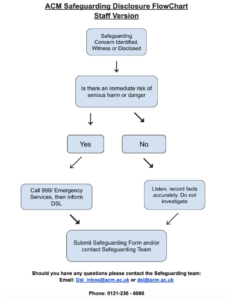
2.9 Should you wish to contact someone other than staff associated with ACM then you should contact your campus Local Authority Designated Officers (LADO):
- ACM Guildford – 0300 470 9100
- ACM Clapham – 0121 675 1669
- ACM Birmingham – 0208 871 7440
Whistleblowing
2.10 Staff are provided a platform to disclose anonymously any low level concerns they may have regarding ACM.
This could include, but is not limited to:
- Concerns regarding staff behaviour
- Staff member health or wellbeing concerns
- Concerns for ACM organisational risk
- Concerns for ACM reputational risk
2.11 All responses are reviewed by three stakeholders across the organisation and followed up accordingly.
2.12 The named stakeholders who will review the low level Staff Concerns response are:
- Head of Governance and Quality Assurance or nominee
- Designated Safeguarding Lead
- Group Lead on Student Experience
2.13 Should the concern relate to any of the above stakeholders, concerns can be sent directly to HR by emailing hrrequests@acm.ac.uk
Safeguarding Information
2.14 Information relating to Safeguarding can be found at the following locations:
- On the ACM website
○ Including:
■ Safeguarding team information
■ Disclosure platform
- Campus posters
○ Health & safety information
○ Student & visitor disclosure information (Student areas)
■ QR code link
○ Staff disclosure information (Staff areas)
■ QR code link
○ Do’s & Don’ts of safeguarding (Staff areas)
- Ask for Angela poster
○ Code for immediate support
Contacting the Safeguarding Team
2.15 This can be done in a number of ways:
- ACM Website
○ A disclosure link and information pages can be found at the base of each page
○ Calling 01483 927509
○ Emailing dsl_inbox@acm.ac.uk
○ or using the QR code link found on the campus and staff area posters
Staff Awareness of the ACM Safeguarding Culture
2.16 To fulfil our requirements as an educational establishment as stated in ‘Part 1 of Keeping Children Safe In Education’, all staff have been invited into a shared drive titled ‘ACM Staff Safeguarding Folder’.
This folder contains the following information:
- ACM Safeguarding Policy
- Disclosure Procedure
- Government Legislation Information
- Best Practises
- Staff CPD Resources
- Useful Links and Information
2.17 Further information regarding the ACM Safeguarding Policy can be found on the ACM Website, within the Staff Safeguarding Shared Drive or by asking a member of the safeguarding team.
Safeguarding ACM Staff
2.18 In order to safeguard both staff and students against potential misunderstandings or miscommunication, all staff must be aware of ACM policies and procedures relating to all aspects of their role and adhere to these at all times. It is staff’s responsibility to ensure that they seek additional support and guidance where necessary to undertake their roles and responsibilities.
2.19 When working, it is important for staff to be aware of their environment and the space in which they are occupying. It is advisable that staff maintain safer working practises such as the following:
- Ensuring that all exits are clear at all times
- Ensuring that staff are aware of how and where to access additional staff support
- Ensuring that staff undertake dynamic risk assessments and adjust their working as necessary. For example if there is a concern where a student has displayed violent or aggressive behaviour historically, it may be appropriate, that staff do not undertake 1-1 working with the student in isolated areas, without support.
- It is advised that staff do not engage with physical contact with students (for example, hugging). This is to protect and safeguard staff in establishing and maintaining positive, professional and appropriate relationships with students. Whilst this is advised, it is noted that in some exceptional circumstances, physical contact may meet the needs of the student and may be appropriate at the time (for example, if a student is distressed). The Designated Safeguarding Lead and Safeguarding Team are available for support within this area.
Student interactions
2.20 It is recognised that due to the high levels of support that we offer to our students some students might form close relations with certain staff members. It is imperative that staff establish and maintain professional, positive and appropriate relations with students at all times. Where there are concerns that a student has developed an inappropriate relationship with a member of staff (such as an over-reliance, dependency or an over-familiarity) they must ensure that they refer this to the Designated Safeguarding Lead or Safeguarding Team immediately.
2.21 The Designated Safeguarding Lead or member of the Safeguarding Team will provide advice, support and guidance on how to manage the concern and how to establish professional boundaries whilst continuing to maintain the necessary support for the student.
2.22 Social / personal contact with students outside of ACM – It is advised that staff never give out personal details or request them, e.g. telephone numbers or email addresses.
2.23 Do not contact or respond to students via social networks. Report any attempts of contact by students to the Designated Safeguarding Lead immediately.
2.24 Staff should safeguard themselves on social media or networks by assuming that all information they post is public and act accordingly in relation to their job and associated status.
2.25 As a minimum, in order to protect themselves, staff should ensure that they are in control of who can see their account details and content and that this information is private.
2.26 Staff should be mindful that if they comment on a friend’s page / post – their profile settings may be different to their own and may make their comment public.
2.27 Staff should not take photographs (via any method including phone cameras) of students, students’ performances, events or any part of ACM premises on your personal devices. ACM equipment should be used at all times for ACM business.
2.28 The above should be seen as best practice unless otherwise directed and approved by ACM Executives and the Designated Safeguarding Lead.
Safeguarding Training
2.29 ACM staff are required to attend safeguarding training at the start of each term. Content for this training includes safeguarding essentials as well as topic specific information that is current nationally or internally.
2.30 ACM staff also have topic specific videos produced by the ACM safeguarding team that are required to be played at the start of any training session booked regardless of the main focus. This is to maximise awareness of embedding a culture of safeguarding in everything ACM staff do.
2.31 The safeguarding team attends regular CPD sessions where the content is focused on topics featured within the most recent Keeping Children Safe in Education legislation.
2.32 Students are required to complete the Safeguarding canvas module at the start of the academic year.
2.33 Students of further education also are required to attend the Pastoral Development Programme lessons that are based weekly within their timetables. Each topic features awareness of safeguarding furthermore building a culture that is based on awareness and understanding of its importance.
2.34 Students of higher education also have specific topics of this programme embedded within their programmes.
Safeguarding Data and Reports
2.35 The Designated Safeguarding Lead produces monthly and annual reports relating to Safeguarding data:
- Students at risk
- Annual / Monthly Data and actions submitted to the ACM Executive Committee
- Partner report (e.g. East Surrey College)
- Local authority data and information
- PREVENT compliance and accountability
- NSPCC data and information
2.36 The data produced from these reports help to map out necessary staff training requirements, interventions and awareness programmes that can be presented through social media campaigns, staff and student training, pastoral development education programmes or monthly safeguarding blogs.
2.37 The data also helps to map out a calendar trend that benefits the proactive approach and awareness via calendered interventions.
Confidentiality
2.38It is imperative that all information relating to safeguarding and child protection concerns should be treated as confidential and should not be shared with staff outside of the Safeguarding Team.
2.39 Safeguarding concerns must be managed with the highest levels of professionalism and sensitivity. Therefore where information needs to be shared, it will be done so on a need to know basis, in accordance with relevant guidance and legislation by the Safeguarding Team.
2.40 If you have any questions regarding Safeguarding at ACM or require any further support or guidance, please do not hesitate to contact a member of the safeguarding team.
External Services and Local Authority Intervention
2.41 The safeguarding team are fully qualified and experienced to manage communication with external agencies / services and assist local authorities with their support of vulnerable students.
2.42 ACM has developed relationships with local authorities, charities and organisations local to each campus to enable further support options to all our students.
2.43 The procedure applies to all members of the ACM community, including students, staff, applicants, associate members, visitors and contractors.
ACM Lanyards and Photo Identification
2.44 When on campus all staff and students are required to wear their ACM lanyards visibly at all times
2.45This is for safeguarding and security purposes so that everyone who accesses our campuses can be easily identified.
2.46 If you lose or misplace your lanyard, everyone is required to report this to reception immediately.
Social Media Communication
2.47 Staff are advised that they are not to communicate or add students as friends to their personal social media platforms. Where platforms do not require permission for a student to follow a member of staff, it is included in regular communication and training to staff that they are not to communicate with students on any platforms.
Staff Communication to Students
2.48 Staff are only to communicate with students via ACM internal platforms, they are not to communicate using their own personal devices or platforms.
Best Practice for handling a disclosure
2.49 Educate Yourself
- Identify who the Designated Safeguarding Lead is
- Understand who the wider safeguarding team is
2.50 Respond Immediately
- Report any issues using the ACM Safeguarding Disclosure Link Report ● Act Immediately by making a Safeguarding Disclosure
- You can contact the team by emailing – dsl_inbox@acm.ac.uk
2.51 Be Safe
- Keep the students/staff safe at all time, create a safe working culture/environment
- Safeguard yourself and others
- Implement professional boundaries and following good/positive working practice
- Password-protect your laptop / PC / Mac / mobile phone
2.52 Always Listen
- It’s very important you listen carefully to what any individual has to say without interrupting. Listening is key as you can capture important information
2.53 Be Impartial
- Remain calm, approachable and receptive. Take all concerns seriously and follow the appropriate procedure
2.54 Be Aware
- Make yourself aware of the indicators of the following 4 categories of abuse: Physical / Emotional / Sexual / Neglect (see following sections).
- Make yourself aware of the indicators of (FGM) Female Genital Mutilation, (CSE) Child Sexual Exploitation, drug abuse and of the PREVENT duty (see following sections)
- Understand the ACM Social Networking Policy (including the use of mobile phones)
2.55 Remember It Could Happen To Anyone
- ALL individuals, no matter what background can suffer from any type of abuse and that an abuser is often known to them
2.66 Do NOT Investigate concerns yourself
- Do not try and resolve any safeguarding concern yourself this is the role of the Safeguarding Team
2.67 Do NOT Ignore or Dismiss Individuals
- Always make the time to listen, never tell any individual to come back later if they want to make a disclosure
2.68 Do NOT Follow Poor Practice
- React in a professional way, do not look shocked or in a distasteful manner when an individual discloses information to you
- Do not speculate or make negative comments
- Keep concerns about others to yourself, only inform the appropriate team (safeguarding team)
- Do not delay in reporting the disclosure to the Safeguarding team.
- Do not examine an Individual yourself or take any photographs of injuries that are reported to you
- Do not ask leading or probing questions
2.69 Never Make Promises
- You cannot make promises to any individual, the likelihood is that you won’t be able to honour it.
- YOU have a duty of care to report any safeguarding concerns to the safeguarding team if anyone is at risk of harm or if you have concerns regarding their welfare.
2.70 Never Assume
- Everyone that works with children, young people or vulnerable
individuals is safe and will do them no harm.
- If you are in any doubt report straight to the DSL or wider safeguarding team
2.71 Concerns relating to Extremism and Radicalisation

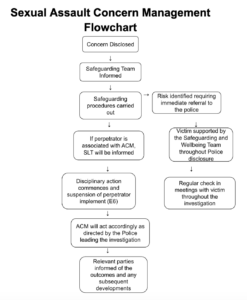
2.72 Concerns relating to Sexual Assault / Sexual Misconduct
Bullying and Harassment
2.73 ACM is committed to maintaining a working and learning environment free from any form of bullying or harassment. ACM operates a zero-tolerance policy towards bullying, harassment, and threatening or antagonistic behaviour from staff and students. Matters relating to bullying and harassment will be subject to this policy, in order for a resolution and outcome to be reached.
2.74 Bullying is the abuse of power or position to, for example, threaten, abuse, intimidate, insult, ridicule or criticise; to humiliate and undermine a person so that their confidence and self-esteem is destroyed. This can range from violence, shouting and sarcasm to more subtle forms such as setting a person up for failure with impossible workloads and deadlines.
2.75 It may be difficult to identify whether name calling is banter or bullying. A student may feel intimidated or under pressure not to raise a complaint or discuss the incident with a member of staff because others are saying it is just a joke. If it is a one-off incident then it may be that it is banter with no harm intended.
2.76 Harassment may be intentional bullying which is obvious or violent, but it can also be unintentional or subtle and insidious. Harassment can create a hostile environment and violate a person’s dignity.
2.77 The terms bullying and harassment are often used interchangeably, and many definitions include bullying as a form of harassment. Harassment may have a strong physical component and may be linked to gender, race, disability or physical violence; bullying tends to be a number of incidents (individually trivial) over a period of time comprising constant unjustified and unsubstantiated criticism.
2.78 A hate crime is any offence committed against a person or property which is motivated by the offender’s hatred of people because they are seen as being different. People do not have to be a member of a minority community to be a target of hate crime. Any incident where an individual or group of people are targeted because they are believed to be of a different race, religion/belief, sexual orientation, gender identity or have a disability can be reported as a hate crime.
2.79 Bullying and harassment can come in different forms and may not necessarily occur face to face; they may be written communications (such as notes, emails, SMS texts or posts on social networking sites); other visual communications (such as photos, pictures or videos); or verbal communication (including via the telephone).
- RELATED POLICIES
- Safeguarding Policy
- Staff Code of Conduct
- Student Charter
- Data Protection Policy
- PREVENT Policy
- External Speaker and Events Policy
- Acceptable Use of IT and E-Safety Policy
- Student Conduct and Discipline Policy
- Student Complaints and Grievances Policy
- Equality & Diversity Policy
- Staff Recruitment Policy
- Health & Safety Policy
- Whistleblowing Policy
- Criminal Convictions Policy
- PROCEDURE OWNER
4.1 The responsibility for this Procedure falls under the remit of the Designated Safeguarding Lead, overseen by the Student Experience and Quality Committee.
4.2 The responsible committee will ensure the cyclical review of this Procedure is carried out under ACM’s Quality Assurance Framework.
- DEFINITIONS
Safeguarding: Safeguarding is the action that is taken to promote the welfare of all people and protect them from harm.
DSL: Designated Safeguarding Lead is the member of staff that coordinates all safeguarding concerns and oversees all referrals.
DDSL: Deputy Designated Safeguarding Lead is the member of staff who supports the DSL in maintaining the function of safeguarding throughout all campuses.
LADO: Local Authority Designated Officer
Abuse: A form of maltreatment of a person. Somebody may abuse or neglect another person by inflicting harm or by failing to act to prevent harm. Someone may be abused in a family or in an institutional or community setting by those known to them or, more rarely, by others. Abuse can take place wholly online, or technology may be used to facilitate offline abuse. People may be abused by an adult or adults or by young people.
Physical Abuse: A form of abuse which may involve hitting, shaking, throwing, poisoning, burning or scalding, drowning, suffocating or otherwise causing physical harm to anyone. Physical harm may also be caused when a responsible adult fabricates the symptoms of, or deliberately induces, illness in someone.
Emotional Abuse: The persistent emotional maltreatment of a person such as to cause severe and adverse effects on that person’s emotional development. It may involve conveying to a person that they are worthless or unloved, inadequate, or valued only insofar as they meet the needs of another person. It may include not giving the person opportunities to express their views, deliberately silencing them or ‘making fun’ of what they say or how they communicate. It may feature age or developmentally inappropriate expectations being imposed on people. These may include interactions that are beyond a person’s developmental capability as well as overprotection and limitation of exploration and learning or preventing the person from participating in normal social interaction. It may involve seeing or hearing the ill-treatment of another. It may involve serious bullying (including cyberbullying), causing people frequently to feel frightened or in danger, or the exploitation or corruption of people. Some level of emotional abuse is involved in all types of maltreatment of a child, although it may occur alone.
Sexual Abuse: Involves forcing or enticing someone to take part in sexual activities, not necessarily involving violence, whether or not the person is aware of what is happening. The activities may involve physical contact, including assault by penetration (for example rape or oral sex) or non-penetrative acts such as masturbation, kissing, rubbing, and touching outside of clothing. They may also include non-contact activities, such as involving someone in looking at, or in the production of, sexual images, watching sexual activities, encouraging people to behave in sexually inappropriate ways, or grooming someone in preparation for abuse. Sexual abuse can take place online, and technology can be used to facilitate offline abuse. Sexual abuse is not solely perpetrated by adult males. Women can also commit acts of sexual abuse, as can people under the age of 18. The sexual abuse of children by other children is a specific safeguarding issue (also known as peer on peer abuse) in education and all staff should be aware of it and ACM’s policy and procedure for dealing with it.
Neglect: The persistent failure to meet someone’s basic physical and/or psychological needs, likely to result in the serious impairment of the person’s health or development. Neglect may occur during pregnancy, for example, as a result of maternal substance abuse. Once a child is born, neglect may involve a parent or carer failing to: provide adequate food, clothing and shelter (including exclusion from home or abandonment); protect a child from physical and emotional harm or danger; ensure adequate supervision (including the use of inadequate care-givers); or ensure access to appropriate medical care or treatment. It may also include neglect of, or unresponsiveness to, a child’s basic emotional needs.
Child Sexual Exploitation (CSE) and Child Criminal Exploitation (CCE) Both CSE and CCE are forms of abuse and both occur where an individual or group takes advantage of an imbalance in power to coerce, manipulate or deceive a child into sexual or criminal activity in exchange for something the victim needs or wants, and/or for the financial advantage or increased status of the perpetrator or facilitator and/or through violence or the threat of violence. CSE and CCE can affect children, both male and female and can include children who have been moved (commonly referred to as trafficking) for the purpose of exploitation.
Serious Violence: Indicators may signal someone is at risk from or is involved with serious violent crime. These may include increased absence from education, a change in friendships or relationships with older individuals or groups, a significant decline in performance, signs of self-harm or a significant change in wellbeing, or signs of assault or unexplained injuries. Unexplained gifts or new possessions could also indicate that someone has been approached by, or are involved with, individuals associated with criminal networks or gangs and may be at risk of criminal exploitation.
Mental Health: Mental health problems can, in some cases, be an indicator that a person has suffered or is at risk of suffering abuse, neglect or exploitation. Only appropriately trained professionals should attempt to make a diagnosis of a mental health problem. ACM staff, however, are well placed to observe students day-to-day and identify those whose behaviour suggests that they may be experiencing a mental health problem or be at risk of developing one.
Female Genital Mutilation (FGM): FGM is a procedure where the female genitals are deliberately cut, injured or changed, even though there is no medical reason for this to be done. It is also referred to as female circumcision. If a member of staff, in the course of their work, discovers that an act of FGM appears to have been carried out, they must report this to the DSL or DDSL and it must be reported to the police.
Peer on Peer Abuse: Children can abuse other children and it can happen inside or outside the institution and online. Even if there are no reports from within the institution, it does not mean it is not happening; it may be the case that it is just not being reported. It is therefore important if staff have any concerns, they should contact the Designated Safeguarding Lead or Deputy. Inappropriate behaviours between peers that are abusive in nature should be challenged. Downplaying certain behaviours, for example dismissing sexual harassment as “just banter”, “just having a laugh” can lead to a culture of unacceptable behaviours, an unsafe environment for people and in worst case scenarios a culture that normalises abuse leading to people accepting it as normal and not coming forward to report it. Peer on peer abuse is seen as a specific safeguarding concern. ACM therefore additionally covers peer on peer abuse in a separate policy and procedures document.
- EXHIBITS/APPENDICES/FORMS
This procedure has been written in accordance with, and with reference to, the following statutory guidance and legislation:
- Keeping Children Safe in Education (DfE, 2021)
- Working Together to Safeguard Children (HM Government, 2018)
- What to do if you’re worried a child is being abused (DfE, 2015)
- The Prevent Duty (DfE, 2015, updated 2019)
- Child sexual exploitation; definition and guide for practitioners (DfE, 2017)
- Sexual violence and harassment between children in schools and colleges (DfE, 2018)
- The Children Act 2004 (with later amendments),
- Safeguarding Vulnerable Groups Act 2006,
- The Sexual Offences Act 2003,
- Guidance for English Higher Education Institutions (HEIs) (DIUS, 2007);
- Protection of Freedoms Act 2012;
- Children and Families Act 2014;
- Care Act 2014;
- Information sharing: advice for practitioners providing safeguarding services to children, young people, parents and carers (HM Government, July 2018)
- SUPPORTING INFORMATION
There are no further supporting documents to this procedure.
- DOCUMENT HISTORY AND NEXT REVIEW
| Version 1.0 | 1.0 |
| Approved on | 01 September 2025 |
| Approved by | Academic Board |
| Next review | August 2027 |
Download: PRO_010_Safeguarding Procedure
Previous
Procedure 011: Fitness to Study
Up next
Policy 044: Conflict of Interest

ACM Part-Time School
Know a young musician who's ready to take things further? ACM's Part-Time School runs weekly evening courses during term time at the…
Read More