









Procedure 010: Safeguarding

If you have a disability which makes reading this document or navigating our website difficult and you would like to receive information in an alternative format, please contact: anddegree@acm.ac.uk 

Procedure 010: SAFEGUARDING


1. PURPOSE 

1.1 ACM recognises its responsibilities for safeguarding students, staff and the wider community in institution-led activities fully, effectively and in accordance with statutory guidance and legislation. 

1.2 Safeguarding and promoting the welfare of children, young people and adults at risk is everyone’s responsibility and everyone has a role to play in child protection and safeguarding. 

1.3 All staff will ensure that their actions are student-centred. Where there is a safeguarding concern, our response will ensure the student’s wishes and feelings are taken into account when determining what action to take and what services to provide. This means that we will consider at all times what is in the best interests of the student.

2. PROCEDURE DETAILS 

2.1 If you become aware of the actual or alleged harm to or abuse of a child or adult at risk or you receive information alleging risk to a child or adult at risk posed by an adult, or by the actions or lack of actions of an organisation providing services or activities for children, you must act without delay. This also includes where you may be concerned about a child or adult at risk’s behaviour, but there is no evidence of or allegation of abuse. 

2.2 Abuse can take different forms and includes physical abuse, sexual abuse, emotional abuse as well as neglect and bullying as set out in section 6. DEFINITIONS of the Safeguarding Policy. 

2.3 The signs of abuse are not always obvious and those experiencing abuse may not feel able to tell anyone what is happening to them. Within a university setting the following may be indicators of a safeguarding issue: 

  • the student is frequently absent from teaching sessions or fails to submit/sit for assessments 
  • the student is very often late for teaching sessions and/or unprepared 
  • the student is studying an online programme and is very reluctant to turn on their camera in teaching sessions or one to one sessions 
  • the student’s academic performance declines over time 
  • the student does too much work or appears overly conscientious – this may be because they are anxious or that study is a distraction from something else in their life that is causing them distress 
  • the student’s behaviour is erratic or disruptive or they are very irritable and easily agitated 
  • the student appears persistently sad, very tense or is very emotional or lacks emotion 
  • the student is withdrawn, does not have friends or appears to have difficulty interacting with classmates 
  • the student expresses feelings of low self esteem 
  • the student avoids eye contact and is hesitant to engage in conversations 
  • the student lacks concentration, is often tired and/or struggles to think logically or make decisions 
  • the student’s appearance or behaviour changes 
  • the student’s appearance is unkempt and/or they have poor personal hygiene 
  • there are visible bruises, cuts, burns 
  • the student uses explicit sexual language out of context 
  • the student’s views have become increasingly extreme regarding another section of society or government policy 
  • the student is observed downloading, viewing or sharing extremist propaganda or sexually explicit content from the web 
  • the student is increasingly intolerant of others’ views and beliefs 
  • the student demonstrates high levels of anxiety, indecision, irritability, hopelessness, despair and distress which cannot be resolved by discussion or explanation 
  • the student is avoiding contact and help from others 
  • the student is exhibiting an overwhelming sense of not being able to cope 
  • the student is preoccupied with odd beliefs and thoughts (be mindful of cultural differences) 
  • the student is misusing drugs and/or alcohol, or taking part in other high risk behaviours 

2.4 All suspicions and allegations of abuse or inappropriate behaviour will be taken seriously by ACM and responded to appropriately. 

Responding to reports of abuse 

2.5 If a child or adult at risk says something or acts in a way that abuse is suspected, the person receiving the information is required to: 

  • React in a calm and considered way but show concern; 
  • Tell them that it is right for them to share this information and that they are not responsible for what has happened; 
  • Take what they have said seriously; 
  • Only ask questions to ascertain whether there is a concern, but not interrogate them. Do not ask leading questions; 
  • Listen to them and don’t interrupt if the child or adult at risk is recounting significant events; 
  • Offer reassurance that the problem can be dealt with; 
  • Do not give assurances of confidentiality but explain that the information will need to be passed on to those that need to know; 
  • If it is an adult at risk, consider their mental capacity to give consent – if it is considered that they have capacity, try to gain their consent for information to be passed on. 
  • Make a comprehensive record of what is said and done immediately and keep all original notes. 

Recording reports of abuse 

2.6 The record should include: 

  • a verbatim record of the child or adult at risk’s account of what occurred in their own words (this could be used in court so needs to be as accurate as possible); 
  • details of the nature of the allegation or concern; 
  • a description of any injury. Please note, you must not remove a child or adult at risk’s clothing to inspect any injuries; 
  • dates, times or places and any other information. 

2.7 The incident should then be reported immediately to your Designated Safeguarding Lead (DSL) or Deputy DSL for action to be taken. 

2.8 Remember – it is not your role to investigate disclosures, allegations or information about harm or abuse of children or adults at risk, or risk to them. This is the role of Social Services (and/or the police). It is your role under these procedures to pass on the information to those who are qualified and authorised to do so. In normal circumstances, this will be via your Designated Safeguarding Lead (DSL) or Deputy DSL If you have any of these concerns you must comply with the following process: 
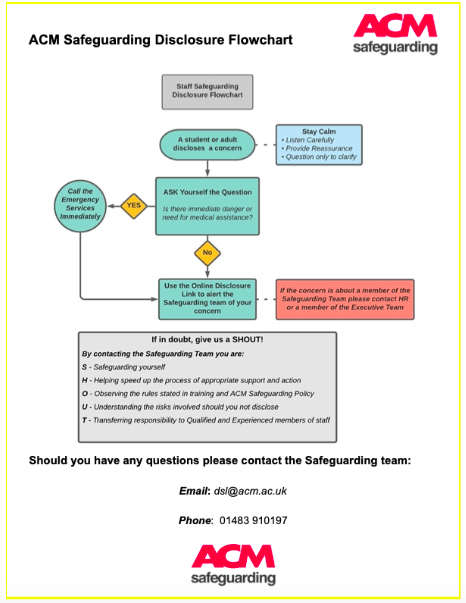
                              

2.9 Should you wish to contact someone other than staff associated with ACM then you should contact your campus Local Authority Designated Officers (LADO): 

  • ACM Guildford – 0300 470 9100 
  • ACM Clapham – 0121 675 1669 
  • ACM Birmingham – 0208 871 7440 

Whistleblowing 

2.10 Staff are provided a platform to disclose anonymously any low level concerns they may have regarding ACM. 

This could include, but is not limited to: 

  • Concerns regarding staff behaviour 
  • Staff member health or wellbeing concerns 
  • Concerns for ACM organisational risk 
  • Concerns for ACM reputational risk 

2.11 All responses are reviewed by three stakeholders across the organisation and followed up accordingly. 

2.12 The named stakeholders who will review the low level Staff Concerns response are: 

  • Head of Governance and Quality Assurance or nominee
  • Designated Safeguarding Lead 
  • Group Lead on Student Experience 

2.13 Should the concern relate to any of the above stakeholders, concerns can be sent directly to HR by emailing hrrequests@acm.ac.uk 

Safeguarding Information 

2.14 Information relating to Safeguarding can be found at the following locations: 

  • On the ACM website 

○ Including: 

■ Safeguarding team information 

■ Disclosure platform 

  • Campus posters 

○ Health & safety information 

○ Student & visitor disclosure information (Student areas) 

■ QR code link 

○ Staff disclosure information (Staff areas) 

■ QR code link 

○ Do’s & Don’ts of safeguarding (Staff areas) 

  • Ask for Angela poster 

○ Code for immediate support 

Contacting the Safeguarding Team 

2.15 This can be done in a number of ways: 

  • ACM Website 

○ A disclosure link and information pages can be found at the base of each page 

○ Calling 01483 910197 

○ Emailing dsl@acm.ac.uk 

○ or using the QR code link found on the campus and staff area posters 

Staff Awareness of the ACM Safeguarding Culture 

2.16 To fulfil our requirements as an educational establishment as stated in ‘Part 1 of Keeping Children Safe In Education’, all staff have been invited into a shared drive titled ‘ACM Staff Safeguarding Folder’. 

This folder contains the following information: 

  • ACM Safeguarding Policy 
  • Disclosure Procedure 
  • Government Legislation Information 
  • Best Practises 
  • Staff CPD Resources 
  • Useful Links and Information 

2.17 Further information regarding the ACM Safeguarding Policy can be found on the ACM Website, within the Staff Safeguarding Shared Drive or by asking a member of the safeguarding team. 

Safeguarding ACM Staff 

2.18 In order to safeguard both staff and students against potential misunderstandings or miscommunication, all staff must be aware of ACM policies and procedures relating to all aspects of their role and adhere to these at all times. It is staff’s responsibility to ensure that they seek additional support and guidance where necessary to undertake their roles and responsibilities. 

2.19 When working, it is important for staff to be aware of their environment and the space in which they are occupying. It is advisable that staff maintain safer working practises such as the following: 

  • Ensuring that all exits are clear at all times 
  • Ensuring that staff are aware of how and where to access additional staff support 
  • Ensuring that staff undertake dynamic risk assessments and adjust their working as necessary. For example if there is a concern where a student has displayed violent or aggressive behaviour historically, it may be appropriate, that staff do not undertake 1-1 working with the student in isolated areas, without support.
  • It is advised that staff do not engage with physical contact with students (for example, hugging). This is to protect and safeguard staff in establishing and maintaining positive, professional and appropriate relationships with students. Whilst this is advised, it is noted that in some exceptional circumstances, physical contact may meet the needs of the student and may be appropriate at the time (for example, if a student is distressed). The Designated Safeguarding Lead and Safeguarding Team are available for support within this area. 

Student interactions 

2.20 It is recognised that due to the high levels of support that we offer to our students some students might form close relations with certain staff members. It is imperative that staff establish and maintain professional, positive and appropriate relations with students at all times. Where there are concerns that a student has developed an inappropriate relationship with a member of staff (such as an over-reliance, dependency or an over-familiarity) they must ensure that they refer this to the Designated Safeguarding Lead or Safeguarding Team immediately. 

2.21 The Designated Safeguarding Lead or member of the Safeguarding Team will provide advice, support and guidance on how to manage the concern and how to establish professional boundaries whilst continuing to maintain the necessary support for the student. 

2.22 Social / personal contact with students outside of ACM – It is advised that staff never give out personal details or request them, e.g. telephone numbers or email addresses. 

2.23 Do not contact or respond to students via social networks. Report any attempts of contact by students to the Designated Safeguarding Lead immediately.

2.24 Staff should safeguard themselves on social media or networks by assuming that all information they post is public and act accordingly in relation to their job and associated status. 

2.25 As a minimum, in order to protect themselves, staff should ensure that they are in control of who can see their account details and content and that this information is private. 

2.26 Staff should be mindful that if they comment on a friend’s page / post – their profile settings may be different to their own and may make their comment public. 

2.27 Staff should not take photographs (via any method including phone cameras) of students, students’ performances, events or any part of ACM premises on your personal devices. ACM equipment should be used at all times for ACM business. 

2.28 The above should be seen as best practice unless otherwise directed and approved by ACM Executives and the Designated Safeguarding Lead. 

Safeguarding Training 

2.29 ACM staff are required to attend safeguarding training at the start of each term. Content for this training includes safeguarding essentials as well as topic specific information that is current nationally or internally. 

2.30 ACM staff also have topic specific videos produced by the ACM safeguarding team that are required to be played at the start of any training session booked regardless of the main focus. This is to maximise awareness of embedding a culture of safeguarding in everything ACM staff do. 

2.31 The safeguarding team attends weekly CPD sessions where the content is focused on topics featured within the most recent Keeping Children Safe in Education legislation. 

2.32 Students are required to complete the Safeguarding canvas module at the start of the academic year. 

2.33 Students of further education also are required to attend the Pastoral Development Programme lessons that are based weekly within their timetables. Each topic features awareness of safeguarding furthermore building a culture that is based on awareness and understanding of its importance. 

2.34 Students of higher education also have specific topics of this programme embedded within their programmes. 

Safeguarding Data and Reports 

2.35 The Designated Safeguarding Lead produces monthly and annual reports relating to Safeguarding data: 

  • Students at risk 
  • Annual / Monthly Data and actions submitted to the ACM Executive Committee 
  • Partner report (e.g. East Surrey College) 
  • Local authority data and information 
  • PREVENT compliance and accountability 
  • NSPCC data and information 

2.36 The data produced from these reports help to map out necessary staff training requirements, interventions and awareness programmes that can be presented through social media campaigns, staff and student training, pastoral development education programmes or monthly safeguarding blogs. 

2.37 The data also helps to map out a calendar trend that benefits the proactive approach and awareness via calendered interventions. 

Confidentiality 

2.38It is imperative that all information relating to safeguarding and child protection concerns should be treated as confidential and should not be shared with staff outside of the Safeguarding Team. 

2.39 Safeguarding concerns must be managed with the highest levels of professionalism and sensitivity. Therefore where information needs to be shared, it will be done so on a need to know basis, in accordance with relevant guidance and legislation by the Safeguarding Team. 

2.40 If you have any questions regarding Safeguarding at ACM or require any further support or guidance, please do not hesitate to contact a member of the safeguarding team. 

External Services and Local Authority Intervention 

2.41 The safeguarding team are fully qualified and experienced to manage communication with external agencies / services and assist local authorities with their support of vulnerable students. 

2.42 ACM has developed relationships with local authorities, charities and organisations local to each campus to enable further support options to all our students. 

2.43 The procedure applies to all members of the ACM community, including students, staff, applicants, associate members, visitors and contractors. 

ACM Lanyards and Photo Identification 

2.44 When on campus all staff and students are required to wear their ACM lanyards visibly at all times 

2.45This is for safeguarding and security purposes so that everyone who accesses our campuses can be easily identified. 

2.46 If you lose or misplace your lanyard, everyone is required to report this to reception immediately. 

Social Media Communication 

2.47 Staff are advised that they are not to communicate or add students as friends to their personal social media platforms. Where platforms do not require permission for a student to follow a member of staff, it is included in regular communication and training to staff that they are not to communicate with students on any platforms. 

Staff Communication to Students 

2.48 Staff are only to communicate with students via ACM internal platforms, they are not to communicate using their own personal devices or platforms. 

Best Practice for handling a disclosure 

2.49 Educate Yourself 

  • Identify who the Designated Safeguarding Lead is 
  • Understand who the wider safeguarding team is 

2.50 Respond Immediately 

  • Report any issues using the ACM Safeguarding Disclosure Link Report ● Act Immediately by making a Safeguarding Disclosure 
  • You can contact the team by emailing – dsl@acm.ac.uk 

2.51 Be Safe 

  • Keep the students/staff safe at all time, create a safe working culture/environment 
  • Safeguard yourself and others 
  • Implement professional boundaries and following good/positive working practice 
  • Password-protect your laptop / PC / Mac / mobile phone 

2.52 Always Listen 

  • It’s very important you listen carefully to what any individual has to say without interrupting. Listening is key as you can capture important information 

2.53 Be Impartial 

  • Remain calm, approachable and receptive. Take all concerns seriously and follow the appropriate procedure 

2.54 Be Aware 

  • Make yourself aware of the indicators of the following 4 categories of abuse: Physical / Emotional / Sexual / Neglect (see following sections). 
  • Make yourself aware of the indicators of (FGM) Female Genital Mutilation, (CSE) Child Sexual Exploitation, drug abuse and of the PREVENT duty (see following sections) 
  • Understand the ACM Social Networking Policy (including the use of mobile phones) 

2.55 Remember It Could Happen To Anyone 

  • ALL individuals, no matter what background can suffer from any type of abuse and that an abuser is often known to them 

2.66 Do NOT Investigate concerns yourself 

  • Do not try and resolve any safeguarding concern yourself this is the role of the Safeguarding Team 

2.67 Do NOT Ignore or Dismiss Individuals 

  • Always make the time to listen, never tell any individual to come back later if they want to make a disclosure 

2.68 Do NOT Follow Poor Practice 

  • React in a professional way, do not look shocked or in a distasteful manner when an individual discloses information to you 
  • Do not speculate or make negative comments 
  • Keep concerns about others to yourself, only inform the appropriate team (safeguarding team) 
  • Do not delay in reporting the disclosure to the Safeguarding team. ● Do not examine an Individual yourself or take any photographs of injuries that are reported to you 
  • Do not ask leading or probing questions 

2.69 Never Make Promises 

  • You cannot make promises to any individual, the likelihood is that you won’t be able to honour it. 
  • YOU have a duty of care to report any safeguarding concerns to the safeguarding team if anyone is at risk of harm or if you have concerns regarding their welfare. 

2.70 Never Assume 

  • Everyone that works with children, young people or vulnerable 

individuals is safe and will do them no harm. 

  • If you are in any doubt report straight to the DSL or wider safeguarding team 

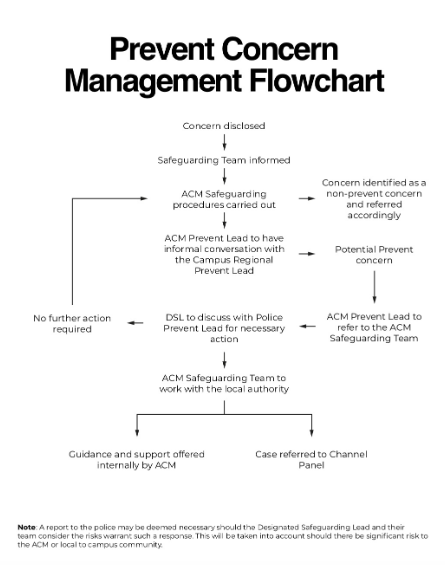
2.71 Concerns relating to Extremism and Radicalisation 
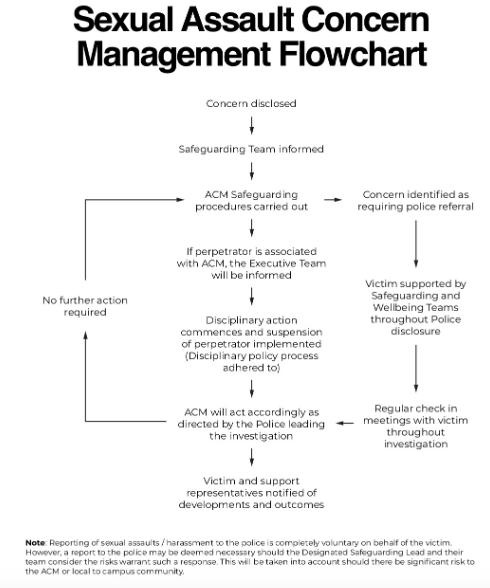
2.72 Concerns relating to Sexual Assault / Sexual Misconduct
Bullying and Harassment

2.73 ACM is committed to maintaining a working and learning environment free from any form of bullying or harassment. ACM operates a zero-tolerance policy towards bullying, harassment, and threatening or antagonistic behaviour from staff and students. Matters relating to bullying and harassment will be subject to this policy, in order for a resolution and outcome to be reached.

2.74 Bullying is the abuse of power or position to, for example, threaten, abuse, intimidate, insult, ridicule or criticise; to humiliate and undermine a person so that their confidence and self-esteem is destroyed. This can range from violence, shouting and sarcasm to more subtle forms such as setting a person up for failure with impossible workloads and deadlines.

2.75 It may be difficult to identify whether name calling is banter or bullying. A student may feel intimidated or under pressure not to raise a complaint or discuss the incident with a member of staff because others are saying it is just a joke. If it is a one-off incident then it may be that it is banter with no harm intended. 

2.76 Harassment may be intentional bullying which is obvious or violent, but it can also be unintentional or subtle and insidious. Harassment can create a hostile environment and violate a person’s dignity. 

2.77 The terms bullying and harassment are often used interchangeably, and many definitions include bullying as a form of harassment. Harassment may have a strong physical component and may be linked to gender, race, disability or physical violence; bullying tends to be a number of incidents (individually trivial) over a period of time comprising constant unjustified and unsubstantiated criticism. 

2.78 A hate crime is any offence committed against a person or property which is motivated by the offender’s hatred of people because they are seen as being different. People do not have to be a member of a minority community to be a target of hate crime. Any incident where an individual or group of people are targeted because they are believed to be of a different race, religion/belief, sexual orientation, gender identity or have a disability can be reported as a hate crime.

2.79 Bullying and harassment can come in different forms and may not necessarily occur face to face; they may be written communications (such as notes, emails, SMS texts or posts on social networking sites); other visual communications (such as photos, pictures or videos); or verbal communication (including via the telephone).

3. RELATED POLICIES 

  • Safeguarding Policy 
  • Staff Code of Conduct 
  • Student Charter 
  • Data Protection Policy 
  • PREVENT Policy 
  • External Speaker and Events Policy 
  • Acceptable Use of IT and E-Safety Policy 
  • Student Conduct and Discipline Policy 
  • Student Complaints and Grievances Policy 
  • Equality & Diversity Policy 
  • Staff Recruitment Policy 
  • Health & Safety Policy 
  • Whistleblowing Policy 
  • Criminal Convictions Policy

4. PROCEDURE OWNER 

4.1 The responsibility for this Procedure falls under the remit of the Safeguarding and Pastoral Services Manager, overseen by the Student Experience and Quality Committee. This role is supported under the Integrated Services Division. 

4.2 The responsible committee will ensure the cyclical review of this Procedure is carried out under ACM’s Quality Assurance Framework.

5. DEFINITIONS 

Safeguarding: Safeguarding is the action that is taken to promote the welfare of all people and protect them from harm. 

DSL: Designated Safeguarding Lead is the member of staff that coordinates all safeguarding concerns and oversees all referrals. 

DDSL: Deputy Designated Safeguarding Lead is the member of staff who supports the DSL in maintaining the function of safeguarding throughout all campuses. 

LADO: Local Authority Designated Officer 

ABUSE: A form of maltreatment of a person. Somebody may abuse or neglect another person by inflicting harm or by failing to act to prevent harm. Someone may be abused in a family or in an institutional or community setting by those known to them or, more rarely, by others. Abuse can take place wholly online, or technology may be used to facilitate offline abuse. People may be abused by an adult or adults or by young people. 

PHYSICAL ABUSE: A form of abuse which may involve hitting, shaking, throwing, poisoning, burning or scalding, drowning, suffocating or otherwise causing physical harm to anyone. Physical harm may also be caused when a responsible adult fabricates the symptoms of, or deliberately induces, illness in someone. 

EMOTIONAL ABUSE: The persistent emotional maltreatment of a person such as to cause severe and adverse effects on that person’s emotional development. It may involve conveying to a person that they are worthless or unloved, inadequate, or valued only insofar as they meet the needs of another person. It may include not giving the person opportunities to express their views, deliberately silencing them or ‘making fun’ of what they say or how they communicate. It may feature age or developmentally inappropriate expectations being imposed on people. These may include interactions that are beyond a person’s developmental capability as well as overprotection and limitation of exploration and learning or preventing the person from participating in normal social interaction. It may involve seeing or hearing the ill-treatment of another. It may involve serious bullying (including cyberbullying), causing people frequently to feel frightened or in danger, or the exploitation or corruption of people. Some level of emotional abuse is involved in all types of maltreatment of a child, although it may occur alone. 

SEXUAL ABUSE: Involves forcing or enticing someone to take part in sexual activities, not necessarily involving violence, whether or not the person is aware of what is happening. The activities may involve physical contact, including assault by penetration (for example rape or oral sex) or non-penetrative acts such as masturbation, kissing, rubbing, and touching outside of clothing. They may also include non-contact activities, such as involving someone in looking at, or in the production of, sexual images, watching sexual activities, encouraging people to behave in sexually inappropriate ways, or grooming someone in preparation for abuse. Sexual abuse can take place online, and technology can be used to facilitate offline abuse. Sexual abuse is not solely perpetrated by adult males. Women can also commit acts of sexual abuse, as can people under the age of 18. The sexual abuse of children by other children is a specific safeguarding issue (also known as peer on peer abuse) in education and all staff should be aware of it and ACM’s policy and procedure for dealing with it. 

NEGLECT: The persistent failure to meet someone’s basic physical and/or psychological needs, likely to result in the serious impairment of the person’s health or development. Neglect may occur during pregnancy, for example, as a result of maternal substance abuse. Once a child is born, neglect may involve a parent or carer failing to: provide adequate food, clothing and shelter (including exclusion from home or abandonment); protect a child from physical and emotional harm or danger; ensure adequate supervision (including the use of inadequate care-givers); or ensure access to appropriate medical care or treatment. It may also include neglect of, or unresponsiveness to, a child’s basic emotional needs. 

CHILD SEXUAL EXPLOITATION (CSE) and CHILD CRIMINAL EXPLOITATION (CCE) Both CSE and CCE are forms of abuse and both occur where an individual or group takes advantage of an imbalance in power to coerce, manipulate or deceive a child into sexual or criminal activity in exchange for something the victim needs or wants, and/or for the financial advantage or increased status of the perpetrator or facilitator and/or through violence or the threat of violence. CSE and CCE can affect children, both male and female and can include children who have been moved (commonly referred to as trafficking) for the purpose of exploitation. 

SERIOUS VIOLENCE: Indicators may signal someone is at risk from or is involved with serious violent crime. These may include increased absence from education, a change in friendships or relationships with older individuals or groups, a significant decline in performance, signs of self-harm or a significant change in wellbeing, or signs of assault or unexplained injuries. Unexplained gifts or new possessions could also indicate that someone has been approached by, or are involved with, individuals associated with criminal networks or gangs and may be at risk of criminal exploitation. 

MENTAL HEALTH: Mental health problems can, in some cases, be an indicator that a person has suffered or is at risk of suffering abuse, neglect or exploitation. Only appropriately trained professionals should attempt to make a diagnosis of a mental health problem. ACM staff, however, are well placed to observe students day-to-day and identify those whose behaviour suggests that they may be experiencing a mental health problem or be at risk of developing one. 

FEMALE GENITAL MUTILATION (FGM): FGM is a procedure where the female genitals are deliberately cut, injured or changed, even though there is no medical reason for this to be done. It is also referred to as female circumcision. If a member of staff, in the course of their work, discovers that an act of FGM appears to have been carried out, they must report this to the DSL or DDSL and it must be reported to the police. 

PEER ON PEER ABUSE: Children can abuse other children and it can happen inside or outside the institution and online. Even if there are no reports from within the institution, it does not mean it is not happening; it may be the case that it is just not being reported. It is therefore important if staff have any concerns, they should contact the Designated Safeguarding Lead or Deputy. Inappropriate behaviours between peers that are abusive in nature should be challenged. Downplaying certain behaviours, for example dismissing sexual harassment as “just banter”, “just having a laugh” can lead to a culture of unacceptable behaviours, an unsafe environment for people and in worst case scenarios a culture that normalises abuse leading to people accepting it as normal and not coming forward to report it. Peer on peer abuse is seen as a specific safeguarding concern. ACM therefore additionally covers peer on peer abuse in a separate policy and procedures document.

6. EXHIBITS/APPENDICES/FORMS 

This procedure has been written in accordance with, and with reference to, the following statutory guidance and legislation: 

  • Keeping Children Safe in Education (DfE, 2021) 
  • Working Together to Safeguard Children (HM Government, 2018) 
  • What to do if you’re worried a child is being abused (DfE, 2015) 
  • The Prevent Duty (DfE, 2015, updated 2019) 
  • Child sexual exploitation; definition and guide for practitioners (DfE, 2017) 
  • Sexual violence and harassment between children in schools and colleges (DfE, 2018) 
  • The Children Act 2004 (with later amendments)
  • Safeguarding Vulnerable Groups Act 2006
  • The Sexual Offences Act 2003
  • Office for Students (OfS) Condition E6
  • Guidance for English Higher Education Institutions (HEIs) (DIUS, 2007)
  • Protection of Freedoms Act 2012
  • Children and Families Act 2014 
  • Care Act 2014
  • Information sharing: advice for practitioners providing safeguarding services to children, young people, parents and carers (HM Government, July 2018)

7. SUPPORTING INFORMATION 

There are no further supporting documents to this procedure.

8. DOCUMENT HISTORY AND NEXT REVIEW 

Version: 1.0 

Approved on: 01 September 2025 

Approved by: Academic Board

Date of next review: August 2026 

Download: PRO_010_SAFEGUARDING PROCEDURE

Policy 044: Conflict of Interest

If you have a disability which makes reading this document or navigating our website difficult and you would like to receive information in an alternative format, please contact: and@acm.ac.uk

Policy 044: Conflict of Interest

1. Purpose and Scope

1.1 This Policy explains in an open, transparent and accessible way how ACM identifies,

manages and mitigates conflict of interest and/or bribery. 

1.2 This policy describes how the Academy of Contemporary Music (ACM) looks upon the issue of conflicts of interest and/or bribery.

1.3.  This policy applies to all staff and is designed to protect ACM as a business and the integrity of our qualifications. It is also designed to protect our staff by providing guidance on handling possible conflicts of interest that may arise.


2. Policy Statement

Conflict of Interest

Definition of a Conflict of Interest

2.1. A conflict of interest is a situation in which financial or other personal considerations may compromise, or have the appearance of compromising, a staff member’s professional judgment in teaching, management, administration, or other professional activities.

2.2 Conflicts of interest have the potential to bias directly or indirectly many activities or aspects of the ACM’s endeavour. This is especially so when staff members are in a position to set ACM policies, manage contracts, select equipment and supplies, involve students in sponsored projects, or when they have managerial and administrative roles for which objectivity and integrity are paramount.

2.3 The appearance of a conflict of interest may be as serious and potentially damaging as an actual conflict. Reports of conflicts based on appearances can undermine public trust in ways that may not be adequately restored even when the mitigating facts of a situation are made known. Apparent conflicts, therefore, have to be evaluated and managed in the same way as known conflicts.

2.4 A conflict of interest exists in relation to an awarding body where:  

  1. An awarding body’s interests in any activity undertaken by it, on its behalf, or by a member of its Group have the potential to lead it to act in any way contrary to its interests in complying with its Conditions of Recognition;  
  2. A person who is connected to the provision of the awarding body’s qualifications has interests in any other activity which have the potential to lead that person to act in any way contrary to his or her interests in that provision by the awarding body in compliance with its Conditions of Recognition; or 
  3. An informed and reasonable observer would conclude that either of these situations was the case.”

Activities which are ordinarily permissible

2.5 Performance of professionally-related activities such as gigs, recordings, writing for publications, service on review boards and panels.

2.6 Service as a consultant to outside organisations.

2.7 Service on boards and committees of organisations, public or private, which do not distract unduly from ACM obligations.


Activities which appear to present potential conflicts of interest or commitment

2.8 Relationships that might enable an employee to influence ACM’s dealings with an outside organisation in ways leading to personal gain or to improper advantage for anyone.

For example, an employee could have a financial interest in an enterprise with which ACM does business and be in a position to influence relevant business decisions. Ordinarily such problems may be resolved by full disclosure as well as making appropriate arrangements that clearly exclude that employee from participating in the decisions.

2.9 Situations in which the time or creative energy an employee devotes to extra-ACM activities, including those listed above, appears substantial enough to compromise the amount or quality of his/her participation in the teaching or administrative work of ACM itself.

2.10 Activities (gigs, recordings, writing, conferences, teaching, consultancy agreements etc) for which employees are personally remunerated that involve, or might be perceived to involve, ACM, its name, or facilities/ equipment without prior permission.

Activities which present such serious problems as to be incompatible with ACM policies

2.11 Situations in which the individual assumes responsibilities for an outside organisation that divert his/her attention from ACM duties, or create other conflicts of loyalties.

2.12 Situations in which an employee would be marking the assessments of friends or relatives pursuing ACM qualifications.

Potential Areas of Conflict

2.13 Conflicts of interest can arise in a variety of circumstances, for example:

  • When an individual works for or carries out work on ACM’s behalf, who has friends or relatives taking ACM assessments or examinations.
  • When an individual has a position of authority in one organisation that conflicts with his or her interests in another organisation.
  • when an individual has interests that conflict with his or her professional position.
  • when an individual works for or carries out work at ACM, but may have personal interests – paid or unpaid – in another business which either uses ACM services, or offers similar services.

2.14 Conflicts can arise from commercial interests, academic situations, ethical or religious views or personal relationships. The most common are those arising from commercial interests and close personal relationships. The existence of an actual, perceived or potential conflict of interest does not necessarily imply wrongdoing on the part of anyone. However, any private, personal, or commercial interests which give rise to such a conflict of interest must be recognised, disclosed appropriately, and either eliminated or managed.

Bribery

2.15 Under the Bribery Act 2010, a bribe is a ‘financial or other advantage’ offered, promised or given to induce a person to perform a relevant function or activity improperly, or to reward them for doing so.

2.16 Under the Bribery Act, individuals can be prosecuted for accepting bribes or offering bribes. In addition, ACM can be prosecuted for failing to prevent bribery committed to obtain or retain business or a business advantage for ACM by an employee or other individual or organisation performing services for ACM.

Individual Responsibility

2.17 Individuals within ACM have responsibility for ensuring that they are familiar with the Conflict of Interest Policy.

2.18 The most important feature of the policy is the requirement that an individual disclose any activity that might give rise to a potential Conflict of Interest. 

2.19 The individual and line manager are equally responsible for ensuring that the issue is documented.

2.20 An individual may wish to raise concerns relating to conflict of interest directly with Human Resources. This may be done in confidence and they are entitled to receive a response to their concerns. It should be noted that individuals are protected under ACM’s Whistle-blowing Policy.

2.21 If the staff member is unsure whether a conflict of interest might arise, they should discuss this with their line manager first. The line manager should contact Human Resources Department if they need advice on whether a situation presents a conflict.

Management and Supervisory Roles

2.22  Staff members who hold a line management or supervisory role have an obligation to make a disclosure in all cases where they find themselves involved in:

  • (a) the recruitment, selection, or appointment of an applicant; or
  • (b) the appraisal, promotion, discipline, or other management activity of a staff member; or
  • (c) the authorisation of any financial payments (e.g. timesheets, expenses claims, salary changes) for a staff member with whom they have a personal relationship, or who is known to them privately through their commercial interest, or whose known religious/ethical views or strong personal values may be perceived to be in conflict with their own.

Contracts and Agreements

2.23 Staff have an obligation to disclose in writing to a responsible person associated with the contract or agreement that they believe that a conflict of interest does or could exist in respect of their involvement in the contract or agreement. If a staff member who is negotiating an agreement on behalf of ACM has an interest such that it could appear to a reasonable observer that negotiations are biased, the staff member should disclose that interest.

2.24  In specific cases, there may be benefits to both staff and ACM for staff to hold other part-time employment simultaneously with their ACM employment. However, there also exists a potential for a perceived or real conflict of interest or commitment where more than one employment relationship exists at any particular time.

2.25 Staff should disclose their intention to hold other employment concurrently with their ACM employment, and they should seek formal ACM approval for such arrangements in accordance with the exclusivity clauses in the Staff Handbook.

Outside Activities or Earnings

2.26 In undertaking any outside activities or earnings, staff must abide by the terms of their contract of employment. Where a member of staff is engaged in outside activities, they must advise their line manager of any potential conflict of interest or any perception of a conflict of interest with their obligations to ACM.

Receipt of Gifts

2.27 It is not acceptable for a staff member to give or receive a gift, favour, or benefit, that may: compromise his/her judgment or have the appearance of so doing; create a conflict of interest; damage relationships with others; or indicate any favouritism or prejudice towards a person or group of people. Staff should consider the cultural context in which the gift, favour, or benefit was offered, and endeavour to avoid giving offence.

Assessing Conflicts of Interest

2.28 Line Managers must determine the permissibility of various activities, and assess the degree to which disclosed activities may pose a risk to the staff member, ACM, and other organisations which may be affected. Below is a suggested list of questions for use in evaluating potential conflicts of interest or commitment.

The list is not exhaustive and other questions related to special circumstances can be added, as appropriate.

  • Has all relevant information concerning the staff member’s activities been disclosed?
  • Do the relevant staff member’s financial interests suggest the potential for conflicts or the appearance of conflicts or bias?
  • Do the staff member’s reported external time commitments exceed permissible (or reasonable) levels?
  • Is there any indication that the staff member in his/her professional role has improperly favoured any outside body or appears to have had incentive to do so?
  • Has the staff member inappropriately represented ACM to outside bodies?
  • Does the staff member appear to be subject to incentives that might lead to conflicts or bias?
  • Is there any indication that obligations to ACM are not being met?
  • Is the staff member involved in a situation that might raise questions of bias, inappropriate use of ACM assets, or other impropriety?
  • Do the current engagements of the staff member represent potential conflicts between outside interests (e.g. working on projects simultaneously for competing business interests)?
  • Could the proposed activity withstand public scrutiny? 


3. Responsible Parties

3.1 Implementation and compliance with the Policy, and corresponding Procedure will be overseen by the following designated staff:

  • Head of Human Resources

3.2 Decisions and appropriate actions in support of the implementation of the Policy will be authorised by the following designated staff: 

  • Head of Human Resources 
  • Staff with Line Management responsibilities


4. Reference Points

4.1 Internal

  • Academic Misconduct
  • Assessment
  • Equality and Diversity
  • Staff Handbook
  • Staff Disciplinary
  • Student Complaints & Grievances 
  • Whistle-blowing

4.2 External

  • Data Protection Act  2018 
  • Bribery Act 2010


5. Date of Approval and Next Review 

Version: 1.2

Approved on: 01 Sep 2025

Approved by: Academic Board 

Next Review: August 2026

Download: 044 POL_Conflict of Interest

Gender Pay Gap Reporting for 2022 / 23

The Equality Act 2010 (Specific Duties and Public Authorities 2017 requires gender pay reporting for employers with 250 or more employees to publish statutory calculations showing how large the pay gap is between their male and female employees. For organisations with less than 250 employees this is voluntary (as was applicable to The Academy of Contemporary Music in 2022-23).

View the organisation’s 2022-23 Gender Pay Gap Report here.

Policy 069: Freedom of Speech

If you have a disability which makes reading this document or navigating our website difficult and you would like to receive information in an alternative format, please contact: anddegree@acm.ac.uk 


Policy 069: FREEDOM OF SPEECH


  1. PURPOSE 

1.1  ACM is committed to fostering an environment that upholds the principles of academic freedom and freedom of speech, as enshrined in the Higher Education (Freedom of Speech) Act 2023. 


1.2  In accordance with the Higher Education (Freedom of Speech) Act 2023, ACM’s objective through this policy is to secure freedom of speech within the law for staff, members and students of ACM, and visiting speakers. 


1.3  ‘Academic freedom’ in relation to academic staff at registered higher education providers refers to their freedom within the law to question and test received wisdom, and to put forward new ideas and controversial or unpopular opinions without placing themselves at risk of being adversely affected by the loss of their jobs or privileges at the provider, and without the likelihood of their securing promotion or different jobs at the provider being reduced.


1.4  This policy acts as a code of practice, fulfilling the requirements of section A2 of the Higher Education (Freedom of Speech) Act 2023. This policy will outline: 


  1. ACM’s values relating to freedom of speech and an explanation of how those values uphold freedom of speech (see 1.5 and 2.1);


  1. the procedures to be followed by staff and students of ACM and any students’ union for students at ACM in connection with the organisation of (i) meetings which are to be held on ACM’s premises and which fall within any class of meeting specified in the code, and (ii) other activities which are to take place on ACM’s premises and which fall within any class of activity so specified (see 2.16 to 2.22). 


        (c) the conduct required of such persons in connection with any such meeting 

             or activity (see 2.2), and 


        (d) the criteria to be used by the provider in making decisions about whether to

             allow the use of premises and on what terms (which must include its criteria       

             for determining whether there are exceptional circumstances for the  

             purposes of section A1(10)) of the Higher Education (Freedom of Speech) 

             Act 2023 (see 2.13 to 2.15). 


1.5  ACM recognises that the free exchange of ideas and diverse perspectives is essential for intellectual growth, critical thinking, and the pursuit of knowledge. This policy outlines ACM’s commitment to protecting and promoting freedom of speech while ensuring that it is exercised responsibly and respectfully within the boundaries of the law and our institutional values.


  1. POLICY DETAILS 


2.1  The guidance outlined in this policy and the obligations to uphold the principles of academic freedom and freedom of speech, as enshrined in the Higher Education (Freedom of Speech) Act 2023, apply to ACM’s students’ union or equivalent as well as to ACM. 


2.2  Guiding Principles:


  • Academic Freedom: ACM is dedicated to maintaining an atmosphere where academic staff and students can engage in open and robust discussions, research, and exploration of diverse viewpoints, theories, and ideas. Academic freedom ensures the pursuit of knowledge is uninhibited by external pressures.


  • Freedom of Speech: ACM respects and safeguards the right to freedom of speech for all members of our community. This includes the right to express opinions, beliefs, and ideas, even those that may be controversial, unpopular, or challenging.


  • Respectful Dialogue: While ACM encourages free expression, it is equally important that all discourse remains respectful and tolerant of differing viewpoints. Communication should be conducted in a manner that upholds the dignity and well-being of all individuals, fostering a constructive and inclusive environment.


  • Lawful Expression: Freedom of speech must be exercised within the boundaries of the law. Speech that incites hatred, discrimination, harassment, violence, or poses a direct threat to the safety and well-being of individuals or the university community will not be tolerated.


Hate speech


2.3  Hate Speech: ACM strictly prohibits the use of hate speech, which includes any form of communication that discriminates, threatens, or incites violence or hostility against individuals or groups based on their race, ethnicity, religion, gender, sexual orientation, disability, or other protected characteristics as defined by the law. 


2.4  Hate Crime: Hate crime is a criminal offence punishable under UK criminal law. The law recognises five types of hate crime on the basis of:


  • Race
  • Religion 
  • Disability
  • Sexual orientation 
  • Transgender identity


Hate crimes can take the form of physical assault, verbal abuse or incitement to hatred and are covered by legislation (Crime and Disorder Act 1998 and section 66 of the Sentencing Act 2020) which allows prosecutors to apply for an uplift in sentence for those convicted of a hate crime. The police and the Crown Prosecution Service (CPS) have agreed the following definition for identifying and flagging hate crimes:


“Any criminal offence which is perceived by the victim or any other person, to be motivated by hostility or prejudice, based on a person’s disability or perceived disability; race or perceived race; or religion or perceived religion; or sexual orientation or perceived sexual orientation or transgender identity or perceived transgender identity.”


2.5  Hate Incident: A hate incident is any incident which the victim, or anyone else, thinks is based on someone’s prejudice towards them because of their race, religion, sexual orientation, disability or because they are transgender. Not all hate incidents will amount to criminal offences, but it is equally important that these are reported and recorded by the police. ACM reserves the right to report such incidents to the police. 


Harassment


2.6  Harassment: Speech that constitutes harassment, whether through verbal, written, or electronic means, is not permitted. Harassment includes unwelcome behaviour that creates a hostile or intimidating environment for others.


Protection from retaliation


2.7  Protection from Retaliation: ACM prohibits retaliation against any member of the community for expressing their opinions in a respectful and lawful manner. This protection extends to academic and employment-related matters.


Application of the Policy


2.8  Classroom and Learning Environments: In academic settings, tutors have the autonomy to teach and discuss topics relevant to their courses. Students are encouraged to engage in thoughtful discussions and express diverse perspectives, promoting a rich learning experience.

2.9  Events and Guest Speakers: ACM values the diversity of ideas and viewpoints that guest speakers bring to our campus. Student groups and organisations have the right to invite speakers of their choice within the confines of the law and ACM’s policies.

2.10  Online and Social Media: The principles of freedom of speech extend to online platforms and social media. Members of the ACM community should be mindful of their online conduct and strive to maintain respectful dialogue. 

2.11  Protests and Demonstrations: Peaceful protests and demonstrations are a valid form of expression. ACM supports these activities as long as they are conducted lawfully and do not disrupt the normal functioning of the institution. 


Events


2.12  Where any person or body subject to the obligations of this Policy wishes to hold any event for the expression of any views or beliefs held or lawfully expressed on premises controlled by ACM or ACM’s student union or equivalent, consent shall not be unreasonably refused. 


2.13  It shall be accepted as reasonable for ACM to refuse consent, or withhold facilities for any event to which this Policy applies, where ACM has reasonable cause to believe, from the nature of the organisation and/or speakers or from similar events in the past (whether previously held at ACM or otherwise), that:


  • the views likely to be expressed by any speaker are contrary to the law;
  • the intention of the speaker(s) is likely to be to incite breaches of the law or to intend breaches of the peace to occur;
  • the views likely to be expressed by any speaker are for the promotion of any illegal organisation or purpose;
  • it is in the interests of public safety, the prevention of disorder or crime, or the protection of those persons lawfully on premises under the control of ACM, that the event does not take place.


For the purposes of this Policy, ‘speaker’ means any organiser or other person invited to address the meeting other than members of any audience at that meeting.


2.14  ACM may impose such conditions and requirements upon the organisers as are reasonably necessary in all the circumstances. These may include, but are not limited to, requirements as to provision of stewards, variation of location and time, ticketing and whether the event shall be open to the public at large. 


2.15  Where ACM concludes that imposing conditions would not be sufficient to prevent serious disorder within premises subject to ACM’s control, it may decline to permit such events to be held.


Booking an external speaker


2.16  Reference to ACM’s External Speaker and Events policy must be made when booking external speakers. In particular, the process in paragraphs 2.17 to 2.22 will apply. 


2.17  The majority of external speaker requests will be straightforward and can be handled entirely at a local (departmental) level. In these cases, following the steps outlined in the “Local assessment of proposed external speaker(s)” below will suffice. However, some requests may be complex and may require referral for further consideration. The “referral process” will only apply in a minority of circumstances – to events or speakers deemed to be higher-risk.

2.18  All requests for an external speaker are to be submitted by the event organiser making the request using the appropriate form to the Industry Link team at least ten working days before the planned event.

2.19  A transcript of the intended talk must be provided, where requested, and a written undertaking to abide by the provisions of this policy and to uphold the ACM policy on Equality and Diversity. Requests that do not comply with this provision will be refused. If the risk is considered medium to high risk a transcript must be attached to the External Speaker Submission Form.

2.20  ACM reserves the right to require references for the proposed speaker and also to refuse permission for the speaker to visit ACM. A refusal is final.

2.21  An appropriate member of staff will be present at all talks to monitor any concerns.

2.22  Speakers must be informed that all such events may be recorded/filmed by ACM. These recordings are for future reference and marketing purposes associated to ACM and to prevent the abuse of trust.


Responsibilities


2.16  It is the duty of all those who are subject to this Policy to assist ACM in upholding the rights of freedom of speech as set out here. Where a breach of this Policy occurs, those to whom this Policy applies should take all reasonable steps to identify the person or persons involved in that breach. Any breach of the provisions of this Policy shall be dealt with under ACM’s disciplinary procedures, where applicable.


2.17  Where breaches of UK criminal law occur, ACM will, where appropriate, assist the Police and the Crown Prosecution Service (CPS). In respect of any criminal charges, ACM will not normally proceed with its own disciplinary proceedings on the same matters until the conclusion of any ongoing criminal proceedings. This does not preclude suspension of a person(s), where deemed appropriate, when actioned in connection with any part of an investigative process. Suspension is not viewed as a punitive measure. 


2.18 This policy will be reviewed periodically to ensure its effectiveness and relevance. Changes or amendments to the policy will be made in accordance with UK law and the best interests of the ACM community.


2.19  By upholding the principles outlined in this policy, ACM aims to create an inclusive, intellectually stimulating, and respectful environment where freedom of speech is celebrated as a cornerstone of our academic and creative community.


  1. RELATED POLICIES AND DOCUMENTS
  • Higher Education (Freedom of Speech) Act 2023
  • European Convention on Human Rights, Articles 10 and 11
  • Public Order Act 1986 
  • Equality Act 2010
  • Office for Students (OfS) Regulatory Framework
  • Middlesex University Code of Practice on Freedom of Speech
  • ACM Student Charter
  • ACM Prevent Duty
  • ACM Equality and Diversity Policy
  • ACM Safeguarding Policy
  • ACM Student Disciplinary Policy


  1. POLICY OWNER

4.1 The policy lead is responsible for the cyclical monitoring and review of the policy in liaison with the Quality Assurance and Enhancement Manager. The Freedom of Speech lead is:

  • Head of Quality and Standards

4.2 Decisions and appropriate actions in support of the implementation of the Policy will be authorised by the following designated staff or their appointed persons:

  • Head of Academic Practice
  • Group Lead on Student Experience
  • Head of Quality and Standards
  • Quality Assurance and Enhancement Manager
  • Designated Safeguarding Lead 


  1. DOCUMENT HISTORY AND NEXT REVIEW

Version:   1.0 

Approved on:   03 September 2024

Approved by:   Academic Board

Date of next review:   August 2025 


Download: POL_069 Freedom of Speech_202309

Procedure 069: Freedom of Speech

If you have a disability which makes reading this document or navigating our website difficult and you would like to receive information in an alternative format, please contact: anddegree@acm.ac.uk 


Procedure 069: Freedom of Speech


  1. PURPOSE 


1.1  This document outlines the procedures to be followed in the event of a breach of ACM’s Freedom of Speech Policy. ACM is committed to ensuring that all members of the community can express their opinions in a responsible and respectful manner, and these procedures are designed to address any instances where this policy is violated.


1.2  These procedures are designed to ensure a fair and transparent process for addressing breaches of ACM’s Freedom of Speech Policy. The institution’s goal is to maintain a respectful and inclusive environment while upholding the principles of freedom of speech and academic integrity.


  1. PROCEDURE DETAILS


Reporting and initial assessment


2.1  Any member of the ACM community who believes that a student has breached the Freedom of Speech Policy should promptly report their concerns to their Designated Safeguarding Lead (DSL). 


2.2  Upon receiving the report, the DSL will conduct a preliminary investigation to determine the severity of the alleged breach. If the breach is deemed minor and can be resolved through informal discussions, the DSL may opt for a mediation process to address the issue. If the breach is more serious and warrants further action, the DSL will escalate the complaint to include relevant parties. 


Investigation


2.3  The investigation may involve gathering evidence, interviewing relevant parties, and reviewing any relevant documents or communications. The investigation will be conducted in a fair and impartial manner, and confidentiality will be maintained to the extent possible.


Suspension


2.4  In cases where the alleged breach is deemed to be of a serious nature and may pose a risk to the ACM community or the individuals involved, the DSL, in consultation with ACM leadership, may decide to suspend the student from the institution temporarily. Suspension is a precautionary measure to ensure the safety and well-being of all parties and is not a punitive measure. Suspension does not imply guilt. During the suspension period, the student will be informed of the reasons for the suspension and the ongoing investigation.


Post-investigation


2.5  Once the investigation is complete, the DSL will prepare a report detailing the findings of the investigation. The report will include information about the alleged breach, the evidence collected, and any relevant statements obtained. The report will be submitted to an ACM panel for review.


2.6  Based on the investigation report, the panel will determine whether the student has breached the Freedom of Speech Policy. If a breach is confirmed, the appropriate actions will be taken, which may include disciplinary measures, educational interventions, or further dialogue with the student.


Right to appeal


2.7  If the student is found to have breached the policy and is subjected to disciplinary action, they have the right to appeal the decision. The appeal process will be communicated to the student in writing along with information on how to submit an appeal.


  1. RELATED POLICIES AND PROCEDURES
  • Higher Education (Freedom of Speech) Act 2023
  • European Convention on Human Rights, Articles 10 and 11
  • Public Order Act 1986 
  • Equality Act 2010
  • Office for Students (OfS) Regulatory Framework
  • Middlesex University Code of Practice on Freedom of Speech 
  • ACM Student Charter
  • ACM PREVENT Duty
  • ACM Equality and Diversity Policy
  • ACM Safeguarding Policy
  • ACM Student Disciplinary Policy
  • ACM Freedom of Speech Policy


  1. PROCEDURE OWNER

4.1 The policy lead is responsible for the cyclical monitoring and review of this procedure in liaison with the Quality Assurance and Enhancement Manager. The Freedom of Speech lead is:

  • Head of Quality and Standards

4.2 Decisions and appropriate actions in support of the implementation of the Policy will be authorised by the following designated staff:

  • Head of Academic Practice
  • Group Lead on Student Experience
  • Head of Quality and Standards
  • Quality Assurance and Enhancement Manager
  • Designated Safeguarding Lead


  1. DOCUMENT HISTORY AND NEXT REVIEW

Version:   1.0 

Approved on:   01 September 2025

Approved by:   Academic Board

Date of next review:   August 2026


Download: PRO_069 Freedom of Speech

Policy 070: Suicide and Risk Intervention

If you have a disability which makes reading this document or navigating our website difficult and you would like to receive information in an alternative format, please contact: anddegree@acm.ac.uk 


Policy 070: SUICIDE AND RISK INTERVENTION

  1. PURPOSE 

1.1 This Suicide and Risk Intervention Policy outlines ACM’s approach to creating a safe and caring environment, encouraging open communication so as to ensure that anyone facing difficulties receives the necessary support.

  1. POLICY SCOPE

2.1 This policy applies to all staff and students at ACM Guildford, ACM London and ACM Birmingham. 

  1. POLICY DETAILS 

3.1 ACM is committed to creating a positive and compassionate community of staff and students. Positivity and compassion encourages individuals to flourish and to achieve their maximum potential. We are committed to promoting good mental health and to taking preventative steps to reduce the risk of suicide. 

3.2 ACM recognises our moral and statutory responsibility to safeguard and promote the welfare of all that are associated with ACM. Safeguarding is a priority at ACM and promoting the wellbeing and welfare of our community is at the heart of everything that we do. 

3.3 We will endeavour to provide a comfortable and welcoming environment where students, staff and visitors feel safe, respected and valued. We will be alert to the signs of abuse and neglect and will follow our policies and procedures to ensure that everyone receives effective support and protection from harm.

Prevention and Intervention

3.4 ACM is committed to taking a proactive stance on suicide prevention and intervention. We recognise the importance of a whole-institution approach to mental health and strive to create an atmosphere that promotes well-being, resilience, and a sense of belonging. 

3.5 We ensure staff and students are aware of internal and external support information regarding mental health support.

3.6 We request feedback from staff and students regarding our support services each academic year to establish the health of the organisation and the effectiveness of the provision we have in place.

3.7 The Safeguarding team, through panel decision, will assess risk and determine the appropriate timing for contacting the next of kin, regardless of permissions set by the student on our internal systems during induction.

3.8 The assessment of risk will take into account specific factors:

(a) Whether contacting the next of kin poses additional risk to the student’s safety and wellbeing.

(b) If the student’s condition may deteriorate as a result of disclosing the intent to contact the next of kin.

(c) Where applicable, whether emergency services recommend or prefer to make the decision regarding contacting the next of kin. 

3.9 If the assessment is inconclusive by panel decision, emergency services will be contacted for their advice and support on the matter.

3.10 If the risk is assessed as high, and the student is at immediate risk, ACM reserves the right to contact the Next of Kin as a supportive measure for the student’s wellbeing and safety.

Compassionate Communities

3.11 ACM recognises that compassionate communities can support the mental health of staff and students. ACM strives to foster a supportive, inclusive environment where individuals feel comfortable sharing their difficulties and distress. We encourage open dialogue and seek to eliminate stigma surrounding mental health. 

3.12 We provide safe spaces and easy reporting platforms of concerns for all staff and students. 

3.13 We understand the challenges associated with sharing mental health concerns, which is why we prioritise creating multiple avenues for disclosure within our organisation. Our goal is to ensure that all individuals feel supported and empowered to share their experiences and seek assistance as needed.

3.14 We encourage staff and students to reach out if they feel that ACM is not adequately supporting their needs by contacting Human Resources (staff), Safeguarding and Wellbeing departments. 

3.15 When concerns regarding adequate support are raised, a panel is convened to address the gaps in support and initiate a review of policies, procedures, and provisions in all relevant areas, where required. 

3.16 When it is identified that a member or members of the ACM community are posing a threat to the mental health of another member or members, appropriate action is taken, which may involve invoking the student or staff disciplinary procedures. All concerns will be thoroughly reviewed by the appropriate teams. 

3.16 Where applicable content warnings will be provided regarding all course content before delivery.

Encouraging Disclosure of Difficulties

3.17 ACM takes the position that seeking help is a sign of strength and actively encourages the disclosure of mental health difficulties and distress. We are committed to providing a safe space where individuals feel heard and supported without judgement. Anyone suffering difficulties and distress should contact dsl@acm.ac.uk  

3.18 We offer support for all members of our community, including staff, volunteers, and students, encouraging open disclosure. We approach every disclosure with a commitment to achieving positive outcomes for everyone involved, irrespective of circumstances, individual needs, or protected characteristics.

3.19 We design our disclosure platforms to accommodate a diverse range of needs and abilities, ensuring accessibility and inclusivity for all individuals.

Emergency support

3.20 Individuals experiencing feelings of self-harm can access support services from our Safeguarding, Wellbeing, and Student Services teams, regardless of their position within ACM. Our support service teams collaborate as part of a comprehensive, integrated approach, leveraging diverse experiences to guide individuals through a positive recovery and supportive journey.

3.21 If you feel you are in immediate danger of seriously harming yourself or someone else, please dial 999 to contact the Emergency Services or go to the nearest A&E Service Department or NHS Walk in Centre. Alternatively, please contact:

Papyrus UK Suicide prevention

Phone 0800 068 4141

Text 07860 039967

https://www.papyrus-uk.org/

or 

The Samaritans Crisis Support 24/7

Phone: 116 123

Email jo@samaritans.org

www.samaritans.org 

3.22 The ACM support services teams are here to assist you throughout this process, especially if reaching out for support feels challenging.

Identification and Signposting

3.23 We strive to identify anyone within the ACM community who may be experiencing difficulties and promptly connect them with appropriate support. ACM is committed to being proactive in identifying potential signs of distress and ensuring that concerns are followed up with sensitivity and care.

3.24 All staff undergo a minimum of two training sessions per year on safeguarding matters, which includes training on identifying signs of poor mental health. Staff are also briefed on disclosure processes and equipped with effective strategies for supporting student needs thereafter.

3.25 Staff receive regular updates through Monthly Safeguarding Newsletters and Termly communications, which cover topics aimed at raising awareness of identifying concerning behaviours, providing guidance on who to contact, and offering strategies to support students in preventing conditions from worsening.

3.26 The education and support services teams convene regularly to address concerns such as attendance, engagement, and students falling behind on their studies. This proactive approach aims to mitigate factors that may contribute to poor mental health among students experiencing difficulties with their academic pursuits.

3.27 Supportive measures, including, where required, the Fitness to Study framework, Team around the Student Initiative, and Student Services 1:1 wellbeing support approaches, are implemented upon the identification of concerns regarding a student’s academic performance or disclosure of poor mental health. These approaches are activated following a panel decision.

Building Relationships with Local Partnerships

3.28 ACM develops and maintains relationships with local suicide prevention partnerships and external agencies. We recognise the value of collaboration and seek to benefit from the knowledge, expertise and quality frameworks of the organisations we work with in order to enhance our suicide prevention and risk intervention efforts.

3.29 We maintain our supportive approach throughout the support journey of staff or students, offering internal check-ins, sharing information with external organisations through partnerships, and facilitating communication with next of kin as needed.

Signposting Support

3.30 ACM is committed to providing clear information on the support available both within the institution and from external organisations. ACM will actively signpost individuals to relevant resources, counselling services, helplines, and other support mechanisms to ensure they have access to the help they need. 

3.31 This commitment extends to:

(a) Internal Resources: ACM will maintain updated information on internal support services, including counselling services, mental health resources, and wellbeing initiatives available to staff and students.

(b) External Organisations: ACM will collaborate with external organisations and agencies to identify and provide information on additional support services available in the community, including inviting these organisations to present an assembly or talk on their provision of support.

(c) Helplines and Hotlines: ACM will ensure that contact information for helplines and hotlines, including those focused on mental health support, crisis intervention, and other relevant services, is readily accessible to all members of the ACM community on our internal VLE, website or posters around campus.

(d) Online Resources: ACM will curate and promote online resources, articles, and tools related to mental health, wellbeing, and self-care, making them easily accessible through digital platforms and communication channels.

(e) Training and Awareness: ACM will conduct training sessions and awareness campaigns to educate staff and students on how to identify signs of distress and effectively utilise available support resources. This will be provided at the start of the academic year.

3.32 By actively signposting support options, ACM aims to empower individuals to seek help and access the resources necessary for their mental health and wellbeing.

Training and Awareness

3.33 To further our commitment to suicide prevention, ACM will implement the following measures:

(a) Training Programmes: ACM will provide comprehensive training programs designed to equip staff and students with the knowledge and skills necessary to recognise mental health issues, identify suicide risk factors, and respond effectively to individuals in crisis situations.

(b) Awareness Campaigns: The wellbeing team will organise regular awareness campaigns focused on mental health issues, suicide prevention, and the importance of early intervention. These campaigns will aim to reduce stigma surrounding mental health, promote help-seeking behaviours, and foster a supportive environment within the ACM community.

(c) Suicide Risk Assessment Protocols: ACM will develop and implement protocols for assessing and responding to suicide risk among staff and students. These protocols will outline clear procedures for identifying individuals at risk, initiating appropriate interventions, and connecting them with necessary support services.

(d) Collaboration with Mental Health Professionals: ACM will collaborate with mental health professionals and organisations to enhance suicide prevention efforts and ensure access to specialised support services for individuals in need.

(e) Crisis Response Plans: The safeguarding team will establish clear protocols and procedures for responding to mental health crises and suicide attempts on campus. These plans will outline steps for managing emergencies, providing immediate support to affected individuals, and coordinating follow-up care.

3.34 By implementing these measures, ACM aims to create a safe and supportive environment where individuals feel empowered to seek help, receive appropriate support, and access resources for suicide prevention and mental health promotion.

Review and Continuous Improvement

3.35 ACM is committed to continuous improvement in its approach to suicide prevention and risk intervention. This policy will be regularly reviewed to ensure its effectiveness and relevance, with reviews taking place not less than once per year.  

  1. RELATED POLICIES AND DOCUMENTS

Internal:

  • Safeguarding Policy
  • Equality and Diversity Policy
  • Additional Needs and Disability Policy
  • Fitness to Study Policy

External:

  • Equalities Act 2010
  • Universities UK and Papyrus publication: Suicide-safer Universities
  1. POLICY OWNER
  • Safeguarding and Pastoral Services Manager
  1. DOCUMENT HISTORY 

Version: 1.1

Approved on: 01 September 2025

Approved by: Academic Board

Next review due: August 2026

Download this document: POL_070_Suicide and Risk Intervention_v1.1 

Policy 059: Criminal Convictions

If you have a disability which makes reading this document or navigating our website difficult and you would like to receive information in an alternative format, please contact: anddegree@acm.ac.uk 


1. PURPOSE AND SCOPE

1.1 This Policy outlines the open, transparent and accessible way in which ACM approaches criminal convictions in relation to admission and ongoing attendance on Higher Education Programmes (Degrees) and Further Education Courses (Diplomas).

1.2 This Policy applies to applicants and students studying at ACM Guildford, ACM Birmingham and ACM London on programmes validated by Middlesex University. 

2. POLICY STATEMENT

2.1 This policy will normally be considered in conjunction with ACM’s main Admissions policy and Student Disciplinary policy.

2.2 ACM has a duty of care to its staff and students and therefore needs to be informed of any alleged criminal activity and/or convictions by its students and by any applicant to the ACM.

2.3  Disclosure will not necessarily bar an individual from studying at  ACM. This will depend on the circumstances and background of the individual’s offence(s). Some types of investigation, charge or offence (e.g. sexual or violent offences) may be particularly strong indicators that an applicant is unsuitable and should not be offered a place; or that a current student may be suspended, excluded or dismissed from ACM.

2.4 When assessing whether an applicant or student is unsuitable, the Admissions or Student Disciplinary Panel will consider the following: 

  • The nature of the offence(s);
  • An assessment of risk to members of the ACM community;
  • How long ago the offence(s) took place;
  • In the event of more than one offence, whether each was a single occurrence or part of a series of similar occurrences;
  • The potential impact on fellow students, staff and others with whom the applicant will have contact;
  • Evidence of the efforts that have been made to elicit extra information from the applicant and from other bodies, such as the Probation Service, and the applicant’s cooperation with this process.

2.5  These factors must be balanced against the rights of the applicant to be treated fairly. Therefore the panel may also look at attaching specific conditions on the offer an applicant may receive such as not residing in student accommodation.

 Applicant disclosure of criminal convictions

2.6 All applicants are required to disclose any unspent relevant convictions as part of the application process. This includes unspent relevant convictions from offences committed outside the UK. Failure to disclose any unspent relevant convictions may result in an offer of study being rescinded. Any Applicant receiving a conviction/being charged with a relevant offence during the application process must ensure they inform ACM immediately at admissions@acm.ac.uk

2.7 When declaring if you have a criminal conviction, first consider if you have a relevant conviction(s) and then whether it is unspent. Reference may be made to the Rehabilitation of Offenders Act 1974. 

2.8 A relevant criminal conviction is deemed to include conviction, caution (including youth caution, verbal or written caution, conditional or unconditional caution), reprimand, final warning, conditional discharge, youth rehabilitation order, warning, reprimand, bind over order, community order, community protection notice (CPN), restraining order, sexual offences prevention order, penalty notices for disorder (PND), anti-social behaviour order (ASBO) or violent offender order (VOO), or similar in the UK or any other jurisdiction, involving one or more of those listed below:

  • Sexual offences, including those listed in the Sexual Offences Act 2003;  
  • Offences listed in the Terrorism Act 2006;
  • Any kind of violence including (but not limited to) threatening behaviour, offences concerning the intention to harm or offences which resulted in actual bodily harm; 
  • The unlawful supply of controlled drugs or substances where the conviction concerns intent to supply, commercial drug dealing or trafficking; 
  • Offences involving firearms; 
  • Offences involving arson.

If the above does not apply, any conviction is not deemed relevant and as such does not need to be declared. 

2.9 If an applicant does have a relevant conviction, the criminal conviction can become ‘spent’ after a period of time. The length of time it takes to become spent is defined in England by the Rehabilitation of Offenders Act 1974 and depends on the sentence, the person’s age at the time of the offence or disposal made by the court following the conviction. Until that period has passed, the conviction is considered ‘unspent’ and must be declared. 

Further convictions can impact when other convictions become spent. Sentences of over four years in prison cannot become spent. Most cautions, reprimands and final warnings become spent immediately, so will not normally be ‘unspent’. Careful reference should be made to the Rehabilitation of Offenders Act 1974. 

2.10 Applicants must, upon request, provide full details of any/or all convictions they may have disclosed under points 2.6 to 2.8 above. 

2.11 Applications from candidates with criminal convictions will receive careful consideration by the Admissions Panel consisting of Designated Safeguarding Lead, Admissions Manager and relevant Programme Managers or nominees, with advice from Senior Managers where deemed necessary.  

2.12 ACM reserves the right to reject any applicant with a relevant unspent criminal conviction or any applicant who may in ACM’s opinion jeopardise the security, safety or reputation and integrity of ACM or its community, or where there are other relevant professional considerations. 

2.13 Matters relating to disclosures of Criminal Convictions are managed by the Designated Safeguarding Lead (DSL). 

Criminal Conviction arising whilst on a course of study

2.14 Where a student who is already on a course of study with ACM receives a new criminal conviction or is arrested and charged with an offence, including convictions and offences from outside the UK, the student is expected to undertake the same consideration as an application in terms of paragraphs 2.6, 2.7, 2.8 and 2.9 above. 

2.15 Where it is deemed that a student has a new relevant, unspent criminal conviction or has been charged with a relevant offence, the student is required to send written confirmation of the conviction and details behind the conviction to safeguarding@acm.ac.uk for consideration.  If they are sent to trial, ACM must also be kept informed at all stages either by the student or by their legal representative. If the student is convicted then this must also be reported along with details of any sentence imposed. 

2.16 Students declaring with criminal convictions will receive careful consideration by the Risk Panel consisting of Designated Safeguarding Lead, Student Engagement Manager and relevant Programme Managers or nominees of the aforementioned, with advice from Senior Managers where deemed necessary.  

2.17 Conduct which may constitute a criminal offence may also amount to misconduct under ACM’s Student Disciplinary Policy. Therefore, in addition to any criminal process, the student may be subject to disciplinary action by ACM. 

2.18 ACM reserves the right to remove any current student with a relevant unspent criminal conviction who in ACM’s opinion may jeopardise the security, safety or reputation and integrity of ACM or its community, or where there are other relevant professional considerations.

2.19 Matters relating to disclosures of Criminal Convictions are managed by the DSL, under this Criminal Convictions Policy. The Admissions Manager or nominee is responsible for communicating the outcome of any risk assessment which results in a decision to offer or reject an application with the individual student.

Non Disclosure of Criminal Offences

2.20 If at any time during a student’s enrolment on a course of study at ACM it is becomes known that the student has a previously unspent, relevant criminal conviction that they failed to disclose at the point of application or notify ACM of in a timely manner, then they will be subject to ACM’s Student Disciplinary Policy and this policy.

2.21 For the avoidance of doubt, it is deemed a disciplinary offence not to have disclosed any unspent, relevant conviction(s) from the UK or overseas at the point of application or while enrolled, regardless of whether the conviction is subsequently spent at the time of actual disclosure or when such information becomes known to ACM. 

Complaints relating to criminal conviction decision

2.22 Students may utilise ACM’s Complaints and Grievances Policy and Procedure should theyfeel removal from a course of study is unjustified. 

2.23 Through utilising the Complaints and Grievances Procedure, applicants to ACM may request a review of ACM’s admission and offer decision, but may not appeal a decision. This is because ACM’s Appeal Policy is used alongside a request to review an academic decision.

3. RESPONSIBLE PARTIES

3.1 The policy lead is responsible for the cyclical monitoring and review of the policy in liaison with the Risk Committee. The Criminal Convictions Policy lead is: 

  • Admissions Manager

3.2 Decisions and appropriate actions in support of the implementation of the Policy will be authorised by the following designated staff or their nominees: 

  • Admissions Manager
  • Head of Student Engagement
  • Head of Student Services
  • Designated Safeguarding Lead
  • Registrar
  • Executive Dean of Higher Education 
  • Principal of Further Education
  • Education Executive

3.3 Reference Points

3.3.1 Internal:

  • Admissions Guidance
  • Student Integrity
  • Student Grievance Policy
  • Data Access and Protection Policy
  • Equality and Diversity Policy
  • Safeguarding Policy
  • Disclosure of Convictions Procedures
  • Fitness to Study Policy

3.3.2  External: 

  • Middlesex University Regulations, B: General Regulations for Admissions
  • UALab Admissions Policy 
  • QAA Quality Code Chapter B2: Recruitment, Selection and Admission to Higher Education
  • Data Protection Act 1998
  • General Data Protection Regulation (GDPR
  • Rehabilitation of Offenders Act 1974
  • Public Interest Disclosure Act 1998
  • Crime and Disorder Act 1998 
  • Human Rights Act 1998
  • Regulation of Investigatory Powers Act 2000
  • Privacy and Electronic Communications (EC Directive) Regulations 2003
  • The Freedom of Information Act 2000
  • The United Kingdom Data Protection (Processing of Sensitive Personal Data) Order 2006 
  • Protection of Freedom Act 2012


4. DOCUMENT HISTORY AND NEXT REVIEW

Version: 1.1

Approved on:               03 September 2024

Approved by:                Academic Board

Date of next review:    August 2025

Download this document POL_059_Criminal Convictions Policy_2024/25

Policy 071: Use of E-Scooters on Campus Policy

If you have a disability which makes reading this document or navigating our website difficult and you would like to receive information in an alternative format, please contact: anddegree@acm.ac.uk 


Policy 071: USE OF E-SCOOTERS ON CAMPUS

  1. PURPOSE AND SCOPE

1.1  This policy outlines in an open and transparent way ACM’s position on the use of e-scooters, and ACM’s position on legality and safety with regard to e-scooters. 

1.2  This policy applies to all ACM campuses, including London, Guildford and Birmingham. 

  1. POLICY STATEMENT

What is an e-scooter?

2.1  Electrical scooters (also known as e-scooters) come under the category of “powered transporters.” This covers a range of personal transport devices which are powered by a motor.

2.2  E-scooters are classed as motor vehicles under the Road Traffic Act 1988. This means the rules that apply to motor vehicles also apply to e-scooters, including the need to have a licence, insurance and tax.

Illegal and dangerous use

2.3  It is not currently possible to get insurance for privately owned e-scooters, which means it is illegal to use them on the road or in public spaces. Using a private e-scooter on the road or in public spaces means the user risks having the vehicle seized under S.165 Road Traffic Act 1988 for having no insurance. 

2.4  If a user causes serious harm to another person whilst riding an e-scooter, the incident will be investigated in the same way as if the user were riding a motorcycle or driving a car. 

2.5  E-scooters therefore pose a significant health and safety risk when they are used on roads and in public places due to their illegal status when in use on UK roads and the unavailability of insurance cover for third party injuries. The UK government is currently reviewing the use of e-scooters, but at the current time, they are not road-legal. 

Prohibition of e-scooters on ACM campuses

2.6  Since it is illegal to use private e-scooters on public roads, to accept them being brought onto campus would be to condone their illegal use as commuting transport. ACM takes its responsibilities seriously and does not condone or encourage such use. E-scooters are therefore not allowed on ACM campuses. 

2.7  Students who bring e-scooters onto an ACM campus are in breach of the condition in paragraph 2.6 and may face a charge of misconduct under the Student Disciplinary Policy.

Fire hazard

2.8  There have been a significant number of reports in the media of spontaneous combustion of the batteries. Some cases have resulted in death due to battery explosions causing fires on premises. ACM believes it can be reasonably assumed that this is in part due to the unregulated nature of e-scooters. ACM therefore strictly prohibits e-scooters being parked or stored on campus in any way due to the concern of them posing a fire hazard. 

2.9  ACM strictly prohibits the charging of e-scooters on campus or at ACM-related events under any circumstances. Students who are found to be in breach of this rule may face a charge of serious misconduct under the Student Disciplinary Policy. 

2.10  ACM reserves the right to confiscate an e-scooter or to remove it from campus if it is considered appropriate to do so. 

Rental e-scooter trials

2.11  Trials of rental e-scooters are currently taking place in the UK. Anyone using a rental e-scooter on a public road or other public space, has to comply with the relevant road traffic legislation or they face potential prosecution.

2.12  To rent an e-scooter you must:

  • meet the minimum age limit; these can vary depending on the provider, so please check with them
  • hold the correct driving licence (category Q or P/M)
  • create an account with the rental company

2.13  E-scooters can only be used in approved areas on public roads. 

2.14  Rental e-scooters must not be brought onto campus and must be parked in a public space with consideration at all times to members of the public and in a way that does not cause a hazard or obstruction. E-scooters must be parked according to the rules of the rental company. 

2.15  Parking rental scooters on campus increases the likelihood of the e-scooter being abandoned, thereby increasing the likelihood of it becoming a hazard. Students who park e-scooters on campus are in breach of paragraph 2.13 and may face a charge of misconduct under the Student Disciplinary Policy. 

  1. RESPONSIBLE PARTIES

3.1  The policy lead is responsible for the cyclical monitoring and review of the policy in liaison with the Quality Assurance and Enhancement Manager. 

The Use of E-scooters on Campus policy lead is:

  • Head of Facilities 

3.2 Decisions and appropriate actions in support of the implementation of the Policy will be authorised by the following designated staff:

  • Campus Leads or their designated person(s)
  • Head of Facilities, Facilities Lead or Facilities Supervisor 
  • Campus security team
  • Quality Assurance and Enhancement Manager 
  1. REFERENCE POINTS

4.1 Internal:

  • Student Disciplinary Policy

4.2 External:

  • Road Traffic Act 1988
  • Metropolitan Police: Advice on using e-scooters 


  1. DATE OF APPROVAL AND NEXT REVIEW

Version:                   1.0

Approved on:          01 September 2025

Approved by:          Academic Board

Next Review:          August 2026

Download this document: POL_071_Use of E-Scooters on Campus Policy

Policy 072: CAS Issuing Policy

If you have a disability which makes reading this document or navigating our website difficult and you would like to receive information in an alternative format, please contact: anddegree@acm.ac.uk 

Policy 072: CAS Issuing Policy

  1. Purpose
  2. Key Responsibilities
  3. Applicant and Student Responsibilities
  4. CAS Issuance Criteria
  5. Resits and repeats
  6. Differentiation Arrangements
  7. Withdrawal of CAS
  8. Academic Progression
  9. Visa Refusals
  10. Terms and conditions
  11. Policy Review

1. Purpose

1.1. This document sets out the Academy of Contemporary Music’s (ACM) policy for the issuance of Confirmation for Acceptance for Studies (CAS) statements to applicants and students. CAS is an electronic record that confirms to the Home Office that ACM wishes to sponsor an individual to study in the UK. 

1.2. This policy is specific to ACM and does not have to cover all requirements of the Immigration Rules. ACM reserves the right to revise its policies or procedures related to Student visa sponsor duties at any time, particularly in response to changes in sponsorship requirements made by UK Visas & Immigration (UKVI). This policy is a part of Student Route documents created to ensure compliance with current legislation. It should be reviewed alongside the ACM Student Visa Compliance Policy, Student Sponsor Guidance, and the Immigration Rules; in case of changes, the current version applies regardless of when the CAS is issued. The obligation outlined in the Immigration Rules and associated UKVI guidance documents will remain the primary source of ACM’s responsibilities, regardless of any coverage in this policy. ACM is not legally obligated to issue a CAS statement and will exercise caution to ensure compliance with duties as a licensed sponsor under the Points-Based Immigration (‘PBI’) system.

2. Key Responsibilities

2.1. The Head of International Student Affairs is responsible for managing and implementing this policy, with support from the Admissions team. All ACM staff working with applicants/students requiring a Student Visa must adhere to the policy.

2.2. In case an applicant or a student fails to adhere to this policy, ACM is not liable for any consequences of declining to issue a CAS. 

2.3. The Head of International Student Affairs assigns CAS to a new applicant and continuing students extending their visas.

3. Applicant and Student Responsibilities

3.1. CAS statements will only be sent electronically via email. ACM will not provide the statement in any other format. ACM will not share any CAS information with a third party without the applicant’s or student’s written consent.

3.2. All applicants and continuing students, must complete CAS Request Form and submit all requested documents. Even applicants and continuing students from ‘low-risk’ countries must provide necessary documents before a CAS is issued, as outlined in section 6 of this document.

3.3. It is the responsibility of an applicant or a student to ensure that all provided documents and information before the CAS assignment are correct and up to date. Any amendments should be emailed to international@acm.ac.uk within 2 working days.

3.4. Issuing a CAS does not guarantee that a visa application will be successful and it is the applicant’s responsibility to ensure that all Home Office requirements are met. ACM are not responsible for any Home Office decisions or any losses (financial or otherwise) of an unsuccessful outcome.

3.5. It is the responsibility of a student to inform ACM about any changes in circumstances after a CAS has been issued. This is crucial to maintaining Student visa status.

4. CAS Issuance Criteria

4.1. ACM will only issue a CAS to applicants who:

  • 4.1.1. Have been offered a place without conditions to study a full-time course;
  • 4.1.2. Accepted the unconditional offer;
  • 4.1.3. Have met the Home Office English Language ability requirements, or are exempt from this condition;
  • 4.1.4. Paid any applicable tuition fee deposits;
  • 4.1.5. Completed the CAS request form satisfactorily;
  • 4.1.6. Passed ACM’s compliance check, under the Home Office’s UKVI approach in managing associated risk with any overseas national entering the UK;
  • 4.1.7. Provided all requested academic and visa-related documents;
  • 4.1.8. Will not exceed a maximum time limit (‘cap’) on studying with a Student route.

4.2. ACM will only issue a CAS to continuing students who:

  • 4.2.1. Have a current leave under the Student Route;
  • 4.2.2. Are not an ACM debtor;
  • 4.2.3. Meet the ‘Academic Progression’ requirement, or are exempt from this condition;
  • 4.2.4. Will not exceed a maximum time limit (‘cap’) on studying with a Student route;
  • 4.2.5. Provide evidence that they left the UK, if they are required to submit their application from outside the country.
  • 4.2.6. Provided all requested academic and visa-related documents;
  • 4.2.7. Will not exceed a maximum time limit (‘cap’) on studying with a Student route;
  • 4.2.8. Passed ACM’s compliance check, under the Home Office’s UKVI approach in managing associated risk with any overseas national remaining in the UK.

4.3. CAS issuance timing is at ACM’s discretion, with a general guideline of not less than one calendar month before the latest course start date.

4.4 A CAS will not be assigned more than 6 months before the official start date for applicants, or students applying from outside the UK, and not more than 3 months for applicants or students applying from inside the UK.

4.5. Additional checks may include Student Eligibility Checks, financial document reviews, checks for previous immigration history, and other relevant information.

4.6. The issuing of a CAS by ACM is subject to careful evaluation, and it will be withheld in the following circumstances:

  • 4.6.1. In instances where the intended course of study does not align with the stipulations outlined in the Student visa requirements;
  • 4.6.2. If there is reason to believe that an applicant or student may not adhere to the conditions of their visa upon approval. This includes situations where ACM is aware of previous breaches of visa conditions, such as unauthorised employment or historic overstaying;
  • 4.6.3. When an applicant submits documents that are proven to be fraudulent or there is a reasonable suspicion of fraudulent activity. ACM is committed to reporting such cases to UKVI;
  • 4.6.4. If the proposed course duration would lead the applicant or student to exceed any relevant study cap outlined by UKVI in their published guidance;
  • 4.6.5. Where the assignment of a CAS is deemed to jeopardise ACM’s sponsor licence, particularly in cases where concerns arise regarding the sincerity of the intention to study and overall genuineness;
  • 4.6.6. If there is an indication that an applicant or student is unlikely to obtain a visa in time to commence their studies;
  • 4.6.7. When an applicant or student, who makes their application inside the UK, fails to demonstrate academic progression, as defined in the Student and Child Student guidance and outlined in part 8 of the policy; 
  • 4.6.8. In cases where an applicant or student has a negative immigration history, including a record of visa refusals;
  • 4.6.9. If an applicant or student has a history of non-engagement with their studies at ACM, particularly if the student has been withdrawn for lack of engagement;
  • 4.6.10. When an applicant or student is unable to demonstrate compliance with Student visa financial requirements, including any outstanding debts to ACM;
  • 4.6.11. If an applicant or student has undisclosed criminal convictions, which will be reviewed under the Criminal Convictions policy. If convictions come to light after an offer is made, ACM reserves the right to withdraw a CAS;
  • 4.6.12 when an applicant or student has been involved in terrorist activities;
  • 4.6.13. If an applicant or student intends to apply for Leave to Remain and has overstayed, consideration will be given to exceptional circumstances, such as severe illness preventing an in-time application;
  • 4.6.14. If a student applies for an extension of the original Student visa but is no longer expected to be actively engaged with their studies;
  • 4.6.15. If a student applies for an extension of their original Student visa to complete a dissertation. Such students will be advised to complete their dissertation from outside the UK;
  • 4.6.16. If an applicant fails to meet the relevant English language requirements, either for visa purposes or academically. 

5. Resits and repeats

5.1. Issuing a CAS for re-assessments and module repeats will be considered on a case-by-case basis and will be subject to CAS availability. Applying for a Visitor visa might be advised in these circumstances.

6. Differentiation Arrangements

6.1. Under ‘differentiation arrangements’, ‘low-risk applicants’ with passports issued by one of the countries or territories listed in paragraph ST 22.1 of Appendix Student of the Immigration Rules do not need to submit evidence of their qualifications or evidence of meeting the ‘Financial Requirements’ with their Student visa application.

6.2. Applicants or students assessed as ‘low-risk applicants’ are required to submit evidence of their qualifications and evidence of meeting the ‘Financial Requirements’ for their Student visa when requesting a CAS from ACM.

7. Withdrawal of CAS

7.1. ACM reserves the right to withdraw a CAS if subsequent information reveals it should not have been issued or if concerns arise about the applicant’s ability to meet Student visa requirements.

8.Academic Progression

8.1. ACM applies Student visa ‘Academic Progression’ rules in cases where a student applies for a new Student visa inside the UK.

8.2. CAS will not be issued to applicants who have failed to successfully complete a UK study programme unless exceptional mitigating circumstances exist.

8.3. ‘Academic Progression’ cases will be considered by a panel consisting of designated ACM staff members.

9. Visa Refusals

9.1. ACM may consider issuing one additional CAS following a visa refusal, provided the applicant demonstrates minimal or no chance of subsequent refusal.

9.2. Further CAS issuance after a refusal due to a credibility interview will be considered only under exceptional circumstances.

9.3. All applicants and students who have a Student visa refused must inform ACM and provide a copy of the refusal letter.

9.4. ACM reports all refusals to the Home Office, following procedures.

10.  Terms and conditions

10.1. All students sponsored by ACM are expected to abide by the ACM’s Student Visa Compliance Policy. ACM reserves the right to withdraw sponsorship at its discretion.

10.2. All students sponsored by ACM are expected to understand the immigration rules that apply to them and keep up to date with changes throughout the duration of their visa.

11. Policy Review

11.1. The policy will be reviewed on a regular basis to ensure it remains compliant with the Student Sponsor Guidance and Immigration Rules as well as good sector practice.

12. RELATED POLICIES AND DOCUMENTS

12.1 Internal: 

  • Admissions Policy
  • Finance Policy 
  • Criminal Convictions Policy

12.2 External:

  • Student Sponsor Guidance
  • UK Immigration Rules

13. RESPONSIBLE PARTIES

13.1  The policy lead is responsible for the cyclical monitoring and review of the policy in liaison with the Quality Assurance and Enhancement Manager. The policy lead for the CAS Issuing Policy is: 

  • Student Visa Compliance Officer

13.2 Decisions and appropriate actions in support of the implementation of the Policy will be authorised by the following designated staff:

  • Student Visa Compliance Officer
  • Head of Admissions
  • Senior Executive team
  • Quality Assurance and Enhancement Manager 
Version Created By Approved By
1.0 

1.1

Student Visa Compliance Officer (Admissions) 

Head of International Student Affairs

Academic Board / 18 April 2024

Academic Board / 20 Feb 2025

Download this policy: POL_072_CAS Issuing Policy_AY2526

Policy 073: Student Visa Compliance Policy

If you have a disability which makes reading this document or navigating our website difficult and you would like to receive information in an alternative format, please contact: anddegree@acm.ac.uk 

Policy 073: Student Visa Compliance Policy

Table of Contents

  1. Policy Introduction
  2. Scope
  3. Recruitment and Admissions
  4. Right to Study Checks and Enrolment
  5. Sponsorship Duties for Student visa Students
  6. Responsibilities of Sponsored Students
  7. Attendance and Academic Engagement
  8. Re-assessments, Repeats and extensions on dissertation
  9. Course change
  10. Withdrawals
  11. Changing immigration category
  12. Visa extensions and passport renewals
  13. Employment and Graduate Route
  14. Overstaying
  15. Definitions of Terms Used and Abbreviations
  16. Policy Review 

1. POLICY INTRODUCTION

1.1.This policy regulates the approach of ACM to sponsorship of students in line with Student Sponsor Guidance

1.2. ACM operates under a Student Route visa Sponsor Licence Number 4B5566FC4 granted in August 2023 by the UK Visas and Immigration (UKVI). This licence enables ACM to sponsor international students under the Student Route, allowing them admission to programs of study offered by the Institution.

1.3. The licence is a subject of annual reviews conducted by the UKVI under the Basic Compliance Assessment outlined in Student Sponsor Guidance, Document 3, paragraph 2.

2. SCOPE 

2.1. This policy applies to applicants and students on programmes of study delivered on ACM’s premises who require a Student visa to study in the UK.

2.2. This policy does not apply to:

  • Employees of ACM (except where the employee is also a student);
  • Applicants and students who hold UK citizenship or are EU citizens, or their family members, who hold either pre-settled or settled residence status under the EU Settlement Scheme;
  • Applicants or students, who hold non-Student Route visas, such as (but not limited to) a Dependant visa, Indefinite Leave to Remain, British National Overseas, Visitor visa, or any other kind of permission where full-time study is allowed;
  • Applicants and students on online courses who are not required to undertake their courses inside the UK.

3. RECRUITMENT AND ADMISSIONS

3.1. Recruitment and admission of applicants required to apply for a Student visa will align with the current guidelines provided by the UKVI. The requirements may be subject to changes in accordance with updates provided by the Home Office.

3.2. In the event of amendments to UKVI’s guidance after an application to study has been received, it is the most current version that applies, regardless of when the Confirmation of Acceptance for Studies (CAS) is issued.

3.3. Only applicants who meet the eligibility requirements of a Student visa and academic criteria will be offered sponsorship under the Student Route.

3.4. The sponsorship will be offered only to applicants and students who need to be in the UK to undertake their studies. In cases where programmes are delivered by distance, CAS will not be issued.

3.5. In cases where an applicant or student starts their programme by distance and changes their status to full-time, campus-based at a later date, sponsorship will only be offered for the period that the student is required to be in the UK. 

3.6. Applicants or students who need to apply for a Student visa, must provide ACM with the required documentation and fulfil all the conditions of their offer before a CAS can be provided. 

3.7. Receipt of an unconditional offer, or an offer of sponsorship, does not guarantee that a CAS will be assigned.

3.8. Sponsorship will be only offered to applicants or exciting students who meet the requirements outlined in the ‘CAS Issuing Policy’.

3.9. If it is discovered that a false statement has been made, false documents submitted or significant information has been omitted from a student’s application, ACM may withdraw or amend its offer, report the student to the Home Office, refuse or withdraw sponsorship/CAS and terminate the student’s enrolment at ACM, according to the circumstances.

4. RIGHT TO STUDY CHECKS AND ENROLMENT

4.1. All applicants will be subject to a Right to Study check prior to or during enrolment.

4.2. Checks will be completed by the Admissions team.

4.3. The student must submit valid and correct documentation and ACM must ensure retaining copies of the documents on the student record in line with the Appendix D of the Sponsor Guidance.

4.4. The student must submit their visa decision letter to ensure the correctness of the visa conditions.

4.5. Students undertaking their studies from the UK are required to live within a ‘commutable’ distance from ACM’s London campus, which means a 60-mile/90-minute radius to ensure they can meet their engagement requirements.

4.6. Students can proceed with enrolment if they provide the required immigration documentation and pay the required amount of tuition fees.

4.7. Students who fail to produce all necessary documentation or who cannot demonstrate their visa status by the latest date to enrol, may have their sponsorship withdrawn by the Head of International Student Affairs.

4.8. Students who fail to enrol by the latest date to enrol set by ACM might have their sponsorship withdrawn by the Head of International Student Affairs.

4.9. Students who have not yet travelled to the UK and are awaiting the decision on their Student visa application can enquire about extending the enrolment period. This will be decided on a case-by-case basis by the Pathway Leader.

4.10. Students who have already entered the UK cannot enquire about extending the enrolment period and must meet the latest date to enrol.

5. SPONSORSHIP DUTIES FOR STUDENT VISA STUDENTS

5.1. ACM is responsible for keeping copies of all documents of non-UK students, including EU and EEA students, in line with Appendix D of the Sponsor Guidance.

5.2. ACM is responsible for keeping in-term UK contact details, including address and phone number, and updating them if necessary.

5.3. ACM must notify UKVI if it becomes aware that a student has been granted leave with incorrect conditions of stay.

5.4. ACM must report to UKVI any incorrect information submitted through SMS, explaining why it is incorrect.

5.5. ACM must report to UKVI within 10 working days any changes to a student’s circumstances, this includes

5.5.1. Withdrawal from a course before travelling to the UK;

5.5.2. Delay of a student’s start date, before they entered the UK but after they have been granted entry clearance;

5.5.3. Non-enrolment within the enrolment period;

5.5.4. Lack of engagement regulated in the Student Route Attendance and Academic Engagement Policy;

5.5.5. A student’s suspension/interruption which exceeds 60 days;

5.5.6. Withdrawal from a course post enrolment;

5.5.7. Withdrawal of a Student visa sponsorship due to moving into a different immigration category;

5.5.8. Withdrawal of a Student visa sponsorship due to a course completion earlier than the expected end date;

5.5.9. Student visa application refusal;

5.5.10. Course change;

5.5.11. Breaking by a student condition of their permission to stay in the UK;

5.5.12. Suspicion that a student is not a genuine student;

5.5.13. Referring to the police any information that ACM has about students engaged in terrorism or other criminal activity.

5.6. ACM is required to inform the relevant Educational Oversight Body within 28 working days of a material change.

5.7. ACM is required to report changes to an institution in line with paragraph 9 of Document 2 of Student Sponsor Guidance.

5.8. ACM must apply for an annual Basic Compliance Assessment.

6. RESPONSIBILITIES OF SPONSORED STUDENTS

6.1. All international students must always follow the conditions of their visas and obey the law.

6.2. All students who wish to come to the UK under the Student route must obtain a visa before they travel. Students who are already in the UK on the Student or Child Student routes can apply for permission to stay in the UK under the Student route, provided they meet academic progression and other requirements of the route listed in Appendix Student of Immigration Rules and the Home Office’s Student and Child student guidance

6.3. To apply for a Student visa all applicants and students must obtain a CAS from ACM. Guidance on a CAS assignment process is available in the CAS issuing Policy.

6.4. Students must enrol by the latest date to enrol from their CAS. Special circumstances may apply in line with paragraph 4 of this guidance.

6.5. Students are responsible for providing evidence demonstrating their right to study and copies of all documentation required to be held by ACM in line with Appendix D of the Sponsor Guidance.

6.6. Students are responsible for providing their visa decision letter to ensure the correctness of the visa conditions.

6.7. Students who want to defer their course placement must contact the Admissions team. These students will have the current CAS withdrawn and be issued a new CAS. The new CAS must be used prior to enrolling on the deferred course.

6.8. Students must provide ACM with their up-to-date UK contact details and inform UKVI of any changes to their contact details during their studies by following guidance on the Home Office website.

6.9. All sponsored students are required to attend and engage in person in all academic aspects of their course. Distance learning is not permitted under the Student route. Failure to attend and academically engage may result in exclusion and withdrawal of visa sponsorship.

6.10. All sponsored students are required to undertake their studies from inside the UK and stay in the country during term-time. In case of exceptional circumstances that require the student to leave the UK in term time, an authorised absence letter can be provided for a travel period not exceeding 3 weeks. This will be assessed on a case-by-case basis by the student’s Personal Tutor or Pathway Leader. If a student leaves the UK during the term time without informing ACM and obtaining an authorised absence letter, their Student visa sponsorship may be withdrawn. 

6.10. Students who wish to interrupt or withdraw from their studies must follow ACM’s processes. Sponsored students who interrupt (for more than 60 days) or withdraw from their programme will be reported to the Home Office within 10 working days of the interruption/withdrawal and their Student visa sponsorship will be withdrawn.

6.11. If monitoring arrangements can be put in place, students who interrupted their studies for less than 60 days might stay sponsored by ACM. If the monitoring cannot be arranged, Student visa sponsorship will be withdrawn.

6.12. All applicants and students who have a Student visa refused must inform ACM and provide a copy of a refusal letter.

7. ATTENDANCE AND ACADEMIC ENGAGEMENT 

7.1. All students must follow ACM’s Student Engagement and Participation Policy.

7.2. Sponsored students are also subject to the Student Route Attendance and Academic Engagement Policy. 

7.3. Sponsored students who do not follow the Student Engagement and Participation Policy and Student Route Attendance and Academic Engagement Policy may have their Student visa sponsorship withdrawn.

8. REASSESSMENTS, REPEATS AND EXTENSIONS ON DISSERTATION

8.1. ACM will continue to sponsor students who need to re-assess their exams, provided this takes place within 60 days of the original results. If the re-assessment exam takes place within more than 60 days of the original results and no attendance is required, ACM will report this to the Home Office, visa sponsorship will be withdrawn, and the student will have to leave the UK.

8.2. New CAS can be issued for re-assessment exams. Issuance of a new CAS will be considered on a case-by-case basis and will be subject to CAS availability. Applying for a Visitor visa might be advised. 

8.3. If a student needs to repeat a part of the programme, they must enrol on the relevant module and meet all relevant attendance and engagement requirements. In this case, ACM will continue sponsoring the student.

8.4. If a student needs an extension on their dissertation, ACM will not provide sponsorship for a write-up period. The sponsorship will only be provided if the student needs access to the equipment only available on ACM premises and if the attendance monitoring process is agreed upon. This will be considered on a case-by-case basis and needs to be supported by the student’s Personal Tutor or Pathway Leader.

9. COURSE CHANGE

9.1. A Student visa is granted for a specific course, and it may not be possible to change a course without applying for a new visa.

9.2. It is not possible to change to a longer course and continue to study on the same visa. A student who wishes to transfer to a longer course is required to withdraw from their current course and obtain a new visa for the new course from overseas.

9.3. It is not possible to change a course to a lower academic level (RQF) and continue to study on the same visa. A student who wishes to transfer to a course on a lower academic level is required to obtain a new visa for the new course from overseas. 

9.4. It is usually possible to change to a shorter course at the same level and continue to study on the existing visa. Once the student completes their course earlier than the expected end date in their CAS, ACM is required to report it to the Home Office and the student’s visa validity will be shortened to a date provided by the Home Office. If a student wishes to transfer to a course that is not related to their current course, ACM may not permit the transfer and the student will need to apply for a new visa from overseas.

9.5.it is usually possible to change a course at the same level with the same expected end date. If a student wishes to transfer to a course that is not related to their current course, ACM may not permit the transfer and the student will need to apply for a new visa from overseas.

10. WITHDRAWALS

10.1. ACM reserves the right to withdraw Student visa sponsorship in the circumstances listed below.

10.1.1. A Student failed to enrol by the latest date to enrol in their CAS. Special circumstances might be considered if the student did not travel to the UK and informed ACM about the delay and the reasons. ACM may consider an extension on the latest date to enrol and amend the CAS;

10.1.2. A student failed to re-enrol when required. Special circumstances may apply in line with paragraph 4 of this guidance;

10.1.3. A student failed to provide a copy of their passport, immigration documents (BRP, share code) or qualifications when requested;

10.1.4. A student failed to provide accurate and up-to-date contact details;

10.1.5. If documents submitted by an applicant/student are found not genuine;

10.1.6. A student withdraws from their programme;

10.1.7. A student transferred to distance learning and is no longer required to undertake their course on ACM’s premises;

10.1.8. A student moved to another study location and is no longer required to be sponsored by ACM;

10.1.9. A student interrupted their study for more than 60 days;

10.1.10. A student is excluded from their programme by ACM;

10.1.11. A student successfully completed their programme earlier than the expected end date in their CAS;

10.1.12. A student failed to engage with and attend their programme in line with the Student Engagement and Participation Policy and the Student Route Attendance and Academic Engagement Policy;

10.1.13. A student left the UK during term time without informing or making the required arrangements with ACM;

10.1.14. A student failed to pay tuition fees when due or accrued financial debt which they failed to clear when required;

10.1.15. A student moved to another immigration category that does not require a sponsorship;

10.1.16. A student undertakes work in the UK (this includes unpaid or remote work);

10.1.17. If any other not listed circumstances accrue that may put ACM’s Sponsor License at risk.

10.2. In exceptional circumstances the withdrawal might be revoked within 10 working days of the withdrawal notification sent to the Home Office. 

10.3. If a student returns after a period when sponsorship has been previously withdrawn, ACM reserves the right to refuse CAS issuing in cases where the student has previously failed to adhere to the Student visa compliance regulations or has previously shown to pose a risk to ACM’s Sponsor Licence. 

11. CHANGING IMMIGRATION CATEGORY

11.1. A student who moved to another Student Route immigration category must inform the Head of International Student Affairs immediately after the new leave is granted and provide a share code for ACM to use to generate the student’s eVisa.

11.2. The Student Visa Compliance Officer is required to notify the Home Office about the change within 10 working days from the date when they were made aware of the change and the Student visa sponsorship will be withdrawn.

12. VISA EXTENSIONS AND PASSPORT RENEWALS

12.1. It is a student’s responsibility to apply for a new visa before their current one expires.

12.2. In the case where a student requires a new CAS to apply for their Student visa, this will be issued in line with the CAS Issuing Policy.

12.3. A CAS request will only be considered where there is an unequivocal requirement for the student to remain, or return to, the UK to complete their studies. Where viable, other visa routes may be considered as preferable option.

12.4. Under no circumstances will a CAS be issued to a student who has already submitted their final elements of assessment.

12.5. Each CAS request will be considered individually under its own merit. ACM reserves the right to refuse a CAS for visa extension purposes to any student and cannot accept any responsibility if a student is unable to secure a visa extension for any reason.  

12.6. If a student needs to leave the UK to apply for an extension of their Student visa, a CAS will only be issued upon receipt of suitable evidence of departure.

12.7. A student must provide ACM with evidence of an in-time new visa application. The evidence must show their full name, date of application and under which route they applied.

12.8. A student must provide ACM with a share code, which ACM will use to generate the student’s eVisa, alongside their visa decision letter, as soon as it has been granted.

12.9. It is a student’s responsibility to renew their passport before the expiry date of the current one.

12.10. A student must provide ACM with a colour copy of the picture page of their new passport as soon as they obtain it.

12.11. Students who fail to provide passports, visas or evidence of their in-time visa application when requested to do so, may be suspended from ACM and their Student visa sponsorship may be withdrawn.

13. EMPLOYMENT AND GRADUATE ROUTE

13.1. ACM Student visa students cannot undertake any work in the UK, this includes any form of unpaid or remote work.

13.2. ACM may withdraw a student’s visa sponsorship in cases when it is made aware that the student undertakes work in the UK.

13.3. ACM cannot send notifications to the Home Office regarding successful course completion in line with the Graduate Route requirements.

14. OVERSTAYING

14.1. Responsibility for a student’s visa validity remains solely with the student.

14.2. Once a visa/immigration permission has expired and an in-time visa application has not been made, the student is deemed to be an overstayer.

14.3. Overstayed students cannot continue to study in the UK and may be suspended from their studies. The suspension might be avoided if the student can continue their studies from outside the UK.

14.4. A student may be permitted by the Home Office to make a visa extension in the UK up to 14 days after their leave has expired if there were reasons beyond the student’s control which meant they could not submit an in-time application. The student is still considered to be an overstayer until a positive decision is received on their application.

14.5. ACM will not sponsor students to make a visa application in the UK when they have no valid immigration permission. In these circumstances, the student must leave the UK to make their new application from overseas.

14.6. CAS issuance to overstayers will be considered case by case depending on the circumstances.

14.7. A student may have to leave the country and interrupt their studies until they obtain valid immigration permission to study and can resume their studies at the date agreed by the school.

15. DEFINITIONS OF TERMS USED AND ABBREVIATIONS

15.1. ACM – Academy of Contemporary Music

15.2. Enrolment – the process a student must complete to become an ACM student. This includes completing fee payment, ID/Immigration Check and obtaining the learner card.

15.3. Sponsored Students – for the purpose of this guidance, the sponsoring institution is ACM and ‘sponsored students’ refers to those students studying under the Student Route. This does not refer to a financial sponsorship.

15.4. Student Engagement – relates to the student’s participation in the programme on which they are registered. Expected engagement includes attendance at lectures, tutorials, supervisory meetings, handling coursework and sitting exams. 

15.5. CAS – Confirmation of Acceptance for Studies – a virtual document created between the Home Office and the Student visa Sponsor Licence holder. This unique number allows the Home Office and ACM to access specific information provided by ACM for that student and their programme. The CAS is only valid for study at the specific institution (ACM) and the specific programme detailed in the CAS. This can be used only once.

15.6. UKVI – UK Visas and Immigration – a part of the UK Home Office responsible for deciding who has the right to enter or remain in the UK.

15.7. Graduate Route – a type of visa that permits one to stay in the UK for at least 2 years after successful completion of a course in the UK.

15.8. Visitor visa – a type of visa that permits to travel to the UK for tourism, business, study (courses up to 6 months) and other permitted purposes. It usually permits to stay for up to 6 months. EU, EEA, and Swiss students usually do not have to apply for this type of visa and are permitted to stay in the UK for 6 months from the date of entry to the UK. 

16. POLICY REVIEW

16.1. The policy will be reviewed regularly to ensure it remains compliant with the Student Sponsor Guidance and Immigration Rules as well as good sector practice.

17. RELATED POLICIES AND DOCUMENTS

17.1 Internal: 

  • CAS Issuing Policy
  • Admissions Policy
  • Finance Policy 
  • Criminal Convictions Policy 

17.2 External:

  • Student Sponsor Guidance
  • UK Immigration Rules

18. RESPONSIBLE PARTIES

18.1  The policy lead is responsible for the cyclical monitoring and review of the policy in liaison with the Quality Assurance and Enhancement Manager. The policy lead for the CAS Issuing Policy is: 

  • Head of International Student Affairs

18.2 Decisions and appropriate actions in support of the implementation of the Policy will be authorised by the following designated staff:

  • Head of International Student Affairs
  • Head of Admissions
  • Senior Executive team
  • Quality Assurance and Enhancement Manager 


Version Created By Approved By
1.0

1.1

Student Visa Compliance Officer (Admissions) 

Head of International Student Affairs

Academic Board / 18 April 2024

Academic Board / 20 Feb 2025


Download this policy: POL_073_Student Visa Compliance Policy_AY2526